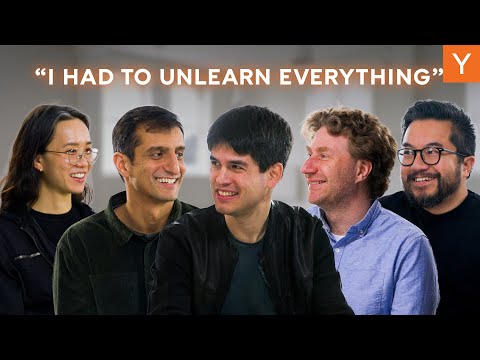
How Amplitude Went From Skeptics to “All In” on AI
Spenser Skates (guest), Harj Taggar (host), Garry Tan (host)
In this episode of Y Combinator, featuring Spenser Skates and Harj Taggar, How Amplitude Went From Skeptics to “All In” on AI explores inside Amplitude’s Painful, All-In Reinvention As An AI-Native Company Amplitude CEO Spencer Skates describes how the company shifted from deep skepticism about AI to making it a central pillar of its product and org strategy.
Inside Amplitude’s Painful, All-In Reinvention As An AI-Native Company
Amplitude CEO Spencer Skates describes how the company shifted from deep skepticism about AI to making it a central pillar of its product and org strategy.
The transition required top-down conviction, bottoms‑up tooling adoption (like an internal “AI week”), multiple org restructurings, and replacing or augmenting leaders who were strong in classic SaaS but not AI-native.
Skates contrasts traditional SaaS product building—customer request–driven, deterministic, reliable—with AI product building, which is technology-first, probabilistic, and demands users who tolerate failure and iteration.
He also reflects on founder psychology, how to learn totally new skills (like enterprise sales), and the difficult evolution from hands-on founder to large-company public CEO in the AI era.
Key Takeaways
AI product strategy must start with understanding model capabilities, not customer feature requests.
Because AI capabilities are “jagged,” customers can’t clearly specify what’s possible; teams need a technology-first view, then map those capabilities back to real workflows and products.
Get the full analysis with uListen AI
Driving AI adoption in an existing company requires both symbolic and practical interventions.
Amplitude ran an AI week, mandated hands-on use of tools like Cursor, showcased live coding demos, and explicitly used a “burn the boats” metaphor to signal that AI wasn’t optional.
Get the full analysis with uListen AI
Leaders and org structures must change when a SaaS company goes AI-native.
Amplitude did two major reorganizations in a year, moved out strong but non–AI-native leaders, acquired AI-first teams, and created dedicated AI product teams rather than treating AI as side projects.
Get the full analysis with uListen AI
AI-era users must be willing to work with imperfect systems that frequently fail.
Unlike traditional SaaS where one failure kills trust, AI workflows often involve repeated prompts, model switching, and editing; products must support this iterative, error-tolerant usage pattern.
Get the full analysis with uListen AI
“Feature, not company” dynamics and commoditization will crush shallow AI tools.
Skates views many AI visibility products as easily replicable and ripe to be given away for free by incumbents; sustainable businesses must sit downstream of such features with deeper value propositions.
Get the full analysis with uListen AI
Founders need a clear, intrinsic ‘why’ to survive inevitable quit-worthy moments.
Skates emphasizes that every successful startup hits periods where quitting looks rational; only a deeply internalized mission and clear top-level goal keep founders going through those valleys.
Get the full analysis with uListen AI
The founder-to-public-CEO transition means giving up being ‘in the weeds’ everywhere.
He notes that large-company leadership is about ruthless prioritization, hierarchy, and deploying resources effectively, not personally solving every hard problem—often becoming the kind of executive founders used to mock.
Get the full analysis with uListen AI
Notable Quotes
“There is going to be a reinvention of analytics in the next few years, and we want to be the ones to go lead it.”
— Spencer Skates
“In SaaS, you go to your customers, ask them what they want, prioritize that list, and start building it. With AI, you have to start from what the models can actually do.”
— Spencer Skates
“There is a point that you get to a year, maybe two years in, where from a rational standpoint, you probably should quit. But for whatever reason, the successful ones don’t.”
— Spencer Skates
“As a founder, your job is always to run to the most difficult problem in the business and lead from the front.”
— Spencer Skates
“You have to be very clear in your own head about what you’re trying to learn, and then be open to where it comes from.”
— Spencer Skates
Questions Answered in This Episode
How can a mid-size SaaS company practically copy Amplitude’s ‘AI week’ to bootstrap AI literacy and buy-in across engineering, product, and design?
Amplitude CEO Spencer Skates describes how the company shifted from deep skepticism about AI to making it a central pillar of its product and org strategy.
Get the full analysis with uListen AI
What criteria should leadership use to decide which existing executives or managers are not the right fit for an AI-native future?
The transition required top-down conviction, bottoms‑up tooling adoption (like an internal “AI week”), multiple org restructurings, and replacing or augmenting leaders who were strong in classic SaaS but not AI-native.
Get the full analysis with uListen AI
How do you design AI product experiences that embrace iterative failure while still earning user trust in high-stakes business workflows?
Skates contrasts traditional SaaS product building—customer request–driven, deterministic, reliable—with AI product building, which is technology-first, probabilistic, and demands users who tolerate failure and iteration.
Get the full analysis with uListen AI
If many AI ‘visibility’ tools are destined to be free, what types of durable business models can sit downstream from them?
He also reflects on founder psychology, how to learn totally new skills (like enterprise sales), and the difficult evolution from hands-on founder to large-company public CEO in the AI era.
Get the full analysis with uListen AI
What specific mindset shifts are most important for a successful pre-AI engineer or PM to become truly ‘AI-native’ rather than just bolting models onto old patterns?
Get the full analysis with uListen AI
Transcript Preview
There is a point that you get to a year, maybe two years in, where from a rational standpoint, you probably should quit. But for whatever reason, um, those successful ones don't, and so that is the number one filtering criteria. The best advice I can have is, be clear in your own head about what you're trying to learn and then, you know, be open to where it comes from. And that's w- I think people fuck that up a lot. They don't get really crystal clear on why they're trying to build a startup or what they need to do to be successful. There is going to be a reinvention of analytics, uh, in the next few years. And, you know, we, we want to be the ones to go lead it.
(music) Welcome back to another episode of The Light Cone. Today, we're really excited to be joined by Spencer Skates, CEO and co-founder of Amplitude. So, Amplitude went through YC in winter 2012. Amplitude is one of the world's leading analytics platforms, and they're used by some of the biggest companies in the world, like Cursor, DoorDash, and Walmart. Thanks for joining us, Spencer.
Absolutely. Good to see you here, Harj.
So, I was really excited to have you here because both of us made people on the internet angry recently, specifically on X or Twitter. Um, I made them angry because I said that a lot of the reason incumbent tech companies can't build AI products is that the engineers are kind of grumpy and don't believe in AI and its capabilities, so they don't want to build the products.
People got mad at you for that?
Yeah, people got really mad. Turns out that, like, there are actually a lot of grumpy engineers (laughs) that don't believe in AI. So, I was curious to hear for you, as like a, a company that started well before the AI wave and is now, um, trying to move in, is moving into AI and building more AI products, how has that change been for you and what have been some of the challenges you faced?
It is hard, um, as a larger company, to reorient and rebuild your company to use AI well. Uh, and this is, I think to your point, the huge advantage that a lot of earlier companies that can build from the ground up in this way. Um, I'll, I'll just tell you the, the Amplitude story. So we, we were frankly skeptics on AI for a while too, so started to become relevant in 2022. Uh, 2023, um, there's discussion but we, we didn't really do that much. And it wasn't until, uh, late in 2024 that we're like, "Okay, we need to get serious because I think this is, has the potential to reshape analytics and what we're doing." Um, I, I think, you know, to just to defend the skeptics for a second, I think... I, I remember being in a board meeting once. You had, like, you know, all these, like, board investor finance people and you had all these salespeople who were like, "Hey guys, shouldn't you look at this AI thing?"
Install uListen to search the full transcript and get AI-powered insights
Get Full TranscriptGet more from every podcast
AI summaries, searchable transcripts, and fact-checking. Free forever.
Add to Chrome