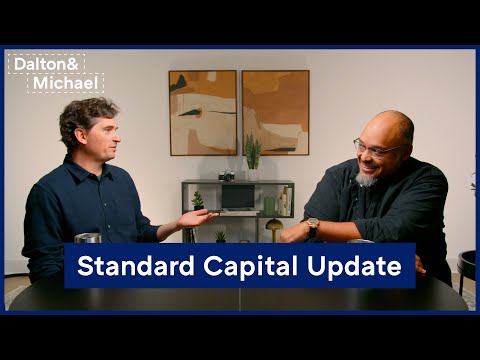
Standard Capital Update
Dalton Caldwell (guest), Michael Seibel (host)
In this episode of Dalton + Michael, featuring Dalton Caldwell and Michael Seibel, Standard Capital Update explores standard Capital streamlines Series A funding with founder-set valuation process Standard Capital adapts Y Combinator’s application-driven selection model to Series A investing to reduce the time and friction of traditional fundraising.
Standard Capital streamlines Series A funding with founder-set valuation process
Standard Capital adapts Y Combinator’s application-driven selection model to Series A investing to reduce the time and friction of traditional fundraising.
After its first cycle, Standard funded nine companies and was surprised by how widely the process spread via founder word-of-mouth, driving far more applications than expected.
The end-to-end timeline is roughly two weeks from application deadline to final decision, with founders spending only a few hours on the application plus two short meetings.
A core design choice is that founders name their valuation upfront, and Standard either accepts that price or declines—there is no valuation negotiation.
They encourage founders to apply even if early or unsure, and to reapply with updated deltas, explicitly rewarding repeat applicants with clearer progress signals.
Key Takeaways
Speed and clarity are a product choice in fundraising.
Standard aims to compress Series A fundraising into a predictable ~two-week process with quick interview turnaround and a firm decision shortly after in-person meetings.
Get the full analysis with uListen
Founder time is treated as scarce; diligence burden shifts to investors.
Founders mainly provide an application, attend a 20-minute first interview and a 30-minute in-person meeting, while Standard does the deeper diligence work by reviewing provided documents.
Get the full analysis with uListen
Setting your valuation is part of the test—and it’s non-negotiable.
Applicants must choose a valuation aligned with traction; pricing too high effectively raises the acceptance bar because Standard won’t counteroffer and may simply reject.
Get the full analysis with uListen
Apply early and reapply; progress is a signal the process is built to reward.
They encourage founders who are uncertain to apply anyway and later reuse the same application with updates, making improvement over time easy to evaluate.
Get the full analysis with uListen
The model is an opt-out from traditional pitch-deck-driven fundraising.
Many successful applicants reportedly applied without building a deck or talking to other investors, using Standard as an alternative to the typical “market-priced” Series A circuit.
Get the full analysis with uListen
“We already know all the good companies” is a dangerous investor posture.
Dalton argues that believing this implies no room for discovery and no real value-add, and suggests it reflects disillusionment inconsistent with doing venture well.
Get the full analysis with uListen
Notable Quotes
““We didn’t negotiate on valuation. We just gave them what they said on the app. We never talked about it.””
— Dalton Caldwell
““The whole shebang was two weeks.””
— Dalton Caldwell
““In like, a four hours of active time investment… I get a yes/no on a Series A.””
— Michael Seibel
““If someone was to choose a 120 post… their odds of acceptance, the bar is twice as high as 60 post.””
— Dalton Caldwell
““If you actually think you know all the good companies, shut down.””
— Dalton Caldwell
Questions Answered in This Episode
What specific application questions best predict Series A readiness (e.g., PMF, growth rate, retention), and which turned out to be least useful?
Standard Capital adapts Y Combinator’s application-driven selection model to Series A investing to reduce the time and friction of traditional fundraising.
Get the full analysis with uListen AI
For founders unsure on valuation, what heuristics does Standard recommend so they don’t “price themselves out” without realizing it?
After its first cycle, Standard funded nine companies and was surprised by how widely the process spread via founder word-of-mouth, driving far more applications than expected.
Get the full analysis with uListen AI
How does Standard define “crazy traction” or “10x year-over-year” in practice—revenue, usage, retention, or something else?
The end-to-end timeline is roughly two weeks from application deadline to final decision, with founders spending only a few hours on the application plus two short meetings.
Get the full analysis with uListen AI
What diligence materials did you request most often, and what were the most common red flags discovered during diligence?
A core design choice is that founders name their valuation upfront, and Standard either accepts that price or declines—there is no valuation negotiation.
Get the full analysis with uListen AI
Did any company you loved get rejected primarily due to valuation choice, and what would have changed the outcome?
They encourage founders to apply even if early or unsure, and to reapply with updated deltas, explicitly rewarding repeat applicants with clearer progress signals.
Get the full analysis with uListen AI
Transcript Preview
We don't wanna negotiate with people over valuation.
Yeah.
And you could talk to any of the nine companies that got in and ask them.
Yeah.
We didn't negotiate on valuation. We just gave them what they saw on the app. We never talked about it.
[laughs]
Like, it was, it was reading the application. We're like, "Great." Like, there was no discussion.
That was the deal. [laughs]
That was the deal. Isn't that awesome?
It's awesome.
'Cause, dude, I don't wanna... Dude, I, I don't negotiate valuation with founders. That's no fun.
[upbeat music] All right. This is Dalton + Michael, and today we're gonna get an update from Standard Capital. So you funded a bunch of companies. You know stuff now that you didn't know before.
Yeah.
Why don't we just start with, like, remind people what the process was. Like, what, what was the process? What was the innovation for this thing?
Yeah. I mean, look, the, the idea for Standard was to take what we know worked well from Y Combinator-
Mm-hmm
... and apply it to the next round. And so-
To Series As.
Yeah, to Series As.
Yes.
Because, look, we... How many companies have you and I funded at YC?
Oh, a lot. [laughs]
A thousand, uh, each.
Yeah. [laughs]
A lot of companies.
A lot of companies.
Part of the job at YC was to help founders raise the A.
Yes.
And so I had a pretty good mental model of what they were experiencing.
Yes.
And it was funny how-
And we also raised As ourselves.
That's... So there was that.
Yes.
Um, it was funny how little, uh, overlap there was on the process to get into YC with raising the next round. It was an entirely different skill, and the idea was to make it kinda the same thing.
So how many companies did y'all end up funding?
So far, we have funded nine companies.
Okay.
And that is not announced anywhere, in fact. Maybe by the time-
[laughs]
... maybe by the time we, uh, release this video, that will be-
Nice. Breaking news. [laughs]
So far, two have been announced and are on our website as of the moment we're recording this.
And then biggest thing you learned, the biggest kind of headline takeaway now that you've run one cycle, either something that's been reconfirmed or something that's new that you didn't expect.
I think what really surprised, uh, PB and Brian and myself-
Yes
... is the following: How many times have we coached founders on launching?
Mm-hmm.
What do we say? We say, "Look, founder, you're gonna have to launch and launch again and launch again, and no one will have heard of your thing."
Yep.
"So just, like, keep launching, and it'll take years. And then someday, maybe people will hear of it."
[laughs] Will know of... know the name of your company.
Will have heard of it, right? Like, that's-
Yeah.
And so this was kind of like my internal thing-
Install uListen to search the full transcript and get AI-powered insights
Get Full TranscriptGet more out of YouTube videos.
High quality summaries for YouTube videos. Accurate transcripts to search & find moments. Powered by ChatGPT & Claude AI.
Add to Chrome