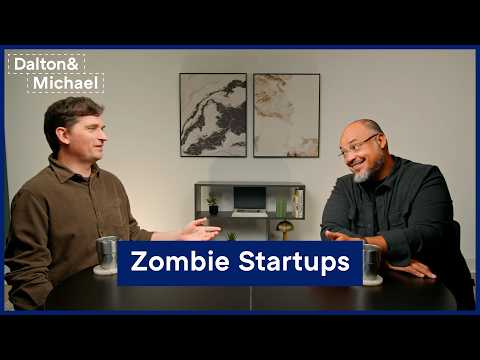
Zombie Startups: Should They Shut Down or Keep Going?
Michael Seibel (host), Dalton Caldwell (host)
In this episode of Dalton + Michael, featuring Michael Seibel and Dalton Caldwell, Zombie Startups: Should They Shut Down or Keep Going? explores how to escape zombie startup limbo: shut down or pivot radically A zombie startup has money, customers, and payroll coverage but lacks meaningful growth, energy, and urgency, often replacing momentum with process and planning.
How to escape zombie startup limbo: shut down or pivot radically
A zombie startup has money, customers, and payroll coverage but lacks meaningful growth, energy, and urgency, often replacing momentum with process and planning.
Shutting down is framed as a common, legitimate startup outcome, with founders’ real obligation being ethical, hard, honest experimentation—not guaranteed winning.
If pursuing acquisition, founders should timebox the effort because acquisitions are rarer and less lucrative than people assume, and many are effectively asset sales or acqui-hires.
To revive a zombie startup, incremental tweaks and “false escape paths” (hiring sprees, gimmicky growth execs, spam, or trend-based fundraising) rarely work; instead, radical change is required.
A credible turnaround often requires reducing team size, revisiting pre-PMF fundamentals, challenging long-held “sacred cows,” and choosing a single direction with founder conviction rather than hedging across many bets.
Key Takeaways
A zombie startup is alive operationally but dead in trajectory.
If you can pay people and have customers yet growth is flat and energy is low, the company drifts into “between living and dying,” where waiting and stalling replace momentum.
Get the full analysis with uListen
Process becomes the product when growth disappears.
Without chaos from real pull, planning cycles and bureaucracy expand to fill the void, slowing dev cycles and making internal rituals feel like the most “exciting” work.
Get the full analysis with uListen
Your obligation is ethical effort and honest experimentation, not victory.
They emphasize checking boxes like working hard, acting ethically, not lying, and actually running the intended experiments; if those are true, you’ve met your duty to investors and employees.
Get the full analysis with uListen
Timebox acquisitions—or you’ll stay a zombie indefinitely.
If you decide to explore being acquired, set a short, explicit timeline (e. ...
Get the full analysis with uListen
Don’t assume acquisition equals getting rich or even a true “exit.”
Many acquisitions are effectively asset sales plus job offers, and once you’re a zombie the odds of a wealth-creating acquisition are “effectively nil,” especially if your revenue is immaterial to a large buyer.
Get the full analysis with uListen
False rescue plans waste runway and morale.
Late-stage hiring sprees, “secret growth execs,” low-ethics funnel stuffing, and trend-driven fundraising are portrayed as denial strategies that avoid confronting the real product/market problem.
Get the full analysis with uListen
Turnarounds require radical, uncomfortable moves—often including shrinking the team.
When incremental changes have failed for 1–2 years, the prescription is a big swing that feels scary; smaller teams are easier to steer, and removing blockers can be necessary in an emergency.
Get the full analysis with uListen
Reapply the pre-PMF mindset: nothing is sacred.
Zombie companies often have years-old assumptions (like bloated onboarding) that were locally optimized; rebuilding with fresh eyes can reveal 10× improvements once “sacred cows” are challenged.
Get the full analysis with uListen
Conviction beats hedged exploration when you’re stuck.
They argue founders must point a direction and “believe harder than everybody else”; even strong conviction in a wrong direction can rally action, produce learning, and enable recalibration, while splitting across five bets signals leaderlessness.
Get the full analysis with uListen
Notable Quotes
“A zombie startup is a startup that is not dead… but it’s not really growing.”
— Michael Seibel
“Versus strapping [employees] into a zombie startup is not really a gift.”
— Dalton Caldwell
“Once you’re to the point of being a zombie, the odds that you will get rich from an acquisition are effectively nil.”
— Michael Seibel
“If none of your current efforts have worked, you need to do something that you would never do on your own.”
— Michael Seibel
“The real job of a founder is to point the way forward and to believe harder than everybody else.”
— Michael Seibel
Questions Answered in This Episode
What specific growth-rate or traction thresholds would you use to label a company “zombie” versus simply “early”?
A zombie startup has money, customers, and payroll coverage but lacks meaningful growth, energy, and urgency, often replacing momentum with process and planning.
Get the full analysis with uListen AI
How should founders decide between a two-month acquisition push and an immediate shutdown—what signals make the decision obvious?
Shutting down is framed as a common, legitimate startup outcome, with founders’ real obligation being ethical, hard, honest experimentation—not guaranteed winning.
Get the full analysis with uListen AI
If acquisitions often require prior relationships, what should non-zombie startups do early to build optionality with potential acquirers?
If pursuing acquisition, founders should timebox the effort because acquisitions are rarer and less lucrative than people assume, and many are effectively asset sales or acqui-hires.
Get the full analysis with uListen AI
What are the most common “sacred cows” you see in zombie startups (pricing, onboarding, target customer, tech stack), and how do you force a clean-slate review?
To revive a zombie startup, incremental tweaks and “false escape paths” (hiring sprees, gimmicky growth execs, spam, or trend-based fundraising) rarely work; instead, radical change is required.
Get the full analysis with uListen AI
When is it actually correct to reduce headcount, and how do you do it without destroying trust or execution speed?
A credible turnaround often requires reducing team size, revisiting pre-PMF fundamentals, challenging long-held “sacred cows,” and choosing a single direction with founder conviction rather than hedging across many bets.
Get the full analysis with uListen AI
Transcript Preview
If none of your current efforts have worked, you need to do something that you would never do on your own.
Take the next swing.
You need to do something so uncomfortable-
Yes
... 'cause your current tactics haven't worked.
Yes.
Right? And so I'll encourage founders to be like, "What's something that seems way too radical or scary that you never would have thought trying before? This is permission. Why don't you try it?"
[upbeat music] This is Dalton + Michael, and today we're gonna talk about zombie startups. Dalton, tell me, what is a zombie startup?
Okay, yeah. So this is another one of those where we're gonna kinda use our own internal lingo that we've been using for a long time.
Yes.
And maybe it'll, it'll resonate with the world, maybe it won't. So a zombie startup is a startup that is not dead.
Nope.
Um, like it's, there's money in the bank.
Yep.
Like, they're making payroll.
Yep.
They have revenue, they have customers.
Yes.
Um, but it's not really growing.
Not growing quickly, no.
It might be growing a little bit-
Yeah
... but it's not growing fast.
Yep.
And so it's not living per se.
Yes.
It's in a s- interesting state between living and dying.
Yeah.
Um, hence the name zombie. Usually the mentality of a zombie startup is different than a super fast growing one.
Mm-hmm.
Where there's kinda like low energy.
Yes.
There's sort of just like going through the motions.
Mm-hmm.
Nothing that exciting is happening.
Yeah.
And it's always like, it's like you're waiting for something to happen. There's a lot of stalling-
Yeah
... for some event, external event to happen.
I also think one of the things that characterizes zombie startups after a while is, like, the creep of bureaucracy and planning and the kind of big company think.
Yep.
And the slowing down of, of dev cycles. It's almost like the metabolism of, of the company is slowing down. It's like the cell is aging, it's less efficient.
Yeah.
It's like-
Well, when you have PMF and you're growing really fast, your job is just to hold on.
Yes.
And you're like, "Oh, this is chaos." Every day is like a fire fight-
Yes
... and you're just trying to make it.
Yes.
When you're not growing that fast, what will often happen is process seeps in-
Yes
... and everyone's like, "Oh, it's time for our quarterly planning meeting." And like-
Yes
... like suddenly we get-
Yes.
There is no chaos, there is no excitement.
Yep.
And parts of the company that are more process oriented tend to take over.
Yes. Yes.
Um, and so it can feel really slow.
Well, and, and arguably the planning is the thing that's exciting.
Yeah.
Like, the product's [laughs] not that exciting.
Yep.
The user growth is not that exciting. The planning becomes the thing that's exciting. So, you know, when there's in this state, it would be remiss for us to not talk about, like, should a company in this state shut down?
Install uListen to search the full transcript and get AI-powered insights
Get Full TranscriptGet more out of YouTube videos.
High quality summaries for YouTube videos. Accurate transcripts to search & find moments. Powered by ChatGPT & Claude AI.
Add to Chrome