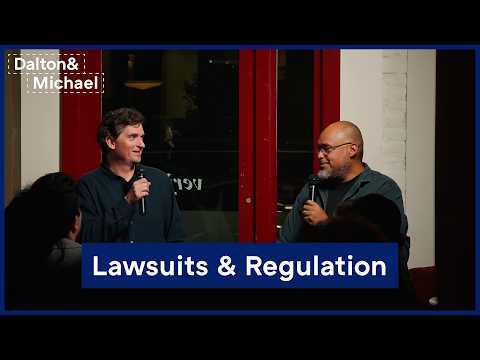
How Great Founders Navigate Lawsuits & Regulation
Dalton Caldwell (host), Michael Seibel (host)
In this episode of Dalton + Michael, featuring Dalton Caldwell and Michael Seibel, How Great Founders Navigate Lawsuits & Regulation explores founder playbook for lawsuits, regulation, and calculated legal risk-taking They argue that new technologies frequently collide with outdated laws, so founders must translate legacy legal frameworks into modern product realities without freezing execution.
Founder playbook for lawsuits, regulation, and calculated legal risk-taking
They argue that new technologies frequently collide with outdated laws, so founders must translate legacy legal frameworks into modern product realities without freezing execution.
They explain that lawyers naturally give conservative advice to avoid being wrong, so founders should lead with business goals and context (including negotiation leverage) to get actionable guidance.
They distinguish between routine, expected legal friction (e.g., C&D letters, industry litigation) and truly existential/legal-jeopardy issues (e.g., financial crimes), urging founders to build judgment about the difference.
They highlight that sophisticated startups can use regulation offensively—getting licenses, suing regulators, or shaping rules—as illustrated by Kalshi and new banking/crypto charter examples.
They frame many breakthrough companies (e.g., OpenAI, YouTube, Uber/Airbnb) as entities that “warehouse” legal risk that big companies can’t tolerate, making calculated risk-taking a source of innovation and value creation.
Key Takeaways
Assume the law lags technology—and plan for translation work.
They describe copyright rules built for physical media being awkwardly applied to digital streaming, and connect this to today’s AI regulation debates where founders must interpret old frameworks in new contexts.
Get the full analysis with uListen
Don’t ask lawyers for permission; tell them the objective and ask for pathways.
Because lawyers optimize to never be wrong, “Can I do X? ...
Get the full analysis with uListen
Always brief your lawyer on your leverage before they negotiate.
Legal negotiating posture should change dramatically depending on whether you have six term sheets or one shaky offer; without that context, lawyers may over-lawyer and harm speed or outcomes.
Get the full analysis with uListen
Classify legal issues into ‘speed bumps’ vs ‘drop everything’ emergencies.
They urge founders to normalize expected litigation in certain businesses (marketplaces, delivery, media) while treating areas like financial crime or jail-risk as existential and requiring immediate escalation.
Get the full analysis with uListen
Treat many C&D letters as the start of a commercial conversation, not war.
A cease-and-desist often signals “we want to talk” (or become a customer/partner) more than “we will destroy you,” and reacting defensively can squander a biz dev opportunity (e. ...
Get the full analysis with uListen
Sophisticated founders can make regulation a competitive moat—even offensively.
Kalshi required a government strategy before product, obtained licensing without big-law support, and later sued regulators to list elections/sports—showing regulation can be navigated proactively rather than endured.
Get the full analysis with uListen
Startups often exist to ‘warehouse’ risk that incumbents can’t take.
They cite OpenAI’s origin as escaping big-tech legal constraints and YouTube’s early copyright exposure as examples where absorbing legal risk enabled a new category to reach scale (and later be stabilized by larger balance sheets).
Get the full analysis with uListen
Notable Quotes
““New technologies often are encumbered… by laws that were created way before the technologies existed.””
— Dalton Caldwell
““Say what you want to accomplish first, versus asking, ‘Can I do X?’””
— Dalton Caldwell
““If you're in trouble, monetizing this content doesn't get you in that much more trouble. So go to town.””
— Michael Seibel (recounting legal advice)
““A lot of startups, their entire reason for existence is to absorb risk, to absorb legal risk.””
— Dalton Caldwell
““They assume that these laws are… written… in the Bible… [but] it’s just the guidelines we’ve all come up with.””
— Michael Seibel
Questions Answered in This Episode
For a founder in AI today, what’s a concrete process to decide which ‘outdated laws’ matter most to address first (copyright, privacy, right of publicity, consumer protection)?
They argue that new technologies frequently collide with outdated laws, so founders must translate legacy legal frameworks into modern product realities without freezing execution.
Get the full analysis with uListen AI
Kalshi needed a “government strategy pre-product”—what are the specific signals that your startup should do that versus shipping first and dealing with regulators later?
They explain that lawyers naturally give conservative advice to avoid being wrong, so founders should lead with business goals and context (including negotiation leverage) to get actionable guidance.
Get the full analysis with uListen AI
How should founders quantify “high sophistication” in legal/regulatory strategy—what skills, hires, or advisors actually move the needle?
They distinguish between routine, expected legal friction (e. ...
Get the full analysis with uListen AI
Where’s the line between ‘warehousing risk’ and being reckless—what’s your framework for deciding which legal risks are ethically acceptable to take?
They highlight that sophisticated startups can use regulation offensively—getting licenses, suing regulators, or shaping rules—as illustrated by Kalshi and new banking/crypto charter examples.
Get the full analysis with uListen AI
In a fundraising negotiation, what exact leverage details should founders share with counsel (number of term sheets, timelines, lead quality, runway), and what should they keep off email?
They frame many breakthrough companies (e. ...
Get the full analysis with uListen AI
Transcript Preview
I remember being in New York and, uh, like it was with Warner Music Group during the litigation, and we spent the whole day negotiating, and they're like, "Hey, you wanna go to the Knicks game tonight?" And so I went to the Knicks game with the lawyers.
While they're suing you?
I don't think they thought it was a big deal.
[laughs]
That's how normal... That's, they were just so used to suing people. They're like, "Oh, you're a good guy. Let's go see the Knicks."
Hello, hello. All right.
All right. Hello.
Our advice on lawsuits and regulation and dealing with the government. I think we've got decent credentials on this subject.
Yeah, you gotta tell them what our credentials are.
Yeah. Why, why don't you start? What are your lawsuit credentials?
My first company that I started in two thousand and three was called imeem, and it was a music streaming site, and it, um-
[laughs]
And many of my early employees formerly worked at a company called Napster, and, um, not kidding, and there was a lot of overlap with the DNA. It was like the thing after Napster. And needless to say, we eventually got deals with the music industry, and that's a whole long story. But in the process, we definitely were in a lot of litigation, and so a lot of my life for a couple years as a startup founder was, uh, dealing with that stuff. And so sadly, I have credentials here.
I represented the other end of the spectrum.
[laughs]
So I worked in a company called Twitch, and when it started, it was called Justin.tv, and I remember this moment where someone in Ohio decided to stream the Super Bowl live on our website, and I remember watching that part in the beginning that says, like, "This can't be rebroadcasted, retransmitted." [laughs] And I'm, like, watching this on my own website, and I was like, "Huh. Um..."
Michael, to be honest, I, I definitely at least once watched the Super Bowl on your website. [laughs]
We were pitching a VC, and he's like, "Oh, I wanted to go to the Masters," and I was like, "You can just watch it on our website." [laughs] Did not invest. So in the process, we got sued by the UFC, NBC, and then we got called in front of Congress to testify about sports piracy by the major, Major League Baseball.
It was you?
Yeah.
You had to go in front of Congress-
Yeah, yeah
...to talk about piracy?
Yeah.
Oh, man. [laughs]
I think maybe what I would start with is what was your experience of being sued and kind of the speed of startups versus the speed of lawsuits?
The way I would frame this as it pertains to current modern startup advice is the following: New technologies often are encumbered, for better or worse, by laws that were created way before the technologies existed. And so dealing with copyright law, there's all this stuff about mechanical reproduction, which was the physical reproduction of records, and that's codified in the law. Again, I, I became an expert on this stuff, and trying to translate law that was about physical media to digital media was, like, totally dumb. I, I, I don't know. I could use other more colorful terms, but it, it, it was really hard. And the way I think this is relevant to right now is the attempts to regulate AI. In addition, a lot of our startups, our portfolio companies, have experienced tremendous change in the regulatory environment over the past few years. Fortunes are being made and lost based on what kind of laws are being passed and the sophistication ability for founders to navigate these things. Um, just to throw out a couple of, of examples here, um, anyone hear, hear of Kalshi? Uh, you know the company? A few people. So look, they're, they're doing extremely well. Michael funded them for YC. That's his company. You're on the board or something, right? Michael is on the board of that company, and they basically spent years suing the government? I... Why don't you tell them? Why don't you tell them about-
Install uListen to search the full transcript and get AI-powered insights
Get Full TranscriptGet more out of YouTube videos.
High quality summaries for YouTube videos. Accurate transcripts to search & find moments. Powered by ChatGPT & Claude AI.
Add to Chrome