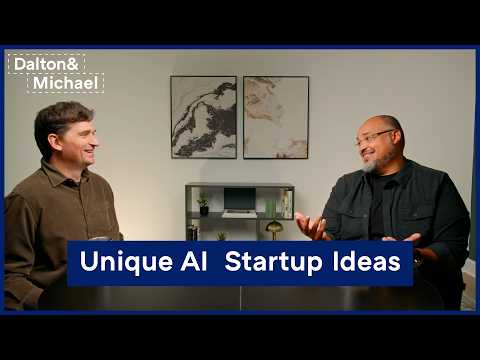
How To Get Unique AI Startup Ideas
Dalton Caldwell (host), Michael Seibel (host)
In this episode of Dalton + Michael, featuring Dalton Caldwell and Michael Seibel, How To Get Unique AI Startup Ideas explores how to find non-consensus AI startup ideas that actually win They argue that today’s AI tools make building easy, so the real bottleneck is generating genuinely non-derivative ideas rather than copying what’s trending on Twitter or recently funded.
How to find non-consensus AI startup ideas that actually win
They argue that today’s AI tools make building easy, so the real bottleneck is generating genuinely non-derivative ideas rather than copying what’s trending on Twitter or recently funded.
They warn that using YC batches, VC content, or recent funding rounds as ‘market validation’ is misleading because funding decisions often reflect teams and pivots—not a pre-validated idea.
They recommend looking in the ‘discard bin’: pursue ideas many people have already considered and rejected, since uniqueness often comes from embracing what others filtered out.
They critique the obsession with $100B+ outcomes as an ideation filter that eliminates quirky but ultimately massive companies like Twitch or Whatnot would have looked early on.
They emphasize that “weird” nonconformists generate novel ideas more naturally, and founders should be ready to endure years of skepticism—or partner with someone who has that ideation strength.
Key Takeaways
Treat idea generation—not building—as the core constraint now.
With AI and modern tooling, execution speed has increased, so the differentiator shifts to having a strong, unusual thesis that isn’t instantly replicable by everyone watching the same trends.
Get the full analysis with uListen
Don’t pick startup ideas by copying what just got funded.
They argue this is a broken proxy: companies often get funded for founders, timing, or a direction that changes via pivot, so copying the visible ‘idea’ is chasing noise, not signal.
Get the full analysis with uListen
Use the ‘discard bin’ to find uniqueness.
Instead of searching for something no one has thought of, look for ideas many people have considered and rejected—then ask what assumption made them discard it and whether that assumption is now wrong.
Get the full analysis with uListen
Actively move away from consensus—friends, investors, and founder-Twitter included.
If everyone around you thinks an idea is obviously good, it’s likely already crowded; controversy or concerned reactions can be a sign you’re exploring a non-consensus space with asymmetric upside.
Get the full analysis with uListen
Consider ideas that take longer than two years to work.
A simple way to ‘cheat’ toward non-consensus is to pursue projects with longer timelines; many founders self-censor to short horizons, which compresses them into the same safe, derivative ideas.
Get the full analysis with uListen
Ignore late-stage “only trillion-dollar outcomes matter” advice during ideation.
Filtering ideas by massive TAM narratives too early would have rejected products that started niche or weird (e. ...
Get the full analysis with uListen
If you’re not an idea generator, partner or join—don’t force it.
They normalize that not everyone must be the ‘weird shaman’ who originates the concept; you can work with an idea-driven founder or contribute by executing and scaling once direction is set.
Get the full analysis with uListen
Notable Quotes
“Instead of trying to find something no one's ever thought of, find something that everyone's thought of and thinks is bad.”
— Dalton Caldwell
“You're gonna decide on what you're gonna work on for maybe the next 10 to 20 years of your life by looking at a list of what other people are working on?”
— Michael Seibel
“If you're making all of your life decisions based on podcasts, that is the definition of coming up with ideas that are not unique.”
— Dalton Caldwell
“Many successful YC companies, every one of their friends and family members thought the idea was bad.”
— Michael Seibel
“Don't be approval seeking from authority figures if you wanna actually have unique ideas.”
— Dalton Caldwell
Questions Answered in This Episode
What’s a practical step-by-step method to ‘look in the discard bin’—where do you source discarded ideas, and how do you evaluate why they were rejected?
They argue that today’s AI tools make building easy, so the real bottleneck is generating genuinely non-derivative ideas rather than copying what’s trending on Twitter or recently funded.
Get the full analysis with uListen AI
How can a founder distinguish a ‘controversial but promising’ idea from one that’s simply bad (e.g., no market, unsolved technical blocker, or poor distribution)?
They warn that using YC batches, VC content, or recent funding rounds as ‘market validation’ is misleading because funding decisions often reflect teams and pivots—not a pre-validated idea.
Get the full analysis with uListen AI
Can you share a concrete example of a YC-funded company where outsiders copied the original pitch, but the real success came from a pivot during the batch?
They recommend looking in the ‘discard bin’: pursue ideas many people have already considered and rejected, since uniqueness often comes from embracing what others filtered out.
Get the full analysis with uListen AI
What are specific signals that VC content is warping your thinking, and what habits can founders adopt to reduce consensus influence while still learning?
They critique the obsession with $100B+ outcomes as an ideation filter that eliminates quirky but ultimately massive companies like Twitch or Whatnot would have looked early on.
Get the full analysis with uListen AI
How should an AI founder decide between solving a personal problem versus chasing an enterprise budget—especially when both are possible paths?
They emphasize that “weird” nonconformists generate novel ideas more naturally, and founders should be ready to endure years of skepticism—or partner with someone who has that ideation strength.
Get the full analysis with uListen AI
Transcript Preview
People that are non-conformist or otherwise quirky, they constantly are generating strange ideas on their own.
Yes.
And if anything, society tells them, "Hey, like-
Ugh. [laughs]
[laughs] Like, shut up.
Yeah. [laughs]
Like, we don't wanna hear-
Yeah
... all your dumb ideas-
[laughs]
... on how to make things work better.
Yeah, yeah.
Right? That's like-
Yes
... like the system grinds that out of you.
Yes.
Those people tend to do well with startups because they don't actually have any problems coming up with unique ideas.
Yes. [upbeat music] All right, this is Dalton + Michael, and today we're gonna talk about how to get unique AI startup ideas. Here are a bunch of old people telling you how to get unique ideas.
[laughs]
Where should we start, Dalton?
I mean, look-
[laughs]
... the problem right now is the tools are so good-
Yes
... you can crank out anything, and so the bottleneck is less building the thing, it's actually, um, having an idea, and the problem is most ideas are extremely non-unique.
Yes, and I- I would even go so far as to say many founders out there are not even being encouraged to come up with unique ideas. Like, they're almost being encouraged to, like, what just raised, what just raised a seed round, what sounds good to investors, just tell me how I can get funded, Dalton.
[laughs]
Just tell me what idea-
Yeah
... gets me funded. [laughs]
It's almost like whatever the current thing is on, on Twitter, oh, I guess I'll make a clone of that. Like, oh-
Yes
... you know, when we're-
There we go
... when we're recording this right now, it's like, oh, OpenClaw, uh, yeah, well, let's just clone that.
Yes.
Like, there you go. That's my startup.
Yes.
Um, [laughs] pretty low effort.
Pretty low effort. I think the other thing that's weird is, like, when people who are trying to start companies think that they can de-risk their idea by s- doing something that they see recently got funded or they see is, like, raised a series B, either one of those is really funny. It's like I've seen so many examples, someone's like, "Well, that thing has raised money at a billion dollar valuation, therefore, dot, dot, dot, dot, dot."
Well-
[laughs]
... what's so funny is we inadvertently were part of that problem, and so what would always happen when I was doing interviews for YC-
Yes
... is someone I was interviewing would flag, oh, YC funded a company two batches ago doing XYZ, so that validates the market. And I'd be sitting there being like, I funded that company. I did not fund it for the idea. I actually funded a different idea, and they pivoted during the batch.
[laughs]
And so as the person who funded that, this is not validation.
[laughs]
Like, I can't stress enough, as the source of this validation thing you're talking about-
Install uListen to search the full transcript and get AI-powered insights
Get Full TranscriptGet more out of YouTube videos.
High quality summaries for YouTube videos. Accurate transcripts to search & find moments. Powered by ChatGPT & Claude AI.
Add to Chrome