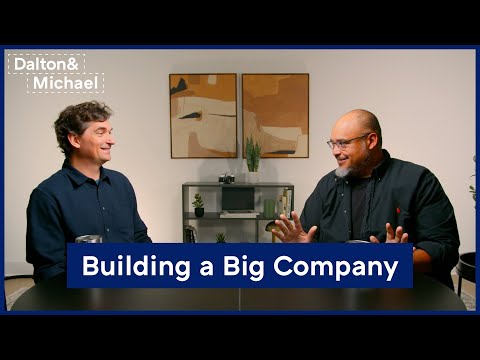
Building A Big Company: Non-Obvious Insights
Dalton Caldwell (host), Michael Seibel (host)
In this episode of Dalton + Michael, featuring Dalton Caldwell and Michael Seibel, Building A Big Company: Non-Obvious Insights explores how founders scale beyond PMF with strategic, risky bets Pre–product-market fit (PMF) founders should ignore most strategy and focus on talking to users and building something people want.
How founders scale beyond PMF with strategic, risky bets
Pre–product-market fit (PMF) founders should ignore most strategy and focus on talking to users and building something people want.
Post-PMF, repeating the same execution-only playbook can trap a company in a local maximum, where growth stalls despite a good product and revenue.
Building a huge company often requires discontinuous, high-conviction strategic bets (expanding market scope, platform shifts, bundling, acquisitions) rather than incremental “hill climbing.”
Being a mid-ranked player in a winner-take-most market is typically far worse than founders assume, because value and revenue tend to concentrate and late players can trend toward zero.
Founders should set strategic targets using real “comps” from proven winners and prepare for credible competition from Big Tech once they become large enough to matter.
Key Takeaways
Pre-PMF: strategy is often a distraction; shipping and learning wins.
They argue that before PMF you lack reliable customer and market models, so “high strategy” creates paralysis; the correct move is to build, talk to users, and make something meaningfully better.
Get the full analysis with uListen
Post-PMF: execution alone can trap you in a local maximum.
What gets you to the first $1M–$10M can be different from what gets you to $100M–$1B, and many companies stall by only optimizing the existing product and go-to-market motion.
Get the full analysis with uListen
Scaling to ‘huge’ often requires discontinuous bets that feel risky.
Facebook’s expansion beyond . ...
Get the full analysis with uListen
“We’re worth one-tenth of the leader” is usually a dangerous illusion.
They claim mid-tier players in concentration markets commonly trend toward negligible revenue/value because advertisers, network effects, and distribution advantages compound to the top few players.
Get the full analysis with uListen
Optimize for long-term market outcomes, not just the next fundraising milestone.
They observe founders sometimes make choices that improve short-term fundraising narratives but reduce the probability of reaching IPO-scale revenue and public-market valuations.
Get the full analysis with uListen
Bundling is a strategic inevitability in many categories.
Markets like HR software often want integrated suites; even strong point solutions (and even big players like Zoom/Slack) face the question of whether they must bundle to reach the next growth level.
Get the full analysis with uListen
Use comps from proven winners to set strategy—and choose your heroes deliberately.
They encourage benchmarking against public-company outcomes and real category winners (not just private startups) to clarify what ‘winning’ requires and to set more ambitious, grounded targets.
Get the full analysis with uListen
Big Tech competition is irrelevant early—then becomes existential later.
The “what if Google builds it? ...
Get the full analysis with uListen
Notable Quotes
“Pre PMF you just need an idea, and you just need to make something that people want.”
— Michael Seibel
“Post PMF, if all you do is that same pre PMF strategy, you can end up in a local maxima.”
— Michael Seibel
“There is this false belief that if I can make $10 million, I can make $100 million, I can make $500 million.”
— Dalton Caldwell
“If the winner is generating 500 million in revenue and we're generating 50 million... I think that the assumption is you're gonna trend towards generating no revenue.”
— Michael Seibel
“You have a sea of public startups... Can we just talk about someone who's really put points on the board?”
— Michael Seibel
Questions Answered in This Episode
What are concrete signs a company has reached PMF such that “strategy” stops being poison and becomes necessary?
Pre–product-market fit (PMF) founders should ignore most strategy and focus on talking to users and building something people want.
Get the full analysis with uListen AI
In the Facebook example, which strategic bet mattered most: opening signup beyond .edu, mobile, platform/app store, or Instagram—and why?
Post-PMF, repeating the same execution-only playbook can trap a company in a local maximum, where growth stalls despite a good product and revenue.
Get the full analysis with uListen AI
How can a post-PMF founder diagnose that they’re stuck in a local maximum versus simply needing better execution?
Building a huge company often requires discontinuous, high-conviction strategic bets (expanding market scope, platform shifts, bundling, acquisitions) rather than incremental “hill climbing.”
Get the full analysis with uListen AI
Which markets are most likely to be “winner-take-most,” making ‘seventh best’ effectively worthless, and how can founders tell early?
Being a mid-ranked player in a winner-take-most market is typically far worse than founders assume, because value and revenue tend to concentrate and late players can trend toward zero.
Get the full analysis with uListen AI
For a best-in-class point solution (e.g., Slack/Zoom/HR tools), what objective thresholds indicate it’s time to bundle versus partner?
Founders should set strategic targets using real “comps” from proven winners and prepare for credible competition from Big Tech once they become large enough to matter.
Get the full analysis with uListen AI
Transcript Preview
There's another misconception that happens that le- leads people to believe being the seventh-best player is okay, which is, well, if the winner is generating 500 million in revenue and we're generating 50 million in revenue, we're just worth, like, one-tenth of the winner. I don't think I've ever seen this thought backed up in fact.
I think that the assumption is you're gonna trend towards generating no revenue.
Yes. [laughs]
[laughs] [upbeat music] This is Dalton + Michael. Today what we're gonna talk about are some non-obvious insights we've had on how you actually make a very large company.
I think what I'd like to explore is how maybe the advice that we give pre product-market fit is slightly different than the advice that we give post product-market fit. And I think sometimes founders-
Yep
... uh, don't get this right. So-
Yeah. So I think-
Break it down
... to start with, uh, disclaimer.
Yeah.
This is a nuanced topic.
[laughs]
This is the... This is a fantastic example-
Yes
... of something that I'm happy to speak about on video-
Yes
... and would never in a million years put on X or social media.
Yeah, yeah, yeah.
Which nuance doesn't work.
Yeah, yeah, yeah.
Even, even writing blog posts, it had to be a very long-
Yeah
... long post.
This is tricky.
So this is super nuanced, and so the nuance here is pre PMF you just need an idea, and you just need to make something that people want. And so much of the advice is to stay out of midwit land.
Yes.
So much of the advice is-
Yes
... to quiet your mind-
Yes
... from all the distractions-
Yes
... all the-
Yes
... you know, super fancy-
Yes
... strategizing you think you're doing-
Yes
... and just, like, go do the thing.
Yes.
And that's how I would summarize lots and lots of the pre PMF advice, is just go do the thing.
Less strategy, more help the customer.
More just do things.
Yeah.
[laughs] Right? And those people win. Again, here comes the nuance.
Uh-oh.
What we will totally acknowledge is that post PMF, if all you do is that same pre PMF strategy, you can end up in a local maxima.
Yes. More common-
[laughs]
... than I ever thought, and I think that there is this false belief that if I can make $10 million, I can make $100 million, I can make $500 million. And actually it u- often starts at $1 million.
Yep. The thing that makes me $1 million can make me a billion dollars.
What's unfortunate is how easy it is to verify that's not true.
[laughs]
Like, what's unfortunate is you can look at a lot of software companies and ask what did they do to make their first million, and is that how they're making all their money now-
Yep
... and for just as many examples as you would find in the positive, you'd find in the negative.
Install uListen to search the full transcript and get AI-powered insights
Get Full TranscriptGet more out of YouTube videos.
High quality summaries for YouTube videos. Accurate transcripts to search & find moments. Powered by ChatGPT & Claude AI.
Add to Chrome