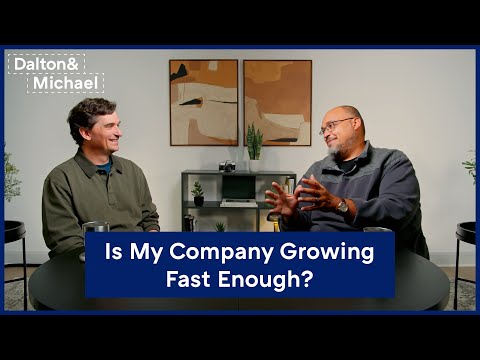
Is My Startup Growing Fast Enough?
Dalton Caldwell (host)
In this episode of Dalton + Michael, featuring Dalton Caldwell, Is My Startup Growing Fast Enough? explores benchmark startup growth properly, ignore hype, and focus on fundamentals AI products and AI-enabled B2B tools are genuinely achieving unusually fast adoption and revenue growth because the capability jump is massive and buyers will pay for clear value.
Benchmark startup growth properly, ignore hype, and focus on fundamentals
AI products and AI-enabled B2B tools are genuinely achieving unusually fast adoption and revenue growth because the capability jump is massive and buyers will pay for clear value.
Publicly cited “ARR” and growth numbers are often inflated or misleading due to annualizing cancellable usage, counting pilots/LOIs, and other creative accounting.
Founders should compare their growth to true direct peers (their category, sales motion, and market constraints) rather than headline outliers like Cursor.
In early, fast-changing cycles it’s difficult even for insiders to predict which companies will be durable winners, so founders shouldn’t overreact to today’s leaderboard.
The right response to slower growth is neither despair nor complacency: use new tools to create more customer value, and pivot thoughtfully if evidence suggests it’s necessary.
Key Takeaways
Benchmark against true comparables, not famous outliers.
Investors and markets judge companies relative to direct peers in the same category and with similar go-to-market constraints; comparing an enterprise, non-self-serve product to a self-serve dev tool will distort decisions and morale.
Get the full analysis with uListen
Treat headline ARR/growth metrics with skepticism.
Usage-based spend can disappear overnight, pilots may not convert, and annualizing short-term signals can overstate traction; focus on contract quality, retention, margins, and what is truly recurring.
Get the full analysis with uListen
Real AI-driven growth exists—but it’s not evenly distributed.
Some products are objectively far better than what existed a few years ago, enabling rapid adoption and spend, but that doesn’t imply every startup should (or can) match those growth curves.
Get the full analysis with uListen
Don’t let “if you’re not 10x you’re dead” memes drive strategy.
The episode frames this as self-defeating founder psychology amplified by social media and marketing; shutting down a strong category leader because it’s not matching a different category’s curve is often a mistake.
Get the full analysis with uListen
In early platform shifts, durability is hard to predict—even for experts.
They cite past “declared winners” (e. ...
Get the full analysis with uListen
Pivoting can be rational when new tools unlock step-change value.
They observed multi-year startups executing well-reasoned AI pivots that increased customer value and restarted growth; the standard isn’t ‘never pivot,’ it’s ‘pivot with clear evidence and leverage.’
Get the full analysis with uListen
Use better tools to go faster, but don’t normalize slow growth.
Their stance is dual: avoid despair from hype comparisons, yet stay ambitious—AI can expand what you deliver, improve meeting generation, and deepen customer ROI, which should reflect in improved momentum.
Get the full analysis with uListen
Notable Quotes
“These days, annual recurring revenue is often not annual, nor recurring, nor revenue.”
— Dalton Caldwell
“You’re gonna be judged relative to your direct peers.”
— Dalton Caldwell
“We’re not growing as fast as Cursor, so therefore we should pivot or do another idea.”
— Dalton Caldwell
“When the game’s early… it’s hard to predict what will have staying power.”
— Dalton Caldwell
“Better tools are coming out every day… Don’t be discouraged… and don’t be accepting of slow growth.”
— Michael
Questions Answered in This Episode
What are the most reliable ways to validate “real ARR” for an AI startup selling usage-based products without fooling yourself?
AI products and AI-enabled B2B tools are genuinely achieving unusually fast adoption and revenue growth because the capability jump is massive and buyers will pay for clear value.
Get the full analysis with uListen AI
How would you define a startup’s true comparables set—category, sales motion, ACV, buyer, or something else—and which matters most?
Publicly cited “ARR” and growth numbers are often inflated or misleading due to annualizing cancellable usage, counting pilots/LOIs, and other creative accounting.
Get the full analysis with uListen AI
What specific red flags indicate a logo-heavy pipeline is mostly pilots rather than scalable enterprise demand?
Founders should compare their growth to true direct peers (their category, sales motion, and market constraints) rather than headline outliers like Cursor.
Get the full analysis with uListen AI
If a founder is growing 6x YoY in enterprise software, what signals would justify staying the course versus executing a pivot?
In early, fast-changing cycles it’s difficult even for insiders to predict which companies will be durable winners, so founders shouldn’t overreact to today’s leaderboard.
Get the full analysis with uListen AI
Which metrics best capture “contract quality” in this AI moment (retention, gross margin after model costs, expansion, payback)?
The right response to slower growth is neither despair nor complacency: use new tools to create more customer value, and pivot thoughtfully if evidence suggests it’s necessary.
Get the full analysis with uListen AI
Transcript Preview
The number of founders I've talked to who basically said some version of, "We're not growing as fast as Cursor, so therefore we should pivot or do another idea." And when you look, you're like, you have the best product in your category. Like, for some reason, I feel like sometimes founders kind of think startups are just kind of fungible. You know, it's like, "Oh, I could make DoorDash or I could make, like, GitLab." And it's like, that's not been my experience. [laughs] Yeah. It's like... [upbeat music] This is Dalton + Michael. Today, we're gonna talk about a topic on every founder's mind. So Dalton, I'm not growing 10X year over year. That means I should shut my company down and go get a job at Google, right? 'Cause I saw on Twitter that investors will only invest in me if I get to- Yeah, I think Andreessen put out a video saying if you don't have that, your company is bad or something. Yeah. I forget what they said. If I were to parody it, 'cause I don't remember it exactly, it's like if I don't have a million ARR in the first week- [laughs] ... it's just like, it's over for me and, like, my life prospects are bad now. Yeah. I'm not gonna get married or have kids. I felt like that was great marketing, by the way. Like, as an aside, like- Rage bait marketing in practice ... everyone's talking about a16z now, right? Of the- I don't know. I don't know if that's the- Hey ... look. All media is good media, right? Okay. [laughs] So anyways, uh, let's try to unpack this a little bit. What's going on? Companies are growing faster- Yes ... than we've seen in the B2B SaaS era, for sure. Maybe not faster than we saw in the consumer era, but we can- Yeah ... leave that aside a little bit. But certainly, um, that's happening. What, what, what's going on? I think we should try to steelman, um, both extremes here. Yes. So let's talk about the growth is real side of the coin. Well, if you go look at the App Store, OpenAI has been number one in the App Store for the past couple years. Right now, I think Sora is number one- Yeah ... which is also OpenAI. Mm-hmm. And holy cow, is the revenue growth real, and the consumer growth real of AI tools. Yeah. And B2B tools that are using the APIs- Yeah ... is real. Well, and, and, and you're saying from the revenue side. From the product side, the OpenAI product is 10X better than anything that existed remotely similar to it five years ago. Imagine if you could- 100X, but- Imagine you had a time machine- Yeah ... and you gave someone access to this. Yeah. [laughs] And they would just be, like, cooking, right? [laughs] Yeah. [laughs] I mean, it's- It's, like, pretty good, right? Yeah. It's like, now everyone has it. Like giving someone Google in, like, the late '80s. Yeah. And just be like, "Whoa. [laughs] Wow." Yeah. So that's on the plus side. On the minus side, what, what's going... Like, eh. I'm quoting someone. A little tricky. I forgot where I read it, but it's sort of like these days, annual recurring revenue is often not annual, nor recur- recurring, nor revenue. [laughs] So every aspect of the term is wrong. Nice. So basically you see a lot of creative accounting- Yes ... where people are, you know, reselling API calls to Anthropic. They're upside down on it. They're multiplying the numbers by 12 to make an annual number. Have it be non-recurring, it's actually just run rate revenue. There's all this, like, bullshit creative accounting going on. Let's, let's go down on that, like, so much deeper. Yeah. Okay. Right. So it's like, all right, I'm running a service that has a monthly subscription. Annualizing that is an estimate 'cause I could cancel at any- That is correct. I'm running a service that has, like, a usage rate, like AWS, where, like, I can pull all of my files from S3 tomorrow and never pay Amazon another cent. Turn that into ARR is a little hokey. I don't wanna name names, but there are a large number of products that YC founders use that I've spoken about, and they say things like, "If I were to pay for the tokens to do this directly with OpenAI or Claude, it would cost this. This product charged me this divided by two. I like using AI." [laughs] Why? [laughs] Um, w- why not get a 50% discount per token? [laughs] So point being, there's a lot of creative accounting for how you define growth rates. Yes. Um, there's people that are... You know, maybe you have an LOI, maybe you have, like, a email, "Oh, we're gonna definitely use your thing," and then you count that as ARR. Yep. Big pilots. I've definitely seen, like, impressive logo on website, dig in, and it's like, it's a big pi- it's a million-dollar pilot. Yeah. But, like, I've seen situations where they're doing pilots with six companies, so their logo's on six different... And it's like, is that an enterprise deal? Is, is that, like, a locked-in scalable thing, or was that just kind of we're demoing it and seeing what's going on? Yeah. And so the point is the following: Are there startups that are actually growing at 5X or 10X, you know, greater than 5X year over year, 10X year over year? Yes. Especially at small scale. Definitely. Yes. Are there startups that go from zero to a million ARR in some form or another faster than we've seen in the past? Yeah. Yes. Yes. And I think partially, we've talked about this before, but it's 'cause big companies are willing to purchase the stuff. Mm-hmm. And it used, that used to be really hard- Mm-hmm ... to get a big logo. Yep. And, and they don't mind spending money. Yeah. If they can see value, they don't mind spending money. Yeah. So that- Yeah ... that's real. Yes. Um, but I think if you're a founder and you're depressed and you're, like, ready to shut down your company 'cause you're only growing 6X year over year, don't do it. No. [laughs] That's- [laughs] Or like, just like- Let's call it an a16z. [laughs] Yeah, it's, that's just, like, self-defeating bad memes. Yeah. Um, I think the best way to think about this from an investor perspective is that you're gonna be judged relative to your direct peers. And so let's say that you're doing voice AI. Mm-hmm. Vertical voice AI. Mm-hmm. You are going to be judged based on how fast the other vertical voice AI companies are growing. Yeah. 'Cause if you're an investor- Yeah ... like, right, like I'm, I'm running a Series A firm- Yeah. You're picking between the lot of- I'm, I s- a lot, I'm looking at a lot of companies that are- Yeah ... building in the space. Maybe not competitors- Yeah ... but they're comparables. Yeah. And yeah, I am looking on a relative basis- Yes ... how the companies are doing compared to each other, but I'm also taking the time to dig into how real the contracts are. Yes. I'm digging into if the product is good. Yes. Like, there's all this nuance- Yes ... that as an investor that I would dig into. Yes. And so the way I would extrapolate this as a founder is realize who your comparables are-Realize who you're gonna be judged against Yes And if you want to be able to keep raising, be better than average. [laughs] I love that you're talking about these comps 'cause the number of founders I've talked to who basically said some version of, "We're not growing as fast as Cursor, so therefore we should pivot or do another idea." And when you look, you're like, you're not even as, in a space that could support this level. Like, you know, it's like you sell enterprise software, it's not self-serve. Like- Yep ... how would you be able to grow as fa- ... Like, or you're growing... You have the best product in your category. Like, why would you care about Cursor? It's a completely different category. And for some reason, I feel like sometimes founders kind of think startups are just kind of fungible. You know, it's like, "Oh, I could make DoorDash, or I could make, like, GitLab." And it's like, that's not been my experience. [laughs] It's like, you, you probably couldn't have made either, but, like, it's probably much more likely you'd have made one than both. And so, um, I think when people don't look at the comps, that's when they can psych themselves out. Yep. I also think that there's a bit of a question about what phase are we in? I think you and I have this kind of really interesting perspective 'cause we've seen multiple cycles now 'cause we're old as fuck. And, like, I think that we just experienced very late stage B2B SaaS, which I would argue is, like, at least I found fairly depressing. But, like, it, you know, it was, A, the technology hasn't changed for years, right? And now we're in this kind of probably a cycle that to us would feel like early web apps or ear- early mobile apps. And I think sometimes people don't understand, like, how little things have firmed up yet. Like, when the game's early, like- Yeah ... like, it's really- Well, it's hard to predict ... hard to predict- [laughs] ... what will have staying power. Yeah. Hard to predict what will have network effects. Yes. And I am fully expecting to be surprised. I know that's a, a weird way to think about it. Yes. Yes. I don't trust my ability to predict- No ... what is enduring and what isn't. It's kind of like do, do you remember the bet that Sam made where he was like, "These YC companies together will be worth, like, X billion dollars"? Mm-hmm. And if you look at the list of companies, there's some really good stuff in there. I think Stripe was on the list. Yeah. But then there was, like, Teespring. Yeah. Yeah. And, like, it's because at the t- I remember at the time- It was taking off ... Stripe and Teespring seemed like equally good startups to me. Yep. Yep. [laughs] And so even when you're completely in the know- Yeah ... it's hard to, to predict what's gonna be sticky and what's gonna be the enduring company. I love that you said expect to be surprised because, like, if we think back through 20, 25 years in tech, how many name brands have we seen just fucking... Remember Palm? Yeah. Yahoo was one of the biggest companies in the world, and now it's just, like, this, like, ad tech stub. Now it's a different thing. Yeah. AOL, Netscape, like, there's so many examples. And what's funny is it's like when you think about some of those examples, it wasn't they're gonna win. It was like the game was declared over. Yeah. Like, by the time Google was going, Yahoo was already declared the winner. Yep. And then- It was, like, the biggest and most important internet company ... literally, yeah. Yeah. And then somehow it un-won 'cause there, there is no kind of, like, permanent winner. [laughs] Yeah. Uh, except Microsoft. That gives... [laughs] Sorry. But, um, I think this is what, when founders discourage themselves, like, man, just take a look at some of the, like, dinosaurs and, like, you might realize something that looks great today, you have no idea what the shelf life is. Yeah. Yeah. And, and again, to, for the record, I have no idea how sticky Cursor is versus Claude Code and stuff. I mean, again, we'll make investments on stuff like this, but if you- Interesting ... feel like, okay, Dalton, bet your life on what's gonna happen and what's sticky, I, I don't know. At this phase? I have no idea. It's, like, the dumbest moment to make... [laughs] I don't know what's gonna stay. Yes. I... To me, I think, like, the lesson I learned from YC in this phase, fund smart people and just see what happens. Yeah. Smart people will figure it out. Yeah. And, like, lean back. And, like, maybe my takeaway from more later stage SaaS was, like, the variance is a little bit less. Yeah. Um, can't predict necessarily who's gonna win, but the variance in outcomes is way, way less, whereas now- How do we- ... I don't even know that we know how to even use the tools we have right now. [laughs] You know, it's like the... I always talk about this example of, like, how long did it take us to squeeze the most out of a mobile phone? How long did it take us to squeeze the most out of a web browser? Like, the idea that a new model drops and we know the best way to extract value out of it is, like, the biggest joke I've ever experienced. Yeah. And maybe the most positive or actionable thing from hearing this, like, oh, everyone's growing faster than me- Yeah ... is I did see a couple of companies apply to Standard Capital in our last funding cycle- Yeah ... where it was a company that had been around two or three years. Yes. And it wasn't really growing fast. Yes. And so they did, like, a crazy pivot nine months ago, and it totally worked. Okay, that was pretty smart. Yep. Does that make sense? Like, I saw people do AI pivots that were well thought through- Yes ... even though they're two or three years in their startup. Yes. And I, and I asked them, "Well, why? Why did you do this?" And they're like, "Well, we weren't growing fast enough." Yeah. Okay, that's- Yeah ... that's fair game. I think this has been a bit of a... And, and we'll see how it works out, but I've definitely seen people who, like, I would describe as had some interesting insights but poor tools as the B2B SaaS thing kind of came to a close, where, like, with AI, they can actually do, they can create way more value for the customer. So, like, oh, like, yeah, we got this contract with a customer, and, like, we can do this much, and then we wake up, and it's like, oh, it turns out we can do this much for our customer. Oh, now they wanna talk to us more. Like, oh, we're get- we're getting meetings we weren't getting before. Yeah. Oh, we're making them more mon- Like, and it's like, yeah, you got better tools. Like, get back in the game. You got better tools. [laughs] Right? It's like you got better pads. Go hit hard now. I think that, um, anyone who's discouraged, it's like, man, better tools are coming out every day. This is a great time to be doing it. Don't get discouraged by someone making it- Don't be discouraged- ... stupid ... and don't be accepting of slow growth. Exactly. Be inspired. [laughs] With great tools, you should be able to go faster than before. All right. Great chat. All right. Thanks, Michael. Thank you. [outro music]
Install uListen to search the full transcript and get AI-powered insights
Get Full TranscriptGet more out of YouTube videos.
High quality summaries for YouTube videos. Accurate transcripts to search & find moments. Powered by ChatGPT & Claude AI.
Add to Chrome