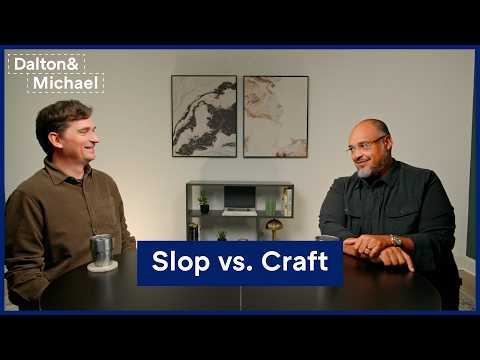
Slop vs Craft
Dalton Caldwell (host), Michael Seibel (host)
In this episode of Dalton + Michael, featuring Dalton Caldwell and Michael Seibel, Slop vs Craft explores avoid the slop war: build craft, retention, and real user value They define slop as products that look good in demos, fundraising, or top-line graphs but fail to solve users’ problems or create lasting satisfaction.
Avoid the slop war: build craft, retention, and real user value
They define slop as products that look good in demos, fundraising, or top-line graphs but fail to solve users’ problems or create lasting satisfaction.
They argue powerful tools like Claude Code can accelerate slop by making it easy to ship lots of features and plausible prototypes without conviction or user value.
They use historical cycles—SEO content farms, early App Store junk, and parts of crypto/ICOs—to show slop can create short-term gains but typically ends as a “turkey startup” when platforms or incentives shift.
They frame “taste” as honest judgment and high standards: resisting self-deception, prioritizing positive-sum value creation, and being proud to put your name on the work.
They recommend avoiding symmetric “spam harder” arms races and instead winning by focusing on retention, real utility, and the hard-to-fake metrics that reflect genuine user benefit.
Key Takeaways
Don’t enter a symmetric “slop harder” arms race.
If competitors are spamming features/content to juice graphs, matching them drives you toward garbage output and fragile growth; find a strategy that avoids competing purely on volume and manipulation.
Get the full analysis with uListen
Slop is often recognizable if you stop self-deceiving.
After rest or outside feedback, you usually “know” the work isn’t that good; craft requires the discipline to acknowledge that and raise the bar rather than pile on more features.
Get the full analysis with uListen
Use the competitor’s product before fearing it.
Fundraising buzz and external signals are misleading—actually trying the product is the fastest way to assess whether it delivers real user value or is mostly hype/slop.
Get the full analysis with uListen
Top-line graphs can be gamed; retention forces reality.
Push notifications, deceptive emails, and dark patterns can inflate DAUs or revenue short-term, but retention work starts with: is the product truly helping and do users feel that value?
Get the full analysis with uListen
Platform-gaming slop creates “turkey startups.”
SEO farms, early App Store gimmicks, and many crypto plays can look like they’re “winning” early, but collapse when algorithms, policies, or market sentiment change.
Get the full analysis with uListen
AI coding tools increase the risk of pivot hell.
When you can “one-shot” prototypes or clone ideas instantly, it becomes easier to chase shiny things with low conviction, drifting away from domains you understand and from real user needs.
Get the full analysis with uListen
Taste in startups is a value compass, not UI polish.
They frame taste as high standards and positive-sum value creation—shipping work you’d proudly stand behind because users reliably get outcomes, not just aesthetics or feature count.
Get the full analysis with uListen
Notable Quotes
“You wanna stay out of a symmetric battle for who can slop harder.”
— Dalton Caldwell
“Slop is products that don't actually help the user.”
— Michael Seibel
“Slop is where you're sort of actively self-deceiving that your thing is good when you kinda know it's not that good.”
— Dalton Caldwell
“In the first 10% of the race, you look like you're winning... you can sometimes just forget that you have 90% of the race to run.”
— Michael Seibel
“Graphs that go up where no value is created, come down. They've, they have a life of a turkey.”
— Michael Seibel
Questions Answered in This Episode
What are concrete “retention-first” metrics you’d track to detect slop early (beyond DAUs and revenue)?
They define slop as products that look good in demos, fundraising, or top-line graphs but fail to solve users’ problems or create lasting satisfaction.
Get the full analysis with uListen AI
In the Claude Code workflow, what specific habits help prevent self-deception about quality (e.g., review rituals, user tests, time delays)?
They argue powerful tools like Claude Code can accelerate slop by making it easy to ship lots of features and plausible prototypes without conviction or user value.
Get the full analysis with uListen AI
How do you distinguish “craft” from “over-engineering,” especially when users aren’t yet present to validate value?
They use historical cycles—SEO content farms, early App Store junk, and parts of crypto/ICOs—to show slop can create short-term gains but typically ends as a “turkey startup” when platforms or incentives shift.
Get the full analysis with uListen AI
Which parts of the SEO/App Store/crypto cycles were legitimate value creation, and what signals separated them from turkey startups?
They frame “taste” as honest judgment and high standards: resisting self-deception, prioritizing positive-sum value creation, and being proud to put your name on the work.
Get the full analysis with uListen AI
What are examples of “symmetric battles” founders commonly fall into today (content volume, feature velocity, AI-generated outreach), and what asymmetric alternatives work?
They recommend avoiding symmetric “spam harder” arms races and instead winning by focusing on retention, real utility, and the hard-to-fake metrics that reflect genuine user benefit.
Get the full analysis with uListen AI
Transcript Preview
I think you wanna stay out of a symmetric battle for who can slop harder. If there's a competitor and they're spamming a lot, and you're like, "Well, our only solution is to spam harder"-
[laughs]
... and you're just in an arms race of who can create the most garbage to make the graph go up-
Yeah
... I, I think don't do it.
Yeah.
I think you have to find a way to stay out of trying to produce the most low-quality crap. [upbeat music]
This is Dalton + Michael. Today, we're gonna talk about slop versus craft.
[laughs]
Maybe another way to describe this is like what does it mean to have good taste? Why don't we kick this off, you and I were talking about Claude Code. You've maybe gone down the smallest of rabbit holes. How is Claude Code changing how you think about slop versus craft?
Sure. So I think for context, I've been doing a fair amount of programming over the past, uh, nine months.
Mm-hmm.
Um, like I was messing with Cursor and Windsurf a while ago-
Mm-hmm
... and it was cool, and, you know, I've been having fun with it. And then of course, Claude Code came out probably a while ago, but it, it really took off memetically-
Mm-hmm
... Q4 of last year, and definitely over, like, Christmas break is when everyone-
Yeah
... went nuts with it. And what I would say is it's really fun.
[laughs]
[laughs] It's like a video game.
[laughs]
And you, like, type stuff in, and it just feels powerful.
Yeah.
Like, you watch the screen fly by. It's like programming with the best programmer you've ever met-
Mm-hmm
... who's, like, really nice and really fast.
[laughs]
And it's so energizing to watch the code fly by on the s- on the screen and, um, see all the tokens it's burning and just, like, you know, it's, it's super cool, so I would recommend it.
Yes.
And this is not yet another, you know, VC podcast talking about how great Claude Code is-
[laughs]
... 'cause here's where I'm going with this.
Uh-oh.
It is great.
Is there a dark secret? [laughs]
No, it is great, but I easily could imagine a younger version of myself-
Hmm
... not really sleeping or taking care of myself-
Mm-hmm
... and then being convinced that all of this junk that I was making with Claude Code was really good.
Yeah.
[laughs] It reminds me of, like, I remember setting up Linux when, uh, when I was super young.
Mm-hmm.
And I used this version of Linux called Gentoo-
Okay
... where you would compile the whole thing from scratch.
Mm-hmm.
And so when you were setting up Linux, it would just be like, stuff would be flying by on the terminal.
[laughs]
And I felt like a really elite guy-
[laughs]
... that I was, like, hand-compiling my own Linux kernel.
Yes.
And in retrospect, that was, like, not-
Install uListen to search the full transcript and get AI-powered insights
Get Full TranscriptGet more out of YouTube videos.
High quality summaries for YouTube videos. Accurate transcripts to search & find moments. Powered by ChatGPT & Claude AI.
Add to Chrome