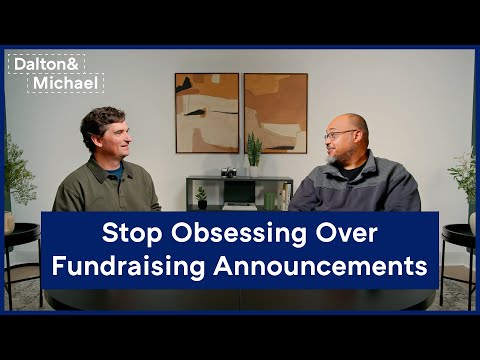
Stop Obsessing Over Fundraising Announcements
Dalton Caldwell (host), Michael Seibel (host)
In this episode of Dalton + Michael, featuring Dalton Caldwell and Michael Seibel, Stop Obsessing Over Fundraising Announcements explores why fundraising announcements mislead founders about startup funding fairness realities Fundraising announcements often trigger founder spirals—envy, outrage, or misguided pivots—even though they rarely change a startup’s actual odds of success.
Why fundraising announcements mislead founders about startup funding fairness realities
Fundraising announcements often trigger founder spirals—envy, outrage, or misguided pivots—even though they rarely change a startup’s actual odds of success.
A funding round is not a meritocratic scorecard or value-creation event; it is an illiquid, probabilistic bet that frequently won’t pay off.
Announcements exist largely to manufacture attention—driving customers, recruiting, and awareness—because the default state is that nobody cares about your startup.
Outsiders lack critical context behind any round (prior relationships, past outcomes, timing, and “creative accounting”), making fairness judgments based on headlines unreliable.
Despite real advantages for certain backgrounds, seed funding can be relatively accessible because investors compete, coordinate little, and often publicize what they’re looking for.
Key Takeaways
Treat fundraising rounds as bets, not verdicts.
A round doesn’t prove a company is “winning”; it signals that someone placed an illiquid wager with meaningful downside and a substantial chance of failure.
Get the full analysis with uListen
Fundraising announcements are marketing, not evidence packets.
They’re designed to attract attention (customers, candidates, partners), not to disclose the full set of diligence materials that would justify the investment.
Get the full analysis with uListen
Stop letting other people’s rounds control your emotions or roadmap.
Spiraling into envy, anger, or “we should pivot to voice AI” thinking is self-defeating because it usually doesn’t change your probability of success.
Get the full analysis with uListen
Evaluate announced startups with a sober probability estimate.
Spend 5–10 minutes with the product and case studies, list pros/cons, and assign a likelihood; it’s harder to call investors “stupid” when you acknowledge uncertainty.
Get the full analysis with uListen
Assume you’re missing key context behind why a round happened.
Prior founder-investor history (e. ...
Get the full analysis with uListen
Funding can be more accessible than it feels—without being easy.
Investors compete and often don’t coordinate heavily at seed, so one “no” doesn’t poison the well, but starting advantages (pedigree, network) still matter.
Get the full analysis with uListen
Use others’ announcements for practical action, not comparison.
The healthiest response is “cool—let me check the product, consider partnership, buy, refer candidates,” rather than interpreting it as a referendum on your startup.
Get the full analysis with uListen
Notable Quotes
“No. End of video. All right, that's it. It's not fair. Sorry.”
— Michael Seibel
“A funding announcement is the announcement of a illiquid bet, and almost every single fundraising announcement you will read is an announcement of an illiquid bet that has a probably less than 50% likelihood of paying off.”
— Michael Seibel
“The natural state of startups is no one cares about your startup.”
— Dalton Caldwell
“Thinking that announcement has all the supporting materials... that's not the purpose of a fundraising announcement.”
— Michael Seibel
“Don't get all worked up over a bet.”
— Michael Seibel
Questions Answered in This Episode
What specific signals do you recommend founders look for in a fundraising announcement besides the dollar amount and investor logos?
Fundraising announcements often trigger founder spirals—envy, outrage, or misguided pivots—even though they rarely change a startup’s actual odds of success.
Get the full analysis with uListen AI
How would you assign a realistic probability of success to an announced startup—what inputs matter most (team, market, traction, distribution)?
A funding round is not a meritocratic scorecard or value-creation event; it is an illiquid, probabilistic bet that frequently won’t pay off.
Get the full analysis with uListen AI
Where’s the line between a healthy competitive awareness of competitors’ funding and an unhealthy spiral that hurts execution?
Announcements exist largely to manufacture attention—driving customers, recruiting, and awareness—because the default state is that nobody cares about your startup.
Get the full analysis with uListen AI
Can you share examples of the “creative accounting” or framing tricks that make rounds look bigger/better than they are?
Outsiders lack critical context behind any round (prior relationships, past outcomes, timing, and “creative accounting”), making fairness judgments based on headlines unreliable.
Get the full analysis with uListen AI
You mention pedigree advantages (e.g., MIT CS majors) but also claim seed is relatively accessible—what concrete steps help non-traditional founders close that gap?
Despite real advantages for certain backgrounds, seed funding can be relatively accessible because investors compete, coordinate little, and often publicize what they’re looking for.
Get the full analysis with uListen AI
Transcript Preview
[gentle music] This is Dalton + Michael. Today we're gonna talk about is startup funding fair?
[laughs]
So I'll set this up. Instead of working on your company, you're browsing Twitter, 'cause that's what all good founders do, and you see company bullshit has just raised a $10 million round from A, C, T, and Z. And you checked out their product last week, and you're like, "Th- that product sucks." And you see all these people being like, "Oh my God, this company's so great. They're gonna win the space." And you are starting to think, "Is this all a joke? I was told this was meritocratic, and da, da, da, da, da, but, like, these folks suck, and they're raising all the money, and they look like they're cool." What's going on? [laughs]
Yeah, I mean, look, think about how many office hours that we do-
Yes
... where, you know, there's some other topic, but when you get right down to it-
[laughs]
... what's actually going on is that someone read a fundraising announcement, and somehow that caused them to go through a, like a total spiral.
Yes.
Like, the founders I'm talking to are spiraling.
Yes.
Sometimes it's because they're sad-
Yes
... because, um, it's-
They're competitive
... a competitor.
Yes.
Sometimes it's they're enraged-
Yeah
... because how dare-
Yes
... this dumb thing that's so bad-
Yes
... that we're better than them raise money.
Yes.
Time for revolution.
[laughs] Yeah. Time for a revolution. [laughs]
We ne- we need to destroy the venture capital industry.
Yeah. [laughs]
I'm so mad.
Yes. [laughs]
Sometimes it's out of magical thinking, where it's like, "Hey, I saw someone raise this money for this voice AI thing. I think we should do voice AI." And so they sort of like-
Yes
... draw parallels-
Yes
... to what they're doing.
Well, no, I would call that the pivot.
[laughs]
Like, we should pivot to that, right? I think the parallel one is, like, a voice AI r- company raised a billion dollars. That means we can be worth a billion dollars, too. Like-
Yeah
... that means this space-
Sure, yeah
... is a new game, right? Like, there's a tailor-
No, good, good
... it's all good. Yeah.
Good news, Dalton. My startup's working. Someone raised money.
Yes. Yes, these other, these other people.
Yeah.
These other guys raised money.
Yes.
I'm going-
Yes
... my startup's doing great. The number of times I've seen a founder basically, "This is a good space because there exists N unicorns in the space."
Mm.
I'm like, what does that even-
[laughs]
What do these things-
Yeah
... have to do with each other? So is it fair?
No.
[laughs]
End of video. All right, that's it.
[laughs]
It's not fair. Sorry.
Yeah.
And so-
You're right. [laughs]
[laughs] It's an injustice.
So again, what's funny is that, for whatever reason, startup culture is heavily centered around fundraising announcements and reaction to fundraising announcements.
Install uListen to search the full transcript and get AI-powered insights
Get Full TranscriptGet more out of YouTube videos.
High quality summaries for YouTube videos. Accurate transcripts to search & find moments. Powered by ChatGPT & Claude AI.
Add to Chrome