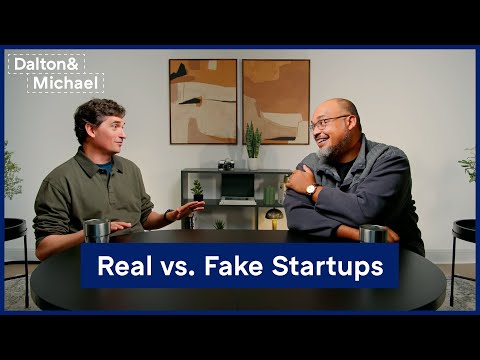
Real vs Fake Startups
Dalton Caldwell (host), Michael Seibel (host)
In this episode of Dalton + Michael, featuring Dalton Caldwell and Michael Seibel, Real vs Fake Startups explores real vs fake startups: building value versus performing startup culture They define an extreme “fake startup” as one that prioritizes optics—hiring, fundraising, status—without building or shipping a real product.
Real vs fake startups: building value versus performing startup culture
They define an extreme “fake startup” as one that prioritizes optics—hiring, fundraising, status—without building or shipping a real product.
They describe a caricature of a “real startup” as intensely technical builders, then note that even iconic “technical” companies succeed through strong sales and marketing.
They argue many founders slide into fakery by cargo-culting startup rituals from social media or by trying to compensate for weak starting conditions with urgency and “grit.”
They explain YC’s advice often emphasizes sales/marketing because many technical teams underinvest there, and advice is only useful when it pushes founders beyond their defaults.
They warn against modeling yourself on myths about famous companies (e.g., “Google didn’t market”), because false narratives create bad strategy and wasted effort.
Key Takeaways
Shipping and customers are the line between real and fake.
A “fake startup” is characterized by raising money, hiring, and chasing prestige without building or delivering a product that users actually adopt.
Get the full analysis with uListen
Startup rituals don’t create outcomes; product value does.
Renting an office, doing investor meetings, and hiring people can look like progress, but without a strong product and distribution they’re just “infrastructure without the point.”
Get the full analysis with uListen
Don’t cargo-cult what you see on social media.
If your understanding of startups comes mainly from Twitter or public narratives, you may copy the visible artifacts of success rather than the underlying work that produced it.
Get the full analysis with uListen
Use grit to improve starting conditions, not to bypass them.
When conditions are weak (no technical cofounder, wrong location, limited time), applying effort to fix constraints is often higher leverage than rushing into pitch decks, contractors, or premature scaling.
Get the full analysis with uListen
Great technology still needs marketing and sales.
They argue the best “technical” companies (e. ...
Get the full analysis with uListen
Good advice changes behavior you wouldn’t change on your own.
Telling builders to do more selling/marketing is valuable precisely because it’s uncomfortable and non-default for many technical teams; obvious advice (“hire A players”) isn’t actionable guidance.
Get the full analysis with uListen
Beware myths about iconic companies when setting your North Star.
False stories like “they never did marketing” or “it was self-serve forever” can cause founders to underinvest in the hard-but-necessary parts of building a real business.
Get the full analysis with uListen
Notable Quotes
“A cartoonishly extreme fake startup... is a startup that never builds a product and never writes any code.”
— Dalton Caldwell
“Basically, it's almost like performance art.”
— Dalton Caldwell
“If we put those three things together, Google pops out, right?”
— Michael Seibel
“If no one knows that your technology exists, it's kinda game over.”
— Dalton Caldwell
“Use the grit to improve your starting conditions. It's a lot more efficient use of grit.”
— Michael Seibel
Questions Answered in This Episode
What are the earliest concrete signals (shipping milestones or customer behaviors) that differentiate a “real shot on goal” from startup “performance art”?
They define an extreme “fake startup” as one that prioritizes optics—hiring, fundraising, status—without building or shipping a real product.
Get the full analysis with uListen AI
How should a founder diagnose “poor starting conditions” in their specific case, and what are the highest-leverage ways to improve them before fundraising?
They describe a caricature of a “real startup” as intensely technical builders, then note that even iconic “technical” companies succeed through strong sales and marketing.
Get the full analysis with uListen AI
What are common examples of cargo-cult behaviors you see (office, hiring, decks, press), and what should replace each one in the first 90 days?
They argue many founders slide into fakery by cargo-culting startup rituals from social media or by trying to compensate for weak starting conditions with urgency and “grit.”
Get the full analysis with uListen AI
For developer tools specifically, what does “posting about your thing” look like when it’s substantive rather than hype-driven?
They explain YC’s advice often emphasizes sales/marketing because many technical teams underinvest there, and advice is only useful when it pushes founders beyond their defaults.
Get the full analysis with uListen AI
Which popular myths about companies like Google or Stripe are most damaging to early founders, and what’s the truer story founders should emulate instead?
They warn against modeling yourself on myths about famous companies (e. ...
Get the full analysis with uListen AI
Transcript Preview
I have encouraged a lot of founders building technical tools, you know, developer tools, to spend a lot of time posting about their thing and telling the world about it.
Yeah.
Because if no one knows that your technology exists, it's kinda game over.
Yeah.
And the, the, the best technologies are good at marketing, whether you admit it or not. [upbeat music]
Welcome to Dalton + Michael. Today we're gonna talk about real startups versus fake startups. In this video, I'm gonna say nice things, and Dalton's gonna make people mad. [laughs]
[laughs] I hope not.
What, what is the definition? I hear [laughs] there's a guy-
Yeah.
What's the definition of a fake startup? [laughs]
Oh, okay. So you're setting me up.
[laughs] I mean, I might be setting you up.
Let's start with the extremes.
Let's-
Right? Like, with the cartoonish extremes.
Yes.
So a cartoonishly extreme fake startup-
Yes
... is a startup that never builds a product and never writes any code.
Nope.
It hires lots of people.
Some-
The founders are on the 30 Under 30 list somehow.
[laughs] Somehow.
[laughs]
That was a, that was a high priority. [laughs]
Some- somehow that's their main work product.
[laughs]
The founders have raised money-
Yeah
... despite never having, um, shipped a product or any customers.
Yes. Yeah.
Basically, it's almost like performance art. It's like if you had a modern artist be, like, trying to, to, to disassemble the startup culture-
Yes
... in some edgy way.
Yes.
That's a fake startup.
Yes. I like that, performance art. It's like Hamilton on stage versus actually being there.
Yeah, the whole thing is a performance.
[laughs] Yeah. Yes, yes.
It's not real.
So what's a real startup?
So-
Or the cartoonish version of it.
The cartoonish version of a real startup is where, you know, everyone is working 9:00 to 6:00.
Yep.
And it's only programmers. There's not a single non-technical person in the business.
Nope.
And they're all writing Rust.
Yes.
And maybe not even Rust. They're, they're writing their own programming language.
To start, obviously.
To start, of course.
Yes.
Um-
'Cause it's gotta scale. [laughs]
[laughs] They can't be bothered to do all sorts of things. They're just, like, super hardcore.
Yeah.
They're super focused, and-
Don't have to do any sales.
They don't have to do any sales.
Yes.
It's all self-service.
Yes.
And I dunno, like, I think back in our day when we were early founders, Google was, like, the textbook example that I was taught of, like-
Mm
... what real is. Just being hardcore. Right?
Yeah. Like, they look at your SAT scores when they're trying to recruit you.
'Cause everything about Google-
Yeah, yeah, yeah
... w- my memory as a founder was-
Yeah
... we were trained that that, that was the golden standard for a real-
Yeah
... hardcore organization.
Yeah. These are clear caricatures, right? Right, like-
Yeah.
Y- Goo- y- you know, perfect example, Google's like one of the best sales companies in the world.
Install uListen to search the full transcript and get AI-powered insights
Get Full TranscriptGet more out of YouTube videos.
High quality summaries for YouTube videos. Accurate transcripts to search & find moments. Powered by ChatGPT & Claude AI.
Add to Chrome