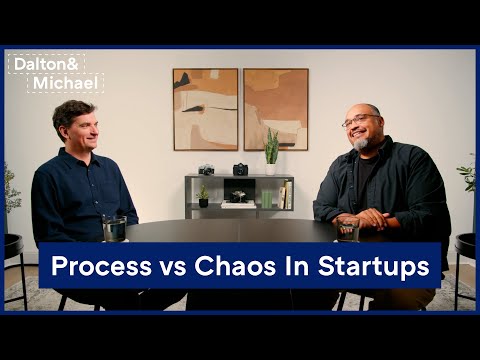
Process vs Chaos In Startups
Michael Seibel (host), Dalton Caldwell (host)
In this episode of Dalton + Michael, featuring Michael Seibel and Dalton Caldwell, Process vs Chaos In Startups explores when startups need process, when chaos drives real innovation forward Good process is measurable, repeatable, and improves outcomes—like an assembly line producing consistently high-quality “bolts.”
When startups need process, when chaos drives real innovation forward
Good process is measurable, repeatable, and improves outcomes—like an assembly line producing consistently high-quality “bolts.”
Bad process behaves like self-serving bureaucracy, expanding headcount and control while shrinking actual product output.
Founders often reach for process when the same problem repeats or when fear/anxiety makes planning feel safer, even if it doesn’t improve results.
Innovation and creative work often start with chaos and rule-bending, while operational work (legal, finance, reliability) benefits from disciplined “bolt-like” process.
Startups must embrace risk and path-blazing rather than adopting big-company carefulness that prevents them from exploring disruptive opportunities.
Key Takeaways
Judge process by outcomes, not by how organized it looks.
A strong process produces consistently good results and gets better over time; “organized” bureaucracy can still generate worse output or slower execution.
Get the full analysis with uListen
Process should be treated skeptically because it naturally expands.
Without a devil’s advocate, procedures accumulate, more people are hired to maintain them, and the process can become the goal instead of the product.
Get the full analysis with uListen
Match the level of process to the work: bolts vs art.
Repeatable, measurable activities benefit from standardization; creative/innovative work resists optimization-by-checklist and can be damaged by “MBAification.”
Get the full analysis with uListen
Process is often an emotional coping tool, not a performance tool.
Fear and anxiety—especially when doing something new—push teams toward planning and procedure for comfort, even when it doesn’t improve output.
Get the full analysis with uListen
Pick a few areas to innovate; don’t try to be “creative” everywhere.
Founders should decide where differentiation truly matters and spend “innovation points” there, while running the rest with reliable, bolt-like practices.
Get the full analysis with uListen
Avoid extremist rules like ‘no meetings ever’ or ‘no specs ever.’
Total rejection of process can create broken systems that never get improved; the goal is a pragmatic middle where process exists but is continually refined.
Get the full analysis with uListen
Startups must embrace risk and rule-bending to compete with incumbents.
Big companies can safely travel the “Autobahn,” but startups win by trailblazing; adopting Google-style carefulness can prevent exploring the very risky paths that create breakthroughs.
Get the full analysis with uListen
Notable Quotes
“You can end up where the process becomes this big, and the actual product is this big.”
— Dalton Caldwell
“A lot of process comes from people being afraid and anxious and wanting the comfort.”
— Michael Seibel
“If you were to ask me... the biggest innovations... they've all started with chaos.”
— Michael Seibel
“The more something looks like producing bolts, the more process works... the more it looks like producing art... the less you can.”
— Dalton Caldwell
“You are chopping down things... you're blazing the path... you represent the risk in the economy.”
— Michael Seibel
Questions Answered in This Episode
What are practical metrics a startup can use to tell if a process is improving outcomes versus just adding overhead?
Good process is measurable, repeatable, and improves outcomes—like an assembly line producing consistently high-quality “bolts.”
Get the full analysis with uListen AI
How would you decide which 2–3 areas deserve “innovation points” in an early-stage startup, and which should be run like “bolts”?
Bad process behaves like self-serving bureaucracy, expanding headcount and control while shrinking actual product output.
Get the full analysis with uListen AI
Can you give an example of a process that started good (like code review) but later became bureaucratic—what were the warning signs?
Founders often reach for process when the same problem repeats or when fear/anxiety makes planning feel safer, even if it doesn’t improve results.
Get the full analysis with uListen AI
Where’s the line between necessary “rule-bending” for startups and irresponsible risk (e.g., the Pokemon/copyright anecdote)?
Innovation and creative work often start with chaos and rule-bending, while operational work (legal, finance, reliability) benefits from disciplined “bolt-like” process.
Get the full analysis with uListen AI
How should a startup handle anxious team members who want more process, without stifling experimentation?
Startups must embrace risk and path-blazing rather than adopting big-company carefulness that prevents them from exploring disruptive opportunities.
Get the full analysis with uListen AI
Transcript Preview
A Google style of carefulness was being applied by a startup whose sole job was to explore the risky paths.
You can end up where the process becomes this big, and the actual product is this big. It, it'd be like if at-
Yes
... at the bolt factory, there was 1,000 process people-
Yes
... and one guy making bolts.
And one bolt a day comes out of the factory. [laughs]
[laughs]
[upbeat music] Welcome to Dalton + Michael. Today, we're gonna talk about, we might even debate-
Ooh
... slightly-
[laughs]
... process, procedure.
The P word.
Bureaucracy.
Yep.
Meetings. And the kinda, the prompt for this one is, um, confusing an organized process with an effective process, and confusing chaos with ineffective or bad outcomes.
Yeah, I mean, I think the context here is you and I have debated this for many years-
Yeah
... as colleagues.
Would people guess which s- I don't know that people-
Yeah, what do you think? Who's the pro-process and anti-process person?
Yes, and who's the chaos guy?
Yeah, who's... I think they-
I think they would assume I'm the chaos guy. I think they might.
People who know me would never. [laughs]
It's a great point. You're right. I actually have no idea if people understand-
Yeah
... that I'm the anti-process guy. [laughs]
[laughs]
And that you're the pro-process guy. I don't know if that's obvious. Beats me, man.
Tell us in the comments. Like [laughs] tell us in the comments.
Um, and so yeah, so the general debate is Michael will be like, "Oh, we need a structured process to do X, Y, and Z."
Yes.
And I'm like, "Why?"
Yes.
"That sounds bad."
We would end in many different places.
Yeah. [laughs]
[laughs] Depending on the case.
There'd be some process and then no process.
Yeah.
Yeah.
But it was always an interesting debate because it was always a, I always like the debate because process should always be treated skeptically.
Yeah. It should always-
Otherwise, it'll inf- otherwise it'll-
Exactly
... take over.
Someone has to be the devil's advocate-
Yep
... for any new process, and you played that role excellently. [laughs]
[laughs] You know. Fair enough. Fair enough.
So how is people thinking about useful process versus bad process?
Useful process, so to take the opp- so to, to argue the opposite side that I'm-
Yes
... usually on, useful process is the following: once a best practice exists-
Yes
... you should just do the best practice.
Yes.
Otherwise, you're just wasting a ton of time. Think about, um, automation, like, uh, the Industrial Revolution-
Yeah
... where if there's one way to make a bolt on an assembly line-
Yeah
... just keep making the bolts.
Yeah.
Those bolts are gonna be better-
Just do it exactly. Yeah
... in every way than a bespoke welder trying to make a bolt by hand. And so process in its best form is just establishing a state-of-the-art best practice-
Install uListen to search the full transcript and get AI-powered insights
Get Full TranscriptGet more out of YouTube videos.
High quality summaries for YouTube videos. Accurate transcripts to search & find moments. Powered by ChatGPT & Claude AI.
Add to Chrome