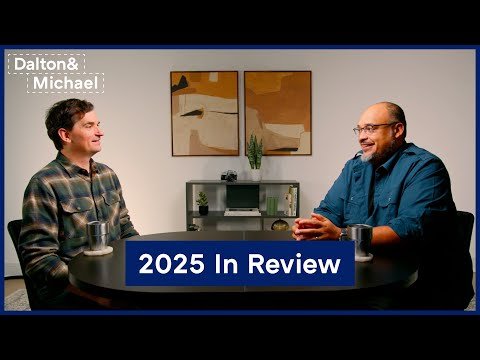
2025 Year In Review
Michael Seibel (host), Dalton Caldwell (host), Michael Seibel (host)
In this episode of Dalton + Michael, featuring Michael Seibel and Dalton Caldwell, 2025 Year In Review explores 2025 hot takes on cities, AI, space, politics, and society They argue that most viral Twitter narratives about San Francisco are low-signal and that macro forces like COVID and downtown vacancy explain more than individual politicians do.
2025 hot takes on cities, AI, space, politics, and society
They argue that most viral Twitter narratives about San Francisco are low-signal and that macro forces like COVID and downtown vacancy explain more than individual politicians do.
They frame depopulation as an underappreciated risk, tracing how 1960s–70s overpopulation ideas influenced culture and policy and noting that common government incentives (e.g., tax credits) appear ineffective at raising birth rates.
They see rapid AI model improvement in late 2025 but remain skeptical of near-term “superintelligence” timelines, warning founders not to make life or startup plans around 6–18 month predictions.
They compare AGI hype to the self-driving arc: early optimism was directionally right but years off, and “human-in-the-loop” (e.g., teleoperators) may become an accepted operational reality that still feels autonomous to users.
They view space as entering a Moore’s-law-like cost decline due to SpaceX, while flagging competitive dynamics where SpaceX/Starlink can bump other payloads, and they debate whether AI is a bubble—concluding value is real but datacenter debt could create painful market turmoil.
They contrast “abundance” (long-term governance and supply expansion) with “affordability” (short-term populist campaign appeal), predicting both parties may lean into competing populisms in 2026.
They conclude that despite process flaws and noisy narratives, many systems “kind of work,” and they caution against overly deterministic stories about politics, technology timelines, or social decline.
Key Takeaways
Treat viral city narratives as noise, not insight.
They argue that memes about San Francisco (positive or negative) often lack grounding, and that relying on them leads to distorted beliefs about real conditions and policy outcomes.
Get the full analysis with uListen
Macro shocks often dominate local political “agency.”
COVID, office vacancy, and shifting policing norms can put any administration in a bind; they caution against simplistic stories that credit or blame a few leaders for complex trend reversals.
Get the full analysis with uListen
Depopulation concerns may be partly cultural and idea-driven, not just economic.
They suggest decades of overpopulation messaging and environmental arguments still influence decisions today, and that once certain ideas take hold, they can shape policy and personal choices for generations.
Get the full analysis with uListen
Child-related incentives are hard to engineer with small financial nudges.
They note that tax credits can shift timing for people already planning kids rather than increase total births, highlighting the mismatch between 18-year commitments and short-term incentives.
Get the full analysis with uListen
AI progress can be fast while “AGI” remains an ill-defined moving target.
They observe models improved faster than expected and are harder to evaluate by benchmarks alone, but they warn that “AGI in 18 months” talk can crowd out more realistic planning.
Get the full analysis with uListen
Self-driving shows why “directionally right” predictions can still be operationally wrong.
They believed autonomy was imminent in 2015–2017; by 2025 it is working in constrained geographies, possibly with human support, underscoring how timelines change strategy and life decisions.
Get the full analysis with uListen
AI may not be a ‘hoax bubble,’ but infrastructure financing could still blow up.
They compare AI to the internet era: value creation is real, but overbuilding and debt issuance for datacenters/GPUs could create losers and public-market volatility even as users benefit.
Get the full analysis with uListen
Notable Quotes
“If you're reading it on Twitter, it's like, there's a greater than 50% chance it's wrong.”
— Michael Seibel
“People give politicians way too much agency.”
— Michael Seibel
“Wow, is that different now.”
— Dalton Caldwell
“I think the models improved faster than I would've expected January 1, 2025.”
— Dalton Caldwell
“I'm always skeptical of ideas that take all the oxygen out of the room.”
— Michael Seibel
Questions Answered in This Episode
On San Francisco: what specific on-the-ground indicators (crime stats, downtown foot traffic, vacancy rates, permitting, homelessness metrics) do you trust more than Twitter narratives?
They argue that most viral Twitter narratives about San Francisco are low-signal and that macro forces like COVID and downtown vacancy explain more than individual politicians do.
Get the full analysis with uListen AI
You argue politicians have limited agency—where do you think mayor/city council choices actually matter most (policing, housing approvals, transit, permitting), and where do they matter least?
They frame depopulation as an underappreciated risk, tracing how 1960s–70s overpopulation ideas influenced culture and policy and noting that common government incentives (e. ...
Get the full analysis with uListen AI
Depopulation: which countries’ policies (Japan, South Korea, Hungary, France, etc.) do you think offer the most credible evidence on what does or doesn’t raise fertility—and why?
They see rapid AI model improvement in late 2025 but remain skeptical of near-term “superintelligence” timelines, warning founders not to make life or startup plans around 6–18 month predictions.
Get the full analysis with uListen AI
How much of the birth-rate drop do you attribute to ideology (environment/overpopulation beliefs) versus economics (housing, childcare) versus social change (later marriage, education)?
They compare AGI hype to the self-driving arc: early optimism was directionally right but years off, and “human-in-the-loop” (e. ...
Get the full analysis with uListen AI
AGI: what operational definition would you use that is actionable for founders (e.g., ‘can replace X% of knowledge work reliably’) rather than a vague superintelligence threshold?
They view space as entering a Moore’s-law-like cost decline due to SpaceX, while flagging competitive dynamics where SpaceX/Starlink can bump other payloads, and they debate whether AI is a bubble—concluding value is real but datacenter debt could create painful market turmoil.
Get the full analysis with uListen AI
Transcript Preview
Hot take, depopulation. Is humanity gonna make it, Dalton? And will it be too few people or too many?
Yeah. I mean-
[laughs]
... the graphs look bad.
[laughs] They look really bad.
[laughs]
[upbeat music] This is Dalton + Michael, and, uh, this feels gonna be a little different. We're gonna do a little bit of a 2025 in review. What are hot takes from 2025?
The hottest of takes, Michael.
The hottest of takes. Dalton was inspired by the Colin Jost, Michael Che end of the year SNL skit-
[laughs]
... where they give each other extremely challenging jokes to say out loud that will get themselves canceled.
Let's not do that.
We're not gonna do that, no.
[laughs]
But it's a cool idea. Maybe next year.
[laughs]
Anyways, where do you wanna start? Where, where, what's the first, first hot take topic?
So let's start with, um, San Francisco, Michael. Let's start at the, the hottest of-
Ooh, yes
... hot takes. So what's your hot take on the status of the city and politics and, like, the whole shebang?
My hot take is, like, if you're reading it on Twitter, it's like, it, it's, there's a greater than 50% chance it, it's wrong.
In what way?
Just, just wrong. Just, like, just assume anything that is meme-ing about San Francisco, either positive or negative, on Twitter is wrong.
So is it better? You're just saying it's different.
It's just different. It's just, like, it's just, like-
[laughs]
... there's no signal. Like, the signal that you're getting on the things that are meme-ing is, like, you should ignore that signal. It's the fuzz. It's not real signal.
I'm sure they're all gonna listen to you. You sol- you solved it, Michael.
Solved the problem.
Thank you. [laughs]
Nothing's gonna trend re: San Francisco.
[laughs]
I think my second hot take, people give politicians way too much agency. I don't care who the people leading San Francisco were, if you have COVID, if you have the emptying of downtown's office spaces, and if you have, um, a defund the police movement, you're gonna be in a challenging situation. I don't care who's leading a city, if you're emerging from those things [laughs] -
Yep
... [laughs] you're gonna be in a better situation. And all too often I feel like humans need, like, viral narratives to explain simple things. And, like, yes, there are, you know, there's more work to be done and blah, blah, blah, all these things, but, like, those two trends are generally gonna hold, and probably the people running the city are just trying to do best with the general [laughs] situation that they're in. What's that phrase where, like, the king goes down to the thing and Charles is, "I'm gonna show all of my citizens how powerful I am, and I'm gonna, I'm gonna command the tide to go out." [laughs]
[laughs]
And the tide doesn't move. And he's like, "That's, that's my power." [laughs] That's what I-
Install uListen to search the full transcript and get AI-powered insights
Get Full TranscriptGet more out of YouTube videos.
High quality summaries for YouTube videos. Accurate transcripts to search & find moments. Powered by ChatGPT & Claude AI.
Add to Chrome