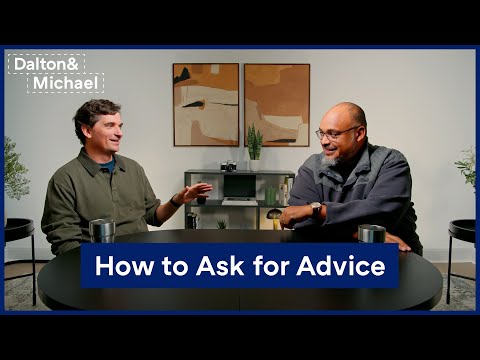
How To Get Better Advice
Dalton Caldwell (host), Michael Seibel (host)
In this episode of Dalton + Michael, featuring Dalton Caldwell and Michael Seibel, How To Get Better Advice explores how founders can ask for advice that actually helps them Start advice conversations by explicitly stating what kind of help you want (decision-making, validation, tactics, or emotional support).
How founders can ask for advice that actually helps them
Start advice conversations by explicitly stating what kind of help you want (decision-making, validation, tactics, or emotional support).
Vague, open-ended prompts produce random or low-value guidance, so founders should come with an agenda and a clear definition of meeting success.
Good advisors also set boundaries on what they can’t answer well (e.g., predicting customers, summarizing an entire industry, or doing broad investor lists).
The most valuable advice often comes from identifying the “real problems” that cause anxiety (including morale and burnout), not superficial or filler topics.
Founders should assess an advisor’s actual strengths using signals like operating background, technical interests, and portfolio patterns rather than surface-level bios.
Key Takeaways
Ask upfront what kind of advice session this is.
Before diving in, clarify whether you want a pep talk, help making a decision, tactical debugging, or simply space to talk through hard feelings; it prevents misalignment and wasted time.
Get the full analysis with uListen
Don’t “shop for advice” to get permission for a decision you already made.
If you’ve decided to accept an acquisition offer (or reject it), recognize when you’re seeking validation and either own the decision or directly ask for the specific support you want.
Get the full analysis with uListen
Bring a tight agenda or you’ll get random advice.
Open-ended prompts like “tell me what to do” invite scattered feedback; specific questions (e. ...
Get the full analysis with uListen
Surface the core issue early, not in the last two minutes.
Founders often avoid the real topic (runway, cofounders leaving, shutdown thoughts) and discuss minor items instead; naming the “aorta problem” unlocks the meeting’s real value.
Get the full analysis with uListen
Good advice givers draw a border around what they can’t answer.
Advisors can help prioritize and pressure-test thinking, but they often can’t reliably answer things like “what customers want” without context; explicit scope keeps advice high-quality.
Get the full analysis with uListen
Use the “lawyer rule”: state what you want plus constraints.
Like managing lawyers, advisors work best when you specify the outcome and limits (time, risk tolerance, non-goals) so they don’t wander into irrelevant detail.
Get the full analysis with uListen
Match questions to the advisor’s real expertise, not their headline bio.
A superficial label (“music guy”) may hide the person’s strongest value (growth, hiring/firing, fundraising, developer tools); look at operating history, technical signals, and portfolio to infer strengths.
Get the full analysis with uListen
Notable Quotes
“What kinda office hours is this? What advice do you wanna hear from me?”
— Dalton Caldwell
“If you already know what you wanna do… just like, do the thing.”
— Michael Seibel
“Tell the lawyer what you want and give them constraints. And then ask for legal advice.”
— Dalton Caldwell
“Hey, we’ve been shot eight places… Can we talk about the sprained ankle?”
— Michael Seibel
“The quality of what you give us is the only factor in the quality of what we give you back.”
— Dalton Caldwell
Questions Answered in This Episode
In the acquisition-offer example, what are the best ways to distinguish “I want validation” from “I genuinely need help deciding” in a single meeting?
Start advice conversations by explicitly stating what kind of help you want (decision-making, validation, tactics, or emotional support).
Get the full analysis with uListen AI
What’s a concrete agenda template founders can use for advisor meetings (including a section for morale/mental state) without turning it into rambling therapy?
Vague, open-ended prompts produce random or low-value guidance, so founders should come with an agenda and a clear definition of meeting success.
Get the full analysis with uListen AI
How should an advisor tactfully redirect a founder when the agenda is clearly a “sprained ankle” while the business has an “aorta” problem?
Good advisors also set boundaries on what they can’t answer well (e. ...
Get the full analysis with uListen AI
What are the most useful “constraints” to provide when asking for fundraising advice (e.g., timeline, dilution tolerance, runway, desired investor type)?
The most valuable advice often comes from identifying the “real problems” that cause anxiety (including morale and burnout), not superficial or filler topics.
Get the full analysis with uListen AI
What signals should founders use to infer an advisor’s true expertise beyond their bio—portfolio, operating roles, technical output, public writing—and which is most reliable?
Founders should assess an advisor’s actual strengths using signals like operating background, technical interests, and portfolio patterns rather than surface-level bios.
Get the full analysis with uListen AI
Transcript Preview
If I'm super honest, what are the three things in my business that kinda gave me a stomachache? And to your point, one of them often is, I'm not having fun.
Yeah. [laughs]
Like, we're, we're-
This-
We have low morale.
Yeah. [laughs]
We feel bad.
Yeah.
And we wanna talk about it, and that's totally cool. Like, that's-
On the agenda. [laughs]
Let's do it. Like-
Yeah. [laughs]
Let's talk through it. [upbeat music]
All right. Welcome to Dalton + Michael. Today, I think we're gonna ask a question that I think as office hour givers we've learned to ask ourselves quite a bit. When a founder comes in to talk to us, I think the question we sometimes ask ourselves is, exactly what advice does this person want? [laughs]
Yeah. Well, and here's-
What are we gonna be doing today? [laughs]
I'll just, I'll just ask them.
[laughs]
I'd be like, what kinda office hours is this? What advice do you wanna hear from me? Let me start off with, like, a really common example I hear.
Please.
Which is, they'll be like, "Oh, we got an offer to get acquired."
Yes.
"What do you think we should do?" And I will say, "Look, let's be real. Is what's going on here you've already decided that you're gonna do it-
Yep
... and that you just wanna tell me about it-
Yes
... in a roundabout way, and you want me to be excited for you?
Yes. Or...
Or, do you not wanna do it and you just need the pep talk that it's a good idea to not take it?
Exactly.
So I've just learned to ask that at the front of the office hours. [laughs] And it's, it's actually helpful for both parties to know which way they wanna take it, right?
It's funny, because we have this concept in YC called shopping for advice, right? And we often say some version of, if you already know what you wanna do, y- you know, step one isn't go talk to a bunch of advisors and find one who agrees with you. [laughs] Like, just like, do the thing.
Just do it.
Like, do the thing.
Yeah.
Where I get in trouble as an advice giver is when the topic is meta advice and I don't realize it. Like, when the topic is, like, I want a cheer-up, and I think the founder actually wants to talk about practical things to do-
Yeah
... in their startup, you know? And I'm sitting here trying to get details, and they're really trying to tell me, "I'm thinking about shutting it down."
Right. [laughs]
In which case, like, the design of the front page is not really the talk. [laughs] You know, it's like-
No, and then what they'll do is they'll bring it up in the final two minutes. They'll be like, "Oh, by the way, three of the four founders are leaving," and, you know. [laughs] Don't you love those-
Install uListen to search the full transcript and get AI-powered insights
Get Full TranscriptGet more out of YouTube videos.
High quality summaries for YouTube videos. Accurate transcripts to search & find moments. Powered by ChatGPT & Claude AI.
Add to Chrome