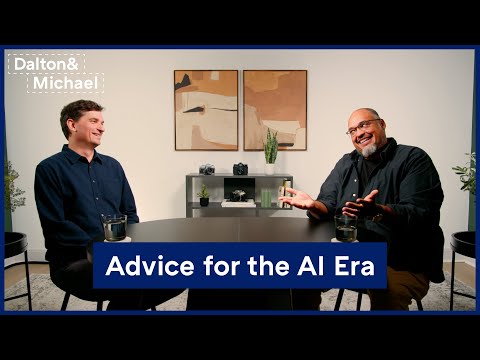
How Impatient Should Founders Be In The Pre-AGI Era?
Dalton Caldwell (host), Michael Seibel (host)
In this episode of Dalton + Michael, featuring Dalton Caldwell and Michael Seibel, How Impatient Should Founders Be In The Pre-AGI Era? explores balance urgency and patience when building startups in AI era They argue that the AI era rewards early movers who deliberately choose what to learn and build, but that doesn’t invalidate the timeless reality that great work takes years.
Balance urgency and patience when building startups in AI era
They argue that the AI era rewards early movers who deliberately choose what to learn and build, but that doesn’t invalidate the timeless reality that great work takes years.
They push back on “doomsday/AGI-pilled” urgency that encourages abandoning long-term paths (school, careers, hard startups) in favor of frantic, short-term optimization.
They note a cultural drift toward “casino-ification” (sports betting, crypto, options) that conditions people to expect wealth and success from quick hits rather than sustained compounding.
They explain that founders must hold a productive contradiction: move with hair-on-fire urgency while emotionally preparing for long, difficult execution.
They warn against searching for a startup “cheat code” or rigid playbook (an “MBA-ification” mindset), emphasizing that startups remain luck-influenced, high-variance, and non-formulaic.
Key Takeaways
Be early on AI skills, but don’t confuse speed with shortcuts.
Learning the new tools and positioning yourself early can create outsized leverage, but it won’t remove the multi-year nature of building something real.
Get the full analysis with uListen
Treat “end-times” AGI narratives as emotionally compelling, not strategy-proof.
They suggest doomsday framing can become pseudo-religious and distort decision-making into reckless “break glass” behavior rather than thoughtful prioritization.
Get the full analysis with uListen
Hold two truths: urgency in pace, patience in outcomes.
Founders should push themselves and their environment to move fast, while also building resilience for long timelines so they don’t panic-quit when progress is slow.
Get the full analysis with uListen
If the problem is important, it will often feel hard and messy.
They criticize the instinct to abandon tough customer problems in search of “easier” ones, comparing it to misreading hard SAT questions as a sign you’re doing it wrong.
Get the full analysis with uListen
Don’t benchmark success by intermediate milestones like fundraising speed.
They argue that raising a Series A is not “winning,” and may still imply a very high chance of failure; the finish line is enduring value, not optics.
Get the full analysis with uListen
Ignore the desire for a rigid startup formula or “guidebook.”
Startups are high-variance and luck-influenced, unlike roles designed for standardized best practices; trying to follow a fixed recipe can replace judgment with cargo-culting.
Get the full analysis with uListen
Optimize for enjoyment to sustain long-term excellence.
Their closing advice is that people rarely persist through years of difficulty without intrinsic motivation; fun enables the stamina required for exceptional work.
Get the full analysis with uListen
Notable Quotes
“Look at the 20 software companies that you respect the most. Tell me which one of those blew up super fast. Which one was like, they made it in a year?”
— Michael Seibel
“You have to simultaneously be impatient and ambitious… and at the same time… hold the idea that doing great work takes a long time.”
— Dalton Caldwell
“Everything that is valuable is hard, but not everything that is hard is valuable.”
— Michael Seibel (citing Peter Thiel)
“Raising a Series A means you have a 90% chance of death.”
— Michael Seibel
“Make sure that you’re having fun… I have not seen people be able to stick with hard challenges for a long time when they’re not having fun.”
— Michael Seibel
Questions Answered in This Episode
What are concrete examples of “being early” on AI that are actually durable advantages (not just trend-chasing)?
They argue that the AI era rewards early movers who deliberately choose what to learn and build, but that doesn’t invalidate the timeless reality that great work takes years.
Get the full analysis with uListen AI
How should a founder decide when “impatience” means pivoting versus when it means pushing through a hard-but-valuable problem?
They push back on “doomsday/AGI-pilled” urgency that encourages abandoning long-term paths (school, careers, hard startups) in favor of frantic, short-term optimization.
Get the full analysis with uListen AI
What signals tell you a hard customer problem is truly valuable, versus merely complicated or distracting?
They note a cultural drift toward “casino-ification” (sports betting, crypto, options) that conditions people to expect wealth and success from quick hits rather than sustained compounding.
Get the full analysis with uListen AI
If Series A isn’t a meaningful endpoint, what milestones should founders use to measure real progress in the first 12–24 months?
They explain that founders must hold a productive contradiction: move with hair-on-fire urgency while emotionally preparing for long, difficult execution.
Get the full analysis with uListen AI
How do you counteract the ‘casino-ification’ mindset in a founding team that expects fast wins and constant dopamine hits?
They warn against searching for a startup “cheat code” or rigid playbook (an “MBA-ification” mindset), emphasizing that startups remain luck-influenced, high-variance, and non-formulaic.
Get the full analysis with uListen AI
Transcript Preview
If all of your norms are the way to get rich is to just make short-term bets, you actually may know, know more people in your real life that made money from short-term bets-
Yes
... than long-term bets.
Yes. Look at the 20 software companies that you respect the most. Tell me which one of those blew up super fast. Which one was like, they made it in a year?
None.
And like, what does that, what does that mean? [laughs]
[laughs] Why?
[upbeat music] All right. This is Dalton + Michael, and we're gonna talk about some advice for young people now that we're in this AI era.
Yeah.
This is the AI era, right?
Yeah. We're, we're in the AI era.
In the AI-
It's hard to be in the era when you're in it.
I think-
But we're in it
... we might be.
Yeah. We're in it.
I'm gonna set this up, Dalton. I'm gonna give you the controversial first thing to bounce off of. Super intelligent is imminent. We might be entering the, you know, end of days. How much of the pre-A advice even applies anymore? N- you know, I'm a young person. Like, are we not in a break glass in case of emergency zone where I need to ignore everything and just like go nuts, start my company, do whatever I'm gonna do, like-
Yeah
... like, like you know, it's like time is of the essence.
I mean, look, in some ways time is of the essence in that if you're paying attention to what's going on, and you're learning the tools, and you're in the right place at the right time-
Mm-hmm
... it's a really good move. Um, and so there is a, there actually is an argument that being strategic about what you spend time on, who you spend time on, what you learn-
Yeah
... is smart.
Especially in the beginning of an era.
Right?
You get a lot of extra juice if you're early on a skill set in the beginning of an era, right?
Yeah.
So that's, that is totally true, and you should think about that, and we can talk about that in a second.
In addition, though, I think there's something about doomsday culture, I don't know what you wanna call it, but there's something about kinda pseudo-religious stuff that gets people going that they just happen to be alive in the time that the world is going to end, and that if they do a good thing, then they'll be rewarded for it, and then everyone else is in trouble.
Yeah. This rhymes with some things in humans' past.
Yeah. Yeah. Sounds familiar, right?
[laughs] Yeah.
Um, and certainly, you know, to... Let me try to steelman a little bit. Certainly, I've talked to people that believe that they have a short window to try to make their way in the world and make money before AGI happens, and it'll be much harder in a post-AGI world for them to be set up. I'm trying to steelman that argument, but I've heard people make it.
Install uListen to search the full transcript and get AI-powered insights
Get Full TranscriptGet more out of YouTube videos.
High quality summaries for YouTube videos. Accurate transcripts to search & find moments. Powered by ChatGPT & Claude AI.
Add to Chrome