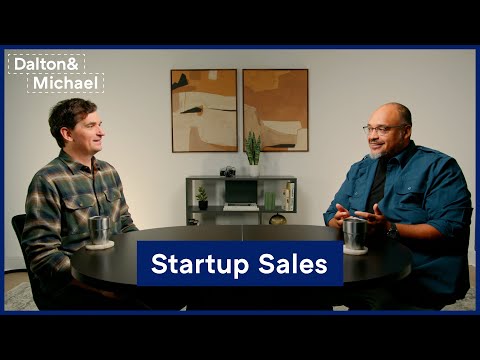
How Great Founders Approach Sales
Dalton Caldwell (host), Michael Seibel (host)
In this episode of Dalton + Michael, featuring Dalton Caldwell and Michael Seibel, How Great Founders Approach Sales explores great startup sales means solving customer problems, not tactics-driven pitching They argue that the best sales doesn’t feel like “sales,” but like a helpful, responsive partner solving a real customer problem.
Great startup sales means solving customer problems, not tactics-driven pitching
They argue that the best sales doesn’t feel like “sales,” but like a helpful, responsive partner solving a real customer problem.
They highlight frequent founder mistakes such as monologuing feature lists, relying on discounts, and trying to get paid without being sure they can deliver value.
They emphasize deep customer empathy—actually understanding the customer’s business, pressures, and goals—as the core skill behind effective selling.
They warn against the misconception that hiring a VP of Sales replaces founder involvement, especially in enterprise-style B2B where CEOs often drive major deals.
They challenge the blanket fear of “consulting,” suggesting early custom work and deep integrations can be a learning path and even a moat if it productizes over time.
Key Takeaways
Great sales feels like help, not persuasion.
They describe the best sales experiences as service-provider interactions: fast, empathetic, and focused on fixing a real problem—so smooth it doesn’t register as being “sold to.”
Get the full analysis with uListen
If you can’t create value, you’re not doing trade.
Trying to sell something you don’t believe will benefit the customer is framed as fundamentally misaligned with the idea of trade, where both parties should end up better off.
Get the full analysis with uListen
Discounts don’t create desire; they create suspicion.
If the customer doesn’t understand value, cutting price won’t fix it and can backfire (“What’s wrong with this burrito? ...
Get the full analysis with uListen
Stop feature-dumping; start diagnosing.
Founders often default to a monologue and feature list, but the strongest sellers listen, say less, and aim for the customer to feel relief because the real issue got solved.
Get the full analysis with uListen
Customers often don’t know what to ask for—your job is to reframe.
Taking a customer’s requested checklist at face value can be a trap; treat the conversation as problem-solving about what will actually improve their business, not order-taking.
Get the full analysis with uListen
“Put yourself in the customer’s shoes” must be literal, not performative.
They recommend a method-acting level exercise: imagine their inbox, boss pressure, upcoming meetings, and top business problems—because many founders can’t even describe the customer’s business.
Get the full analysis with uListen
You can’t outsource founder-led sales too early, especially in enterprise.
Hiring a VP of Sales doesn’t replace a founder-originated playbook; big deals often require CEO-level access and sponsorship, with sales teams acting as a multiplier around founders rather than separate from them.
Get the full analysis with uListen
Fear of ‘consulting’ is often overapplied; the real risk is dead-end revenue.
The true anti-consulting warning is about building bespoke, non-repeatable software (e. ...
Get the full analysis with uListen
Notable Quotes
“Good sales is so good it doesn't feel like sales.”
— Dalton Caldwell
“I think that founders may resolve themselves they need to do sales... but they deep down are still thinking about the used car salesman somewhere.”
— Dalton Caldwell
“Good sales is good problem-solving.”
— Michael Seibel
“Are you trying to help your customer, or are you just trying to accomplish your goals, and your customer's goals are incidental? ... you'll never win.”
— Michael Seibel
“The sales organization is almost built around the founders... as a multiplier effect on their work, as opposed to built to the side of them.”
— Michael Seibel
Questions Answered in This Episode
In a first sales call, what specific questions would you ask to avoid the ‘feature monologue’ and get to the customer’s real problem faster?
They argue that the best sales doesn’t feel like “sales,” but like a helpful, responsive partner solving a real customer problem.
Get the full analysis with uListen AI
How do you determine whether a customer request is a valuable ‘gray area’ integration versus a Disney-style bespoke dead end that won’t generalize?
They highlight frequent founder mistakes such as monologuing feature lists, relying on discounts, and trying to get paid without being sure they can deliver value.
Get the full analysis with uListen AI
What are the strongest signals that discounting is being used to mask unclear value—and what should founders do instead in that moment?
They emphasize deep customer empathy—actually understanding the customer’s business, pressures, and goals—as the core skill behind effective selling.
Get the full analysis with uListen AI
If a founder ‘doesn’t know the customer’s business,’ what’s the minimum research or discovery process you’d require before pitching?
They warn against the misconception that hiring a VP of Sales replaces founder involvement, especially in enterprise-style B2B where CEOs often drive major deals.
Get the full analysis with uListen AI
Where is the practical boundary between founder-led sales and bringing in a VP of Sales—what milestones indicate a repeatable playbook exists?
They challenge the blanket fear of “consulting,” suggesting early custom work and deep integrations can be a learning path and even a moat if it productizes over time.
Get the full analysis with uListen AI
Transcript Preview
If I'm trying to sell you a burrito you don't want-
Yeah, yeah
... trying to keep cutting the price doesn't make you want the burrito.
No.
If anything, it make, it makes it kinda worse if you keep discounting it-
100% worse
... 'cause you're like, "What's wrong with this burrito?"
Yes. [laughs] [upbeat music] All right. Welcome to Dalton + Michael. Today we're gonna talk about startup sales, and specifically mess-ups, screw-ups, misconceptions. Like, I think that, uh, instead of trying to make a sales 101 style video, we wanna make it more entertaining by talking-
[laughs]
... about when people screw up. And, uh, that's always the most fun stuff. So when you're in office hours with a founder and you're just sitting here, you know, you're hearing kind of, kind of a, a ho-hum story, something didn't work, and then, like, you just hear something that makes you cringe.
[laughs]
You're just like, "Eh." [laughs] Like, tell an example of that, like where you're just like, "Oh."
Look-
[laughs]
... I certainly was the type of founder who wasn't excited about the concept of sales, and I had a lot of cartoonish ideas-
Fair
... about what sales looks like, right? You picture, like, a used car salesman or an insurance salesman or just, like, a high-pressure, um-
Yeah
... timeshare salesman. Oh, you love those, right? And so I'm like, "Man, I never wanna do that. That's bad."
Yes.
I think that founders may resolve themselves they need to do sales, like it's a nec- necessary thing.
Yeah.
But they deep down are still thinking about the used car salesman-
Yeah
... somewhere.
It's like they never had a canonical example of good sales.
It's like this. It's that good sales is so good it doesn't feel like sales.
Yeah. Yes.
Like, think about service providers.
Yeah.
You know, I've, I've had good service providers.
Yes.
You just kinda email them with a problem, and they're like, "Yeah."
Yeah.
"You have a problem? Like, let's fix it. Let's do the thing that you wanna do."
Yes.
And they're super responsive, and they're really nice, and they understand where you're coming from.
Yeah.
And those people are totally making money off me. [laughs]
[laughs]
Those people are selling me a product. But when I'm interacting with these people, it feels like, they're not a friend, but it feels like someone-
A colleague
... that knows me. They understand me.
Yeah, a partner.
I present a problem to them, and they're in a position to help me with a good or service.
Yes.
And we both walk away feeling really good about the-
Yes
... the transaction.
Yes.
That's good sales.
Yes.
And it's so good that it would never register in my brain as that's a salesperson selling me something.
Which is so weird, 'cause I'm like, well, is, there isn't another word for that. [laughs] Like, there isn't, like, another word, it's just... It's almost like, oh, this was all my idea. Like, this was all... Like, it was just like-
Install uListen to search the full transcript and get AI-powered insights
Get Full TranscriptGet more out of YouTube videos.
High quality summaries for YouTube videos. Accurate transcripts to search & find moments. Powered by ChatGPT & Claude AI.
Add to Chrome