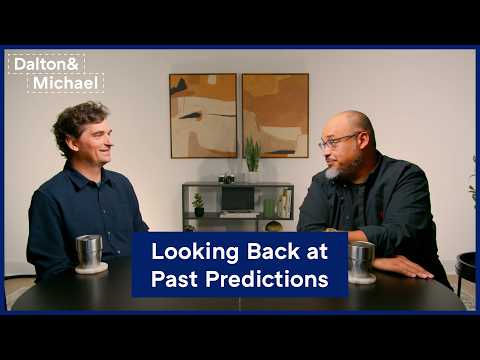
Shockingly Good Predictions
Dalton Caldwell (host), Michael Seibel (host)
In this episode of Dalton + Michael, featuring Dalton Caldwell and Michael Seibel, Shockingly Good Predictions explores startup lessons from surprisingly right bets on markets, talent, incumbents They revisit how underestimating the US as a venture-return engine was a correctable blind spot, while noting standout international successes like India’s Groww and Razorpay.
Startup lessons from surprisingly right bets on markets, talent, incumbents
They revisit how underestimating the US as a venture-return engine was a correctable blind spot, while noting standout international successes like India’s Groww and Razorpay.
They discuss Sam Altman’s early focus on nuclear power and the broader thesis that abundant electricity becomes a critical bottleneck, now echoed by AI’s energy demands.
They argue that intelligence and ambition compound over time, making “smart people win” a more predictive framework than social status or early-life “coolness.”
They emphasize that seemingly unassailable incumbents can rot from within and collapse quickly, so startups should look for hidden fragility rather than assume permanence.
They explain why revenue generation is rewarded more than cost-cutting—by customers and public markets—making “save five engineers” pitches far weaker than founders expect.
Key Takeaways
The US market is structurally easier for outsized venture outcomes.
Seibel admits he dismissed a data-backed claim that ~97% of venture returns come from the US; the takeaway is not “ignore international,” but to price in the US’s unusually large, liquid, and repeatable scaling environment.
Get the full analysis with uListen
Naivety can be an edge when “smart money” has blinders.
They suggest YC backed Indian decacorns partly because they weren’t “sophisticated enough” to avoid them; founders/investors can benefit from questioning inherited rules about what’s fundable.
Get the full analysis with uListen
Energy abundance is a durable, cross-cycle macro thesis.
Altman’s 2013 pivot toward nuclear is reframed as seeing the real limiting input—electricity—years before AI made the constraint obvious; founders can look for similarly foundational bottlenecks.
Get the full analysis with uListen
Talent attraction is a core company-building mechanic, not fluff.
Beyond product/market/pricing checklists, Seibel stresses that an exciting mission recruits exceptional people and capital; ambitious narratives can make “impossible” projects feasible by concentrating top talent.
Get the full analysis with uListen
Assume incumbents are mortal and search for internal rot.
They cite Yahoo! ...
Get the full analysis with uListen
Treat hype cycles like weather: inevitable, sometimes useful, often noisy.
Caldwell describes learning to stop moralizing about bubbles (e. ...
Get the full analysis with uListen
B2B buyers and markets reward revenue growth far more than cost savings.
They argue “save five engineers” rarely matches real procurement behavior, and public markets prize credible attempts to become 10× bigger; cost-cutting only works when savings are massive, immediate, and measurable (and even then, headcount often just reallocates).
Get the full analysis with uListen
Notable Quotes
“Companies like Google could become completely irrelevant.”
— Dalton Caldwell
“They have to keep winning.”
— Michael Seibel
“There’s something beautiful about being naive.”
— Michael Seibel
“It’s like being mad about the weather.”
— Dalton Caldwell
“If you can’t attract the smartest people, you can’t even make the possible happen.”
— Michael Seibel
Questions Answered in This Episode
What specific structural factors (capital markets, customer budgets, distribution, regulation) make US scaling “not just as easy” elsewhere, and which of those are changing?
They revisit how underestimating the US as a venture-return engine was a correctable blind spot, while noting standout international successes like India’s Groww and Razorpay.
Get the full analysis with uListen AI
YC funded major Indian companies despite the conventional wisdom—what signals today look “unfundable” but might be the next Groww/Razorpay pattern?
They discuss Sam Altman’s early focus on nuclear power and the broader thesis that abundant electricity becomes a critical bottleneck, now echoed by AI’s energy demands.
Get the full analysis with uListen AI
On the energy thesis: what would you watch to decide whether nuclear (vs solar/storage, gas, grid upgrades) is the best path to “unlimited electricity” for AI?
They argue that intelligence and ambition compound over time, making “smart people win” a more predictive framework than social status or early-life “coolness.”
Get the full analysis with uListen AI
When evaluating an incumbent, what concrete indicators suggest “rotting from within” rather than simply being mature (e.g., product velocity, talent drain, internal incentives)?
They emphasize that seemingly unassailable incumbents can rot from within and collapse quickly, so startups should look for hidden fragility rather than assume permanence.
Get the full analysis with uListen AI
Microsoft is cited as a big-company comeback—what were the pivotal decisions (cloud, VS Code, GitHub) that signaled genuine renewal vs superficial PR?
They explain why revenue generation is rewarded more than cost-cutting—by customers and public markets—making “save five engineers” pitches far weaker than founders expect.
Get the full analysis with uListen AI
Transcript Preview
Companies like Google could become completely irrelevant.
Yeah.
Or they could just become juggernauts even-
Yeah
... more.
Yeah.
They're not like institutions that are gonna last no matter what happens. That's what I'm trying to say.
Yes.
I think they seem, like, infallible.
Yes.
They felt like, I don't know.
They have to keep winning.
Yes. [laughs]
[laughs]
Yes.
This is Dalton + Michael. Today, we're gonna talk about predictions that turned out way better than we ever could have imagined, specifically ones that maybe in hindsight look a little bit more obvious, but at the time o- one or both of us didn't quite rock. I remember one of YC's LPs, um, very large LPs, said to me, "Historically, the venture market, something like 97% of returns are generated in the US market." And I remember thinking to myself, like I always do, like, "Eh, that doesn't really align with my current thesis, so I don't believe it." [laughs]
[laughs] Discard. Opinion discarded.
[laughs]
Brr.
You know, it's a superpower for a startup founder. [laughs]
Brr.
I'm embarrassed I didn't realize how good the US was. We're so privileged to live in a market that is kinda just really big.
Yep.
That I could just blind myself to my own privilege and be like, "No, it's just as easy to build a billion-dollar company somewhere else." And it's like, is it? No. It's not. Not that you can't do it. It's just not just as easy.
It's definitely not.
It's not just as easy. What were your thoughts, by the way, back then? 'Cause, like, we invest in a lot of international companies.
Yeah, we did. Um-
So, domestic.
I think-
Some of them are doing really well.
Some of them are.
Yes.
Like, we, we just had a bunch of Indian companies, um, doing phenomenally well.
Yeah.
Like, Groww just went public, which was a really big deal in India.
Yes.
So that's a counterexample. But yeah, I think you're right. I think I just didn't know. I think that a lot of folks that are investors are basically specialized finance people.
Mm-hmm.
And I don't mean that in a negative way.
Mm-hmm, mm-hmm.
But it's... I, I just am stating the truth, which is if you, if you're, like, a stock trader or, like, a private equity person-
Yeah
... I think you're more attuned to this.
Yes.
We were just startup founders. There was never a time at our startups that we had to worry about-
[laughs]
... capital markets in India.
At our US-based startups. [laughs]
Like, this, this was just... We were just trying to fund smart people.
But weirdly, I think that's why we got to fund Groww-
Yes
... and Razorpay-
Yes, yes
... and Nisha.
Yes, yes, yes.
Like, all of these decacorns in India.
Yes.
I think it's because we weren't sophisticated enough to know that we're not supposed to fund that stuff.
Yeah. [laughs]
[laughs] Like, we didn't get the memo-
Install uListen to search the full transcript and get AI-powered insights
Get Full TranscriptGet more out of YouTube videos.
High quality summaries for YouTube videos. Accurate transcripts to search & find moments. Powered by ChatGPT & Claude AI.
Add to Chrome