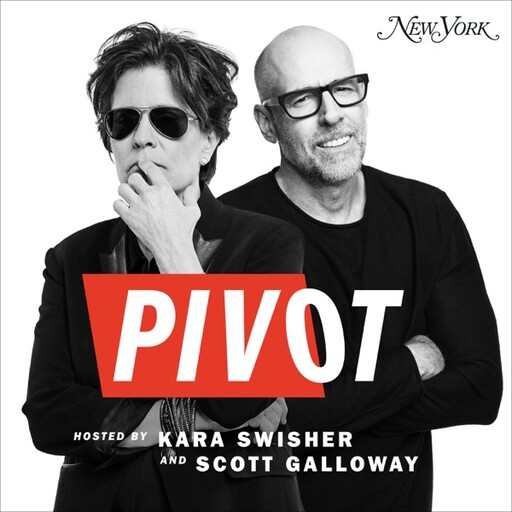
 Pivot
PivotKash Patel Defends FBI's New Policy on Bestiality. Kara and Scott Have Questions.
At a glance
WHAT IT’S REALLY ABOUT
From Sydney Sweeney backlash to AI fear and political theater
- Kara Swisher and Scott Galloway open with tour news and a sharp debate over Sydney Sweeney’s controversial ads, using the backlash to explore culture-war dynamics and career strategy.
- Jessica Tarlov joins to discuss her book on constructive disagreement and applies its tactics to Canada’s Mark Carney pursuing closer alignment with the EU amid Trump’s tariff threats.
- The hosts argue a potential Universal retreat from distributing an Elon Musk documentary illustrates a chilling effect on journalism when political retaliation becomes a business risk.
- They critique Mark Zuckerberg’s AI-safety stance as self-serving, arguing liability and competition are insufficient and calling for meaningful government oversight of frontier AI.
- The episode closes with bipartisan-populist concern about AI (Bernie Sanders and Steve Bannon) and a surreal segment on Kash Patel defending an FBI policy tied to bestiality, framed as institutional decline and political theater.
IDEAS WORTH REMEMBERING
5 ideasThe Sydney Sweeney ad fight is really about status, agency, and how we police sexuality in media.
Swisher argues the ads are creatively weak and risk pigeonholing Sweeney, while Galloway argues the backlash is overblown and ignores the commercial logic—especially if she has equity in the brand. The exchange becomes a stand-in for a larger debate about cultural “double standards” vs. simple taste and judgment.
Canada’s EU alignment is portrayed as a rational response to U.S. unpredictability, not an anti-U.S. provocation.
Tarlov frames Carney’s approach as a practical model: begin with a cooperative tone, move to facts and shared interests, and escalate only when the other side proves unresponsive. The Trump tariff threat is treated as a catalyst for allies to diversify away from U.S. dependence rather than as a serious negotiating strategy.
“Disagree better” is presented as a learnable skill with tactics—soft starts, data, audience awareness, and boundaries.
Tarlov emphasizes listening, avoiding constant interruption, and recognizing when style attacks signal you’re winning on substance. She also notes some relationships are not salvageable, suggesting strategic disengagement can be healthier than endless “debate.”
The Musk documentary story is framed as evidence that powerful figures can quietly reshape media incentives.
They argue Universal/Comcast potentially delaying the Musk documentary signals a broader “chilling effect” where fear of retaliation—especially from Trump-aligned power centers—changes what gets distributed. The point isn’t whether the film is fair; it’s the precedent of self-censorship under political/commercial threat.
The hosts see self-regulation on AI safety as structurally inadequate—power, speed, and incentives overwhelm goodwill.
Zuckerberg’s claim that competition and liability are sufficient guardrails is rejected as “grade your own homework,” given the scale of capital and the difficulty of litigating harms. They liken AI to a Manhattan Project with quarterly earnings calls and argue external oversight (embedded regulators, enforceable rules) is missing.
WORDS WORTH SAVING
5 quotesAmerica being indignant here and s- calling it an act of hostility is like, uh, you know, someone who's in an abusive relationship, and then the husband finds out, what do you know, she's downloaded Hinge.
— Scott Galloway
This is a hinge in history. We have to handle this right, correctly. To handle it correctly, number one, we can never trust what a oligarch says, because all they do, they're disingenuous and they lie.
— Steve Bannon
Meta alone is gonna spend $150 million of CapEx this year, so that's, that's not a company. It's a Manhattan Project with quarterly earnings calls.
— Scott Galloway
Here's what I do know. I don't trust any of them, not a one of them.
— Kara Swisher
We touch more people and have benefit from more relationships before 9:00 AM than any medieval king had in his entire lifetime. Modern prosperity is a team sport, uh, disguised as individual achievement, and this is what this president does not understand.
— Scott Galloway
High quality AI-generated summary created from speaker-labeled transcript.



