Jensen Huang's podcast appearances: which to watch and why
Start with his Lex Fridman conversation, or sample seven stretches in a crash course of about 81 minutes.
Every quote checked against its transcript
If you watch one
From the CUDA bet to how he handles pressure
 Play episode
By playing, you agree to uListen's Terms and Privacy Policy and YouTube's Terms of Service.
CUDA on GeForce, 11:27 · Power and the grid, 37:59 · Handling pressure, 1:35:38
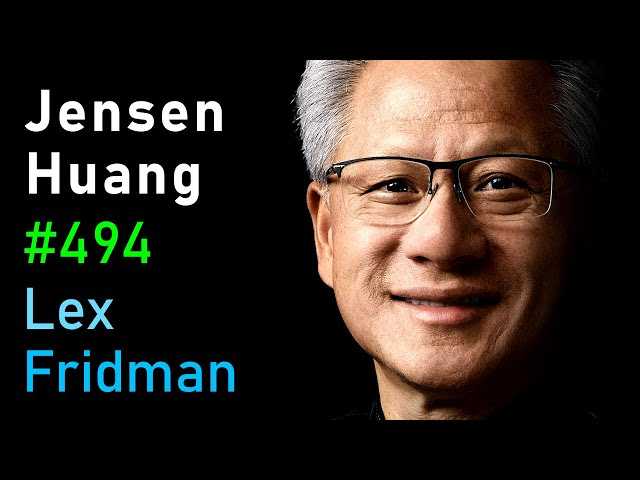
Lex Fridman Podcast (March 23, 2026). In 146 min, Lex Fridman asks broad questions and lets Huang reason aloud: why Nvidia put CUDA on every gaming GPU at the cost of its margins, the four scaling laws he counts, how a power grid that often sits partly idle could feed AI, and why he thinks China innovates so fast. The last hour turns personal, with how he handles pressure and setbacks, his claim that AGI is already here by Fridman's own definition, and his hope to die on the job. No other episode here covers as much of his thinking, technical and personal, in one sitting.
On uListen: summary · chapters · transcript
Or start with
 13 min
Curious about his life and Nvidia's near-death years
The Joe Rogan Experience (December 3, 2025). Joe Rogan lets him tell his immigrant childhood in Kentucky and the rescues that kept Nvidia alive, including how he asked Sega's CEO to invest after admitting Nvidia's technology was wrong (1:19:28 to 1:32:53, 13 min).
 12 min
Investing, or worried about an AI bubble
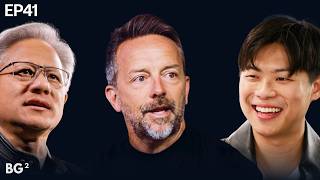
Bg2 Pod (October 15, 2026). Brad Gerstner asks whether AI revenue can justify the spending, and Huang answers with a three-way split of who actually buys Nvidia's compute (1:00:34 to 1:12:39, 12 min).
 17 min
Want to see him pushed hard
Dwarkesh Podcast (April 15, 2026). Dwarkesh Patel presses him on TPUs, supply chains and chips for China, and he makes his case for selling chips to China under sustained pushback (57:37 to 1:14:20, 17 min).
one course
Want the best stretches back to back
The crash course. Seven clips from seven episodes, played one after another.
A guided watch
The Jensen Huang crash course
Seven stretches from seven episodes: the founder first, then the business, then what he thinks AI means for everyone else.
Total: about 81 minutes.
Play all · 81 minThe founder
- A boy sent to Kentucky 13 min
2:04:28 to 2:17:46, 13 min of The Joe Rogan Experience (December 3, 2025): how he ended up at a Kentucky boarding school at nine, the cassette tapes he and his brother recorded for their parents, and the family's struggle once his parents arrived.
- The chip that had to be perfect 9 min
3:03 to 12:07, 9 min of Acquired ft. Ben Gilbert & David Rosenthal (October 16, 2023): the 1997 Riva 128 launch with the company running out of money, the emulator bought from a company closing that day, and why he says the lesson is pulling risk forward, not betting the company.
- Founder advice he hesitates to give 5 min
42:33 to 48:02, 5 min of No Priors ft. Sarah Guo & Elad Gil (April 25, 2023): why he calls ignorance an entrepreneur's superpower, why you must believe both that you are right and that you could be wrong, and the quarter Nvidia missed by about $2 billion.
The business
- Why CUDA still matters 15 min
25:58 to 41:06, 15 min of Dwarkesh Podcast (April 15, 2026): why CUDA counts even for labs that write their own kernels, his challenge to TPUs and Trainium to show their numbers on public benchmarks, and his admission that not investing early in Anthropic was his mistake.
- AI factories and the bubble question 11 min
15:04 to 26:25, 11 min of Sequoia Capital (October 14, 2025): delivering the first DGX-1 to OpenAI, why performance per watt sets a customer's revenue, and why he says this is not the 2000 dot-com bubble.
AI and everyone else
- Task versus purpose 10 min
4:57 to 15:13, 10 min of No Priors ft. Sarah Guo & Elad Gil (January 8, 2026): the radiology prediction that went wrong, the three new kinds of plants AI needs, and why he expects a billion robots to create the largest repair industry on the planet.
- Safety as engineering 16 min
30:36 to 46:43, 16 min of Bg2 Pod (October 15, 2026): why he calls alignment a forever problem, how zero trust and out-of-band monitoring would contain AI, and his view of the new US oversight structure.
Lately
Seven of the 14 episodes come from the last twelve months, from December 3, 2025 to October 15, 2026. Compared with the earlier seven, they spend more time on agents, jobs and safety, and the two longest, with Joe Rogan and Lex Fridman, are also his most personal here.
- 1:50:12He says fear of failure drives him more than the wish to succeed
- 9:09The radiologist story and his test of a job's tasks against its purpose, absent from the earlier episodes, now come up on five shows (see Stories he tells)
- 16:19Agents get a security rule: two of three powers (sensitive data, running code, outside communication), never all three at once
- 34:46His most detailed safety plan: contain new AI with zero trust and monitor it out of band, which he says Nvidia is building with more than 100 partner companies
- 1:01:55He calls Nvidia's move into mobile chips a genuine strategic mistake
- 38:56He names not investing early in Anthropic as his own miss
“But, um, I'm not gonna make that same mistake again.”
Huang on ...
Jensen Huang on accelerated computing, co-design and CUDA
Huang argues that general-purpose processors have run their course, so speed now comes from accelerating whole systems, with chips, networking, software and algorithms designed together. The craft, he says, is staying general enough to run many workloads while still beating the CPU by a wide margin.
“if you become too general purpose, you're like, just like a CPU. How can you accelerate a CPU with a CPU?”
Go deeper: 1:14 to 13:32, 12 min · Stanford Online (May 13, 2026).
More on accelerated computing, co-design and CUDA 3 moments
On Stanford Online he traces co-design to John Hennessy's RISC lesson and puts Nvidia's gain at 100,000 to a million times in a decade, against about ten times from Moore's law (12:28). On Lex Fridman Podcast he explains putting CUDA on every GeForce chip despite thin margins: install base, not elegance, defines an architecture (12:09). On Acquired ft. Ben Gilbert & David Rosenthal he calls compatibility across every chip the only rule at Nvidia that isn't negotiable (54:24).
Jensen Huang on AI factories, inference and the bubble question
Huang argues that AI generates every answer fresh instead of fetching stored files, so its data centers are factories, and the tokens they make per watt set their owners' revenue. Because reasoning and agents multiply the compute each task needs, and buyers reach far beyond a few labs, he rejects the comparison with the dot-com bubble.
“It's not a data center, it's a factory. They're making money from it.”
Go deeper: 29:40 to 38:39, 9 min · Bg2 Pod (October 13, 2024).
More on AI factories, inference and the bubble question 4 moments
On Bg2 Pod (October 15, 2026) he splits Nvidia's demand into rough thirds: classical accelerated computing, a handful of frontier labs, and thousands of startups renting compute (1:05:59). On No Priors ft. Sarah Guo & Elad Gil (January 8, 2026) he says OpenAI's revenue is held back by capacity: “First of all, if OpenAI currently has twice the capacity, their revenues would double.” (1:07:00). On Bg2 Pod (September 26, 2025) he says he underestimated his own forecast that inference would grow a billion times (1:43), a forecast he made on Bg2 Pod (October 13, 2024) (58:25).
Jensen Huang on custom chips, TPUs and Nvidia's moat
Huang argues that new algorithms arrive faster than chips can be redesigned, so a programmable architecture that runs in every cloud beats chips built for one job. Because data centers are limited by power, he says, a rival chip that makes fewer tokens per watt costs its buyer revenue even if the chip is free.
“even when the chips are free, it's not cheap enough.”
Go deeper: 38:29 to 56:55, 18 min · Bg2 Pod (September 26, 2025).
More on custom chips, TPUs and Nvidia's moat 4 moments
On Dwarkesh Podcast he challenges TPU and Trainium to prove their cost claims on InferenceMax or MLPerf (32:24) and says Anthropic accounts for essentially all their growth (37:09). On Bg2 Pod (September 26, 2025), drawing on his time at LSI Logic, he argues that once a chip market gets large, customers stop paying ASIC vendors and handle the design themselves, as Apple does (46:58). On Bg2 Pod (October 15, 2026) he calls specialization the enemy of fungibility, which he ties to how easily capacity can be rented and financed (1:25:29).
Jensen Huang on robotics, self-driving and physical AI
Huang argues that if a model can generate a video of someone opening a bottle, it can drive a robot to do it, and that cars and humanoid robots run on the same kind of AI in different bodies. Each, he says, needs three computers: one to train the brain, one to simulate a world to practice in, and one inside the machine.
“Everything that moves will be robotic, and everything that moves is a very large space.”
Go deeper: 24:47 to 30:35, 6 min · Bg2 Pod (October 15, 2026).
More on robotics, self-driving and physical AI 4 moments
On Bg2 Pod (October 15, 2026) he says Nvidia did $10 billion of physical AI business in the first half of the year (24:47). On No Priors ft. Sarah Guo & Elad Gil (January 8, 2026) he lays out four eras of self-driving, ending in cars that reason (47:13). On No Priors ft. Sarah Guo & Elad Gil (April 25, 2023) he guessed amazing robots in about five years (40:42); on All-In ft. Jason Calacanis, Chamath Palihapitiya, David Sacks & David Friedberg (March 19, 2026) he says robots will be everywhere in three to five years (52:58).
Jensen Huang on AI and jobs
Huang separates a job's purpose from its tasks: AI takes over tasks such as reading scans, while the purpose, such as diagnosing disease, remains and can grow. He argues that companies made more productive by AI hire more, because they have more ideas than people, and he tells anxious workers to become expert users of AI.
“The surprising outcome is the number of radiologists actually went up, and the demand for radiologists has skyrocketed.”
Go deeper: 1:56:31 to 2:09:14, 13 min · Lex Fridman Podcast (March 23, 2026).
More on AI and jobs 3 moments
On Acquired ft. Ben Gilbert & David Rosenthal (October 16, 2023) he says you are more likely to lose a job to a person using AI than to AI itself (1:04:23). On All-In ft. Jason Calacanis, Chamath Palihapitiya, David Sacks & David Friedberg he says a $500,000 engineer who spends less than $250,000 a year on tokens would alarm him (24:51). On Lex Fridman Podcast he says the number of people who can code just went from about 30 million to probably a billion, since coding is now writing specifications (2:02:17).
Jensen Huang on AI safety and doom
Huang treats safety as engineering: since alignment will never be perfect, new AI should start contained with zero trust, be monitored out of band (a smart system acts differently when it knows it is watched), and earn wider rights as testing builds confidence. He calls predictions of a sudden, all-powerful AI science fiction, and argues that cheaper AI means each system can be watched by many others.
“there will be no AI technology industry if we don't build it safely and securely.”
Go deeper: 21:52 to 29:25, 8 min · No Priors ft. Sarah Guo & Elad Gil (January 8, 2026).
More on AI safety and doom 4 moments
On The Joe Rogan Experience he argues AI risk will look like cybersecurity, where defenders share what they find, and since everyone gets better with AI every day, a new threat is only slightly ahead: “So when, when that, whatever that AI threat comes, it's a click ahead. It's not a galaxy ahead.” (25:00). On Stanford Online he says safe AI has to be open, because you cannot secure a black box (23:55). Asked about Anthropic on All-In ft. Jason Calacanis, Chamath Palihapitiya, David Sacks & David Friedberg, he says warning is good and scaring is less good (19:22). On Acquired ft. Ben Gilbert & David Rosenthal (October 16, 2023) he argued that AI should not learn and change in the wild without being retested (1:01:45).
Jensen Huang on China, export controls and sovereign AI
Huang argues that every country needs AI of its own and that the US should want its technology used around the world, including by China's AI researchers, about half the world's total by his count. He rejects comparing GPUs to nuclear weapons, and warns that conceding big markets could leave US tech a shell of an industry, as he says happened to telecom.
“Everybody should have AI. Nobody should have nuclear bombs. Can you guys agree with that?”
Go deeper: 1:15:45 to 1:35:05, 19 min · Dwarkesh Podcast (April 15, 2026).
More on China, export controls and sovereign AI 4 moments
On No Priors ft. Sarah Guo & Elad Gil (January 8, 2026) he backs export controls grounded in national security and calls decoupling naive (58:59). On Dwarkesh Podcast (April 15, 2026) he argues that China already has the energy, chips and researchers it needs, and that research dialogue is the safer path (1:00:17). On Sequoia Capital (October 14, 2025) he says Nvidia's share in China fell from 95% to zero and its forecasts assume nothing from China (48:10); on All-In ft. Jason Calacanis, Chamath Palihapitiya, David Sacks & David Friedberg (March 19, 2026) he says licenses for Chinese customers have since been approved (34:09).
Jensen Huang on leadership and running Nvidia
Huang says a company should be built like the machine that makes its product, so he runs Nvidia as a computing stack rather than a military-style hierarchy, with dozens of direct reports, no one-on-ones and information shared with everyone at once. He reasons aloud in meetings so people can challenge his steps, not just his conclusions.
“I think there's nothing inconsistent with being a leader and being vulnerable.”
Go deeper: 27:56 to 34:16, 6 min · Acquired ft. Ben Gilbert & David Rosenthal (October 16, 2023).
More on leadership and running Nvidia 4 moments
He puts his direct reports at about 40 on No Priors ft. Sarah Guo & Elad Gil (April 25, 2023) (32:40) and about 60 on Lex Fridman Podcast (5:18), where he also lays out his speed-of-light method: test every quantity against its physical limit before accepting a compromise (56:45). On a16z (Andreessen Horowitz) he says he never wanted divisions or business units (43:34).
Stories he tells
The stories that return, and where he tells them most fully.
Told in 5 episodes
The radiologists who were supposed to disappear
People were told not to become radiologists because AI would read the scans; it does, yet radiologist numbers grew.
2 min · Fullest tellingTold in 4 episodes
CUDA on every gaming chip
Nvidia added CUDA to every GeForce chip at a cost no customer paid for, and its margins and market value fell before the bet paid off.
5 min · Fullest tellingTold in 4 episodes
A first chip that was precisely wrong
Nvidia's first architecture rested on curved surfaces and forward texture mapping, choices that turned out wrong.
9 min · Fullest tellingTold in 2 episodes
Riva 128 and the last emulator
Nearly out of cash, Nvidia bought an emulator from a company going out of business, tested the whole chip in software and went straight to production.
7 min · Fullest tellingTold in 4 episodes
What AlexNet told him
AlexNet beat decades of hand-built computer vision on Nvidia GPUs, and Nvidia reasoned that deep learning could learn almost any function.
10 min · Fullest tellingTold in 3 episodes
The first DGX-1, delivered by hand
Only Elon Musk wanted Nvidia's first AI supercomputer, for a company that turned out to be a nonprofit, and Huang delivered it to OpenAI in San Francisco himself.
5 min · Fullest tellingTold in 3 episodes
xAI's cluster, up in weeks
He credits Elon Musk and xAI, with Nvidia's pre-planning, for bringing up a 100,000-GPU cluster far faster than usual.
4 min · Fullest tellingTold in 3 episodes
Bussing tables and cleaning toilets
His first jobs in America, which he brings up when he talks about hard work, humility and the American dream.
5 min · Fullest tellingWhere else he tells each story
- The radiologists who were supposed to disappear. People were told not to become radiologists because AI would read the scans; it does, yet radiologist numbers grew. Fullest on No Priors ft. Sarah Guo & Elad Gil (January 8, 2026) (7:49 to 9:49); nearly word for word on The Joe Rogan Experience (December 3, 2025) and Lex Fridman Podcast (March 23, 2026); also on All-In ft. Jason Calacanis, Chamath Palihapitiya, David Sacks & David Friedberg (March 19, 2026) and Dwarkesh Podcast (April 15, 2026).
- CUDA on every gaming chip. Nvidia added CUDA to every GeForce chip at a cost no customer paid for, and its margins and market value fell before the bet paid off. Fullest on Lex Fridman Podcast (March 23, 2026) (11:27 to 16:44); also on The Joe Rogan Experience (December 3, 2025), Acquired ft. Ben Gilbert & David Rosenthal (October 16, 2023) and No Priors ft. Sarah Guo & Elad Gil (April 25, 2023).
- A first chip that was precisely wrong. Nvidia's first architecture rested on curved surfaces and forward texture mapping, choices that turned out wrong. Fullest on The Joe Rogan Experience (December 3, 2025) (1:24:14 to 1:32:53); also on Stanford Online (May 13, 2026), Acquired ft. Ben Gilbert & David Rosenthal (October 16, 2023) and Dwarkesh Podcast (April 15, 2026).
- Riva 128 and the last emulator. Nearly out of cash, Nvidia bought an emulator from a company going out of business, tested the whole chip in software and went straight to production. Fullest on Acquired ft. Ben Gilbert & David Rosenthal (October 16, 2023) (4:10 to 10:50); also on The Joe Rogan Experience (December 3, 2025).
- What AlexNet told him. AlexNet beat decades of hand-built computer vision on Nvidia GPUs, and Nvidia reasoned that deep learning could learn almost any function. Fullest on The Joe Rogan Experience (December 3, 2025) (1:02:20 to 1:11:51); also on Sequoia Capital (October 14, 2025), Acquired ft. Ben Gilbert & David Rosenthal (October 16, 2023) and Stanford Online (May 13, 2026).
- The first DGX-1, delivered by hand. Only Elon Musk wanted Nvidia's first AI supercomputer, for a company that turned out to be a nonprofit, and Huang delivered it to OpenAI in San Francisco himself. Fullest on The Joe Rogan Experience (December 3, 2025) (1:13:38 to 1:18:43); also on Sequoia Capital (October 14, 2025) and Acquired ft. Ben Gilbert & David Rosenthal (October 16, 2023).
- xAI's cluster, up in weeks. He credits Elon Musk and xAI, with Nvidia's pre-planning, for bringing up a 100,000-GPU cluster far faster than usual. Fullest on Bg2 Pod (October 13, 2024) (47:42 to 51:15); also on No Priors ft. Sarah Guo & Elad Gil (November 7, 2024) and Lex Fridman Podcast (March 23, 2026).
- Bussing tables and cleaning toilets. His first jobs in America, which he brings up when he talks about hard work, humility and the American dream. Fullest on Stanford Online (May 13, 2026) (42:41 to 47:13); also on Bg2 Pod (September 26, 2025) and Lex Fridman Podcast (March 23, 2026).
Every episode
Across these conversations Huang explains how Nvidia survived its early years and why it bet on accelerated computing, CUDA and deep learning, and he argues about AI factories, custom chips, robots, jobs, safety and China. The two earliest, from April 25, 2023 and October 16, 2023, lean on company history and founder lessons. From October 13, 2024 to October 14, 2025 the talk turns to AI factories, scaling laws, custom chips, AI agents and sovereign AI, and from December 3, 2025 on he adds the radiologist story, a worked-out safety plan and more of his own life. This page helps you choose where to start, find the best stretches and see which stories he tells more than once.
14 conversations · About 20 hours · Videos from YouTube
20266 episodes
1 hr 40 minCapex, bottlenecks and safety as engineering
Jensen Huang | Does AI Revenue Justify Capex, '27 AI Bottlenecks, Singularity, Open vs Closed & more
Who it’s for, and what you’ll learn
Best for: Investors weighing AI spending and Nvidia's moat, and anyone who wants his engineering plan for AI safety.
On uListen: summary · chapters · transcript
A warm, number-heavy investor conversation: Brad Gerstner lays out long premises, and Huang confirms, reframes and jokes.
You'll learn:
- How reasoning models act like strategists, rolling out options and pruning them (9:56).
- Why safety can't wait for perfect alignment: “And so my point is this: alignment is going to be a forever problem.” (33:32).
- What his father brought home from a training trip to New York, and where it led (3:03).
Huang speaks 69% of the words
 1 hr 8 min
A Stanford class on co-design, careers and his mistakes
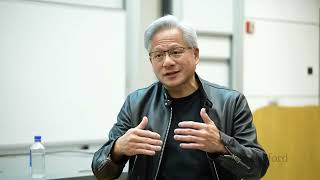
Stanford CS153 Frontier Systems | Jensen Huang from NVIDIA on the Compute Behind Intelligence
Who it’s for, and what you’ll learn
Best for: Computer science students, and founders who want candid strategy lessons.
On uListen: summary · chapters · transcript
A live class session: the host reads student questions voted up on Discord, and Huang answers each with a long, joking mini-lecture.
You'll learn:
- Why he calls MFU the wrong metric and would rather run at low utilization (27:50).
- Why he tells students to seek some suffering, not only passion (42:07).
- What became of Nvidia's mobile business: “We built it up to about a billion dollars and then went back to zero.” (1:03:47).
Huang speaks 88% of the words
1 hr 43 minNvidia's moat, pressed point by point
Jensen Huang – Will Nvidia’s moat persist?
Who it’s for, and what you’ll learn
Best for: Readers following Nvidia against TPUs and custom chips, and the China export debate.
On uListen: summary · chapters · transcript
A dense, increasingly adversarial interview in which Dwarkesh Patel brings supply chain numbers and export control premises and keeps pressing.
You'll learn:
- His model of what Nvidia is: “Well, in the end, something has to transform electrons to tokens.” (0:32).
- Why he thinks no chip bottleneck lasts more than two or three years, while energy does (15:04).
- Why Nvidia doesn't raise prices when demand spikes (54:28).
Huang speaks 72% of the words
 2 hr 26 min
Reasoning from first principles, then personal
Jensen Huang: NVIDIA - The $4 Trillion Company & the AI Revolution | Lex Fridman Podcast #494
Who it’s for, and what you’ll learn
Best for: Anyone who wants one long conversation covering his technical, business and personal thinking.
On uListen: summary · chapters · transcript
A long, admiring conversation in which Lex Fridman asks broad questions and lets Huang reason aloud, turning philosophical and personal in the final hour.
You'll learn:
- Why Amdahl's law forces Nvidia to speed up the whole system, not one part (2:13).
- His speed-of-light method for cutting a 74-day process (56:45).
- How he handles pressure: “I break it down, decompose the problem. And the de-de-decomposition of these circumstances turns it into manageable things that I can do.” (1:37:57).
Huang speaks 76% of the words
 1 hr 6 min
A live panel on agents, tokens and AI's image
Jensen Huang: Nvidia's Future, Physical AI, Rise of the Agent, Inference Explosion, AI PR Crisis
Who it’s for, and what you’ll learn
Best for: Viewers who want his numbers on inference and agents, in a casual live format.
On uListen: summary · chapters · transcript
A live, banter-heavy panel taped at GTC, where the hosts fire quick questions and Huang answers in numbered riffs.
You'll learn:
- Why he calls OpenClaw the first personal AI computer (13:07).
- Why he would be alarmed if a $500,000 engineer spent less than $250,000 a year on tokens (24:51).
- What he wants policymakers told: “It is not a biological being. It is not alien. It is not conscious. Um, it is computer software.” (17:14).
Huang speaks 61% of the words
 1 hr 16 min
Rebutting the year's big AI narratives
NVIDIA’s Jensen Huang on Reasoning Models, Robotics, and Refuting the “AI Bubble” Narrative
Who it’s for, and what you’ll learn
Best for: Listeners who want his answers to job-loss, doom, cost and bubble worries, plus predictions for biology, cars and robots.
On uListen: summary · chapters · transcript
A relaxed year-end talk at Nvidia in which Elad Gil and Sarah Guo take the big AI narratives one at a time.
You'll learn:
- His view of DeepSeek: “Probably the single greatest contribution to American AI last year.” (33:58).
- His five-layer cake of energy, chips, infrastructure, models and applications (16:36).
- His prediction that a billion robots will create the largest repair industry on the planet (13:44).
Huang speaks 76% of the words
20254 episodes
2 hr 28 minHis childhood, Nvidia's rescues and his fears
Joe Rogan Experience #2422 - Jensen Huang
Who it’s for, and what you’ll learn
Best for: Non-technical listeners who want the human story behind Nvidia.
On uListen: summary · chapters · transcript
A loose, warm, long conversation: Rogan plays the worried layperson on AI, then lets Huang tell long, funny origin stories.
You'll learn:
- Deep learning in one line: “And instead of describing the insight, you give it examples of input and output, and it figures out the insight.” (1:09:01).
- How, with $200 in his pocket, he bought the store's only three copies of a Silicon Graphics textbook to save Nvidia (1:32:53).
- Why a leader who must always be right can't change course: “if you're always right, how can you possibly pivot? Because pivoting requires you to be wrong.” (1:55:46).
Huang speaks 75% of the words
 1 hr 1 min
An investor's tour from 1993 to AI factories
Nvidia's Jensen Huang on AI & the Next Frontier of Growth
Who it’s for, and what you’ll learn
Best for: Investors who want his whole thesis in one sitting, with a compact origin story.
On uListen: summary · chapters · transcript
A live fireside chat at an investor conference, run in order by Sequoia's Konstantine Buhler and closed with a lightning round.
You'll learn:
- How he pitched Don Valentine, naming Electronic Arts as the killer app (6:31).
- The number he says Wall Street underweights: “Token generation rate per unit energy of your factory is your revenues.” (56:06).
- What he tells his own CIO: “our company's IT department, they're going to be the HR department of agentic AI in the future.” (1:00:18).
Huang speaks 82% of the words
 1 hr 44 min
The OpenAI deal, custom chips and the American dream
NVIDIA: OpenAI, Future of Compute, and the American Dream | BG2 w/ Bill Gurley and Brad Gerstner
Who it’s for, and what you’ll learn
Best for: Investors weighing bubble and custom-chip worries, and readers interested in his immigration views.
On uListen: summary · chapters · transcript
An investor-style talk at Nvidia: Brad Gerstner presses on Wall Street worries, then turns to policy and immigration, in a warm, agreeable tone.
You'll learn:
- His three scaling laws: “thinking, post-training, pre-training, we now have three scaling laws, not one.” (2:42).
- Why he says even a free rival chip can be the worse deal: “Your opportunity cost is so insanely high, you would always choose the best perf per watt.” (52:41).
- Why he thinks fears of mass job loss assume we have run out of ideas (1:36:21).
Huang speaks 61% of the words
 1 hr 1 min
Sovereign AI, alongside Mistral's Arthur Mensch
Jensen Huang & Arthur Mensch: Why Every Nation Needs Its Own AI Strategy
Who it’s for, and what you’ll learn
Best for: Government and business leaders deciding whether to build their own AI.
On uListen: summary · chapters · transcript
A joint conversation in which Mistral's Arthur Mensch speaks about as much as Huang, with questions framed for heads of state.
You'll learn:
- Why a nation's AI is a new layer of infrastructure, next to roads and power (8:04).
- His McDonald's and local cafe picture of global and regional AI (18:39).
- Why he tells leaders to start now: “so it's not that hard, I think the number of excuses is running out.” (27:42).
Huang speaks 44% of the words
20242 episodes
 37 min
A short tour of hyper Moore's law
No Priors Ep. 89 | With NVIDIA CEO Jensen Huang
Who it’s for, and what you’ll learn
Best for: Listeners short on time who want his core infrastructure thesis.
On uListen: summary · chapters · transcript
A short, friendly return visit at Nvidia headquarters: Sarah Guo and Elad Gil ask brief prompts and mostly let Huang run.
You'll learn:
- How Nvidia helped bring up xAI's 100,000-GPU cluster in weeks (15:06).
- Why Nvidia builds whole data centers, not just slides: “it's not unusual to see somebody's actual performance be dramatically lower than their peak performance as shown in PowerPoint slides.” (11:32).
- Why he thinks SaaS platforms sit on a goldmine of specialized agents (30:42).
Huang speaks 85% of the words
 1 hr 21 min
The bull case, argued from first principles
Ep17. Welcome Jensen Huang | BG2 w/ Bill Gurley & Brad Gerstner
Who it’s for, and what you’ll learn
Best for: Investors who want his first-principles case for Nvidia's moat and AI demand, including his answers on custom chips and the Cisco comparison.
On uListen: summary · chapters · transcript
A friendly investor sit-down at Nvidia, recorded to kick off Altimeter's annual investor meeting, with long setups from Brad Gerstner and long Socratic answers from Huang.
You'll learn:
- Why older Nvidia gear keeps earning: “There's a trail of free infrastructure behind the new infrastructure that's CUDA compatible.” (17:25).
- His hope for 50,000 employees working with 100 million AI assistants (1:01:10).
- How he prompts his team the way he prompts an AI (35:08).
Huang speaks 70% of the words
20232 episodes
 1 hr 30 min
Nvidia's history, told by its founder
NVIDIA CEO Jensen Huang
Who it’s for, and what you’ll learn
Best for: Founders and Nvidia followers who want the company's history in his own words.
On uListen: summary · chapters · transcript
A warm, story-driven interview at Nvidia that moves in order from Riva 128 through CUDA and AI to founder advice and a lightning round.
You'll learn:
- Why he calls 1997 Nvidia's best moment: “that time, 1997, was probably NVIDIA's best moment, and the reason for that was our backs were up against the wall.” (5:37).
- What he means by zero billion dollar markets: “it's our way of saying there's no market yet, but we believe there will be one.” (46:44).
- Why he wouldn't start a company again (1:20:22).
Huang speaks 66% of the words
 52 min
Conviction, agility and an early look at ChatGPT
No Priors Ep. 13 | With Jensen Huang, Founder & CEO of NVIDIA
Who it’s for, and what you’ll learn
Best for: Founders and managers thinking about conviction, agility and org design.
On uListen: summary · chapters · transcript
A relaxed late-afternoon talk recorded while he was hoarse and unwell, moving from Nvidia's founding to the AI shift to founder advice.
You'll learn:
- Why programming has changed: “for the very first time in the history of computing, the language of programming a computer is human.” (17:55).
- His joking rule of laziness: reject work fast, defer the rest, do what remains (24:07).
- Why running a profitable company is a skill, not conviction: “Making money is not a, a matter of conviction. Making money is a matter of skill, and it's a learnable skill.” (26:16).
Huang speaks 80% of the words
What others say about him
Jonathan Ross, a guest on Founders with David Senra, on how Nvidia works under Huang
PlayMorris Chang, the founder of TSMC, a guest on Acquired, recalls phoning Huang
PlayAravind Srinivas, a guest on 20VC with Harry Stebbings, on Huang's intensity
PlaySatya Nadella, a guest on Bg2 Pod, on the pace Huang and his team set
Play
The full quotes
- Jonathan Ross, a guest on Founders with David Senra, on how Nvidia works under Huang: “Jensen is world-class, and one of the things that I observed,'cause I've worked at other tech companies, there's no politics. It's the least political large organization you will ever see. And I learned this lesson at Groq, but I didn't take it to the extreme, so seeing it in the extreme shows me just how valuable it is. There is no circumstance at NVIDIA where there-- where Jensen has one-on-ones with people and tells them one thing.” (Jonathan Ross, Founders with David Senra, July 5, 2026, at 16:43)
- Morris Chang, the founder of TSMC, a guest on Acquired, recalls phoning Huang: “Jensen himself picked up the phone, and there was a lot of background noise, so there were, I mean, his- he, he was arguing something with, uh, uh, his people. Uh, but as soon as I introduced myself, uh, I said, "This is Morris Chang," he immediately shouted at to those people that were making noises. He said, "Quiet! Uh, Morris Chang is calling me."” (Dr. Morris Chang, Acquired ft. Ben Gilbert & David Rosenthal, January 27, 2025, at 6:42)
- Aravind Srinivas, a guest on 20VC with Harry Stebbings, on Huang's intensity: “Jensen is so truth-seeking, it's insane. I think he or somebody else told me, or, or read in a book that he, um, is so intense that he wakes up every day and tells himself that he sucks, and goes in... Like, like he's so intense that he tells everybody around him that they're 30 days away from going out of business.” (Aravind Srinivas, 20VC with Harry Stebbings, June 15, 2026, at 1:31:52)
- Satya Nadella, a guest on Bg2 Pod, on the pace Huang and his team set: “let's take even, uh, what Jensen and team are doing, right? I mean, they're at a pace. In fact, one of the things I like is the speed of light, right? We now have GB300s bringing, you know, that we're bringing up. So you don't wanna have ordered a bunch of GB200s that are getting plugged in only to find the GB2- 300s are in full production.” (Satya Nadella, Bg2 Pod, October 31, 2025, at 43:05)
Questions people ask
Which Jensen Huang podcast should I watch first?
Start with Lex Fridman Podcast (March 23, 2026), which covers his technical, business and personal thinking in one long conversation. For his life story, choose The Joe Rogan Experience (December 3, 2025); with less time, No Priors ft. Sarah Guo & Elad Gil (November 7, 2024) runs 37 min and covers his core case for AI factories.
Where does Jensen Huang tell Nvidia's origin story?
His fullest account of the early years is on The Joe Rogan Experience (December 3, 2025), from the Sega deal (1:19:28 to 1:32:53, 13 min) to the textbooks, the last emulator and TSMC (1:32:53 to 1:47:13, 14 min). Acquired ft. Ben Gilbert & David Rosenthal (October 16, 2023) opens with the Riva 128 bet (3:03 to 12:07, 9 min), and on Lex Fridman Podcast (March 23, 2026) he tells why Nvidia put CUDA on every GeForce chip (7:31 to 22:38, 15 min).
What does Jensen Huang say about AI taking jobs?
He argues that AI automates tasks rather than a job's purpose, pointing to radiologists, whose numbers grew after AI took over reading scans. His fullest version is 4:57 to 15:13, 10 min of No Priors ft. Sarah Guo & Elad Gil (January 8, 2026); on All-In ft. Jason Calacanis, Chamath Palihapitiya, David Sacks & David Friedberg (March 19, 2026) he tells anxious graduates to become expert at using AI (1:01:35).
Does Jensen Huang think AI is a bubble?
In his view, no. On Bg2 Pod (October 15, 2026) he says judging the build-out by two labs' revenue is a mistake, because much of Nvidia's demand comes from classical computing and startups (1:00:34 to 1:12:39, 12 min). On No Priors ft. Sarah Guo & Elad Gil (January 8, 2026) he describes a shortage of compute everywhere: “Everybody is dying for capacity, and so we have a global, multi-company, multi-industry shortage.” (1:10:12).
What does Jensen Huang say about selling chips to China?
In his recent episodes he argues against treating GPUs like weapons and against giving up China's market. His strongest case, under sustained pushback, is 57:37 to 1:14:20, 17 min of Dwarkesh Podcast (April 15, 2026), and on Stanford Online (May 13, 2026) he calls the comparison of GPUs to atomic bombs a false analogy (47:56). On No Priors ft. Sarah Guo & Elad Gil (January 8, 2026) he also backs export controls grounded in national security (58:59).
How this guide is made
uListen wrote this guide with AI from the full, speaker-labeled transcripts of the 14 episodes above, all from uListen's catalog, plus the four episodes quoted under What others say about him. Notes on each episode were written from its full transcript and checked by code, and every fact here comes from them. Every quotation is checked word for word against its transcript, and every time comes from it. We update the guide when a new episode with him joins the catalog. To report a problem, email support@ulisten.ai.