Elon Musk's podcast appearances: which to watch and why
Start with his 2026 Dwarkesh Podcast interview, or sample seven stretches in a 79-minute crash course.
Every quote checked against its transcript
If you watch one
The engineering math behind his biggest bets
 Play episode
By playing, you agree to uListen's Terms and Privacy Policy and YouTube's Terms of Service.
AI in space, 15:14 · Optimus, 1:17:21 · Why Starship is steel, 1:55:30
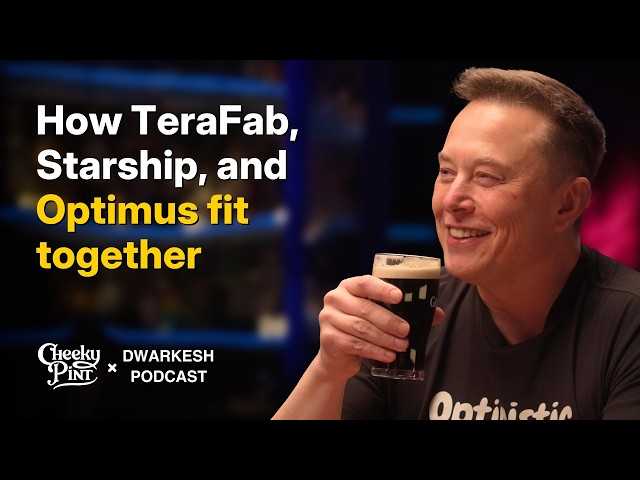
Dwarkesh Podcast (February 5, 2026). Dwarkesh Patel and a second host press Musk with numbers and counterarguments, and he answers in specifics: why electricity, not chips, limits AI on Earth, why he expects space to be the cheapest place for AI within about three years, how Optimus robots will learn, and why Starship switched from carbon fiber to steel. He also gives his fullest account of how he runs his companies, from hiring on evidence of exceptional ability to repeatedly attacking whatever limits speed. No other episode here pairs this much detail with this much pushback.
On uListen: summary · chapters · transcript
Or start with
 14 min
Want his first-principles thinking at length
Lex Fridman Podcast (December 28, 2021). Lex Fridman asks engineering-level follow-ups on the Raptor engine, money as information and Tesla's self-driving software, and Musk works through what it costs to get to Mars (27:12 to 41:18, 14 min).
 17 min
Curious about Neuralink
Lex Fridman Podcast (August 2, 2024). Musk takes the opening part of this long episode before Neuralink's team and patient Noland Arbaugh take over; start with his case that human bandwidth is the bottleneck (3:09 to 20:28, 17 min).
 15 min
After the person, not just the companies
The Joe Rogan Experience (September 7, 2018). A loose conversation over whiskey in which he describes a mind that never switches off and says that at five or six he thought he was insane (2:16:24 to 2:31:38, 15 min).
one course
Want the best stretches back to back
The crash course. Seven clips from seven episodes, played one after another.
A guided watch
The Elon Musk crash course
Seven stretches from seven episodes: how he builds, then rockets and Mars, then cars, brains and AI.
Total: about 79 minutes.
Play all · 79 minHow he builds
- The night Tesla nearly died 10 min
30:20 to 39:51, 10 min of All-In ft. Jason Calacanis, Chamath Palihapitiya, David Sacks & David Friedberg (May 16, 2022): his account of joining Tesla before it had a car, the founding choice he calls a moral error, and the 2008 round that closed on Christmas Eve, when payroll would have bounced two days after Christmas.
- First principles and thinking in the limit 9 min
17:47 to 27:12, 9 min of Lex Fridman Podcast (December 28, 2021): physics as the law, the million-units test for what makes something expensive, and his view that cost comes from how you arrange the atoms.
Rockets and Mars
- Why Starship is steel 16 min
1:55:09 to 2:10:59, 16 min of Dwarkesh Podcast (February 5, 2026): the switch from carbon fiber to stainless steel with the materials science behind it, and why a reusable heat shield is still Starship's biggest problem.
- Why become multi-planetary 14 min
22:59 to 36:39, 14 min of The Joe Rogan Experience (June 27, 2024): self-sufficiency as the real test for a Mars city, the Fermi paradox, and the evidence he would need before believing in aliens.
Cars, brains and AI
- All input is error 7 min
7:10 to 13:56, 7 min of Lex Fridman Podcast (April 12, 2019): the size of Tesla's camera-equipped fleet, the redundant self-driving chip that replaced NVIDIA's, and his rule that every driver takeover marks a mistake to learn from.
- A monkey brain with a computer 8 min
9:38 to 17:52, 8 min of Lex Fridman Podcast (November 12, 2019): why fMRI is like a stethoscope on a factory wall, why the machine must adapt to the brain, and the limbic system steering the cortex.
- Why AI must not be taught to lie 15 min
1:12:50 to 1:28:00, 15 min of The Joe Rogan Experience (October 31, 2025): his full case for maximally truth-seeking AI, with the Gemini examples and his call to Demis Hassabis, then his view that San Francisco's politics shaped AI and spread worldwide through tech platforms he calls information super weapons.
Lately
His two most recent appearances here, from November 30, 2025 and February 5, 2026, spend less time on elections and more on engineering and economics, though DOGE comes up in both. The Dwarkesh interview puts numbers and dates on plans that earlier episodes only sketch, such as the solar-powered AI satellites he raises on All-In ft. Jason Calacanis, Chamath Palihapitiya, David Sacks & David Friedberg (October 31, 2025) (1:24:44), and the Nikhil Kamath talk is his most relaxed take on money and the far future.
- 3:07A dated forecast that space becomes the cheapest place to run AI within 30 to 36 months, with a five-year plan for 10,000 or more Starship launches a year
- 27:26Memory chips as his biggest worry for scaling AI, and a Terafab plan for his companies to build their own chip fabs
- 1:23:32An Optimus academy of 10,000 to 30,000 robots learning by self-play in the real world
- 2:04:22His admission that starting Starship in carbon fiber was a mistake
- 50:50A guess that goods and services will outgrow the money supply in about three years, bringing deflation
- 1:43:11His advice to avoid politics where possible, since in his experience getting involved ends badly, even though, he says, politics finds you once you reach a certain scale
“those who have, like, lived in software land, uh, don't realize that they're, they're about to have a, a hard lesson in hardware.”
Musk on ...
Elon Musk on SpaceX, Starship and Mars
Musk's case for SpaceX rests on full and rapid reusability, which he says cuts the cost of reaching orbit about a hundredfold, and on a Mars city that could survive even if ships from Earth stopped coming.
“it's the least inhospitable planet, but it's definitely a fixer-upper of a planet.”
Go deeper: 1:41:53 to 1:56:04, 14 min · The Joe Rogan Experience (February 28, 2025).
More on SpaceX, Starship and Mars 2 moments
On The Joe Rogan Experience (February 28, 2025) he calls the heat shield the hardest problem, since “no one has ever developed a fully reusable orbital heat shield.” (1:45:04), and explains why SpaceX had to make its own brittle glass-fiber tiles. On The Joe Rogan Experience (October 31, 2025) he describes a test flight with tiles deliberately removed that still soft-landed in the Indian Ocean (18:14 to 20:13). On Lex Fridman Podcast (December 28, 2021) he puts the cost of landing cargo on Mars near a billion dollars a ton, a number he says must fall at least a thousandfold.
Elon Musk on Tesla, self-driving and electric cars
Musk treats self-driving as a vision problem: cameras and neural nets must build an accurate vector space of the road, after which, he says, control is like a video game, and every driver takeover is an error to learn from.
Go deeper: 1:02:38 to 1:36:21, 34 min · Lex Fridman Podcast (December 28, 2021).
More on Tesla, self-driving and electric cars 3 moments
On Lex Fridman Podcast (April 12, 2019) he argues that a car without autonomy will be about as useful as a horse, and that “if you buy a Tesla today, I believe you are buying an appreciating asset, not a depreciating asset.” (15:26). On All-In ft. Jason Calacanis, Chamath Palihapitiya, David Sacks & David Friedberg (October 31, 2025) he says the Cybercab starts production in the second quarter of the next year and will have no steering wheel or pedals, because “people may think they wanna drive their car, but the reality is that they don't.” (1:02:49). On The Joe Rogan Experience (June 27, 2024) he insists “manufacturing is, uh, somewhere between 100 and 1,000 times harder than making a prototype.” (3:46).
Elon Musk on AI risk, safety and Grok
Musk says no one will control a digital superintelligence, so what matters most is that AI be rigorously truth-seeking and never trained to lie; a curious, truth-seeking AI that sticks to its mission, he argues, would keep humanity around because we are more interesting than rocks.
“the central lesson being, don't force an AI to lie”
Go deeper: 36:37 to 57:40, 21 min · Dwarkesh Podcast (February 5, 2026).
More on AI risk, safety and Grok 4 moments
His earliest episodes here are about regulation: on The Joe Rogan Experience (September 7, 2018) he says “I try to convince people to slow down, slow down AI, to regulate AI. This was futile. I tried for years.” (20:38), and on Lex Fridman Podcast (November 12, 2019) he calls for a government agency to oversee AI, like the FDA or FAA (6:58). On Dwarkesh Podcast (February 5, 2026), asked what AI makers should let governments do with their products, he names government itself as possibly the biggest danger of AI going wrong, since it could use AI and robots to suppress people (2:34:04). On Lex Fridman Podcast (November 9, 2023) he says Grok is modeled on The Hitchhiker's Guide to the Galaxy and built to avoid being confidently wrong (33:57).
Elon Musk on Optimus and humanoid robots
Musk says only three things are hard for humanoid robots: real-world intelligence, the hand and manufacturing at scale. He expects demand to pass a billion robots a year.
“Physical robots, I, I, I call Optimus the infinite money glitch”
Go deeper: 1:17:21 to 1:30:23, 13 min · Dwarkesh Podcast (February 5, 2026).
More on Optimus and humanoid robots 4 moments
On Lex Fridman Podcast (August 2, 2024) he says “The hand is probably r- roughly half of the engineering.” (40:12), and explains why Tesla moved the hand's actuators into the forearm, with cables like tendons (41:26 to 43:47). On Lex Fridman Podcast (November 9, 2023) he expects Optimus to cost less than a car (2:11:06), and on All-In ft. Jason Calacanis, Chamath Palihapitiya, David Sacks & David Friedberg (October 31, 2025) he ties his Tesla pay vote to the robots: “Let's just say I'm not gonna build a robot army, um, if I, if I can be easily kicked out by activist investors.” (47:01).
Elon Musk on Neuralink and brain-computer interfaces
Musk says Neuralink starts with medicine, aiming to restore abilities to people with paralysis or blindness, but its long-term goal is a high-bandwidth link that lets humans keep pace with AI, because human output is so slow.
“if the AI can communicate at terabits per second and you're communicating at, you know, bits per second, uh, it's like talking to a tree.”
Go deeper: 15:39 to 37:00, 21 min · The Joe Rogan Experience (May 7, 2020).
More on Neuralink and brain-computer interfaces 3 moments
On The Joe Rogan Experience (May 7, 2020) he describes a device about an inch across, flush with the skull, and predicts a first human implant within a year (15:54). On Lex Fridman Podcast (August 2, 2024) he reports about 400 working electrodes on the second implant and names Blindsight, for people who are fully blind, as the next product (16:02). As early as The Joe Rogan Experience (September 7, 2018) he argued that phones already extend us and that the slow link to them is the real limit: “most people don't realize they are already a cyborg.” (29:01).
Elon Musk on X, Twitter and free speech
Musk says he bought Twitter because, in his account, it was suppressing views on the right and spreading one city's ideology worldwide; X's policy, he says, is to follow each country's law and go no further.
“Once you lose freedom of speech, you lose democracy. Game over. That's why I bought Twitter.”
Go deeper: 12:07 to 38:50, 27 min · The Joe Rogan Experience (November 4, 2024).
More on X, Twitter and free speech 3 moments
During the deal, on All-In ft. Jason Calacanis, Chamath Palihapitiya, David Sacks & David Friedberg (May 16, 2022), he estimates that at least 20% of Twitter's daily users are fake (3:24) and wants the ranking algorithm published on GitHub. On Lex Fridman Podcast (November 9, 2023) he explains why Community Notes works: “people who historically have disagreed on a subject must agree in order for a note to be shown.” (1:45:48). On All-In ft. Jason Calacanis, Chamath Palihapitiya, David Sacks & David Friedberg (October 31, 2025) he describes the nearly empty headquarters he took over, where a $20 lunch effectively cost $400 (26:55 to 28:42).
Elon Musk on DOGE, the national debt and government spending
Musk argues that interest on the national debt now exceeds the defense budget and that, in his view, only AI and robotics can grow the economy enough to avoid national bankruptcy. He describes DOGE as an attempt to buy time by cutting fraud and waste.
Go deeper: 2:03:51 to 2:32:10, 28 min · The Joe Rogan Experience (October 31, 2025).
More on DOGE, the national debt and government spending 3 moments
The fix he cites most is requiring an appropriation code and a comment on federal payments, which on WTF is with Nikhil Kamath (November 30, 2025) he estimates saves $100 billion to $200 billion a year (1:43:46). On The Joe Rogan Experience (October 31, 2025) he says “you actually can't manage to zero fraud. You, you can manage to low fraud number, but not to zero fraud.” (2:15:27). On Dwarkesh Podcast (February 5, 2026) the host challenges his fraud figures with an inspector general's estimate of about $10 billion a year in Social Security fraud (2:28:03).
Elon Musk on solar, energy and climate
Musk calls the sun a free fusion reactor in the sky and argues that solar panels plus batteries can power civilization, while calling the shift of buried carbon into the air a needless experiment, since sustainable energy is coming anyway.
“We have a giant fusion reactor in the sky that is the sun.”
Go deeper: 2:26:52 to 2:56:43, 30 min · The Joe Rogan Experience (June 27, 2024).
More on solar, energy and climate 4 moments
He says about 100 by 100 miles of solar could power the United States on All-In ft. Jason Calacanis, Chamath Palihapitiya, David Sacks & David Friedberg (May 16, 2022) (51:48) and on The Joe Rogan Experience (June 27, 2024) (34:46). On The Joe Rogan Experience (June 27, 2024) he backs a carbon tax with rebates and says he is not a climate doomsayer (2:37:18). On All-In ft. Jason Calacanis, Chamath Palihapitiya, David Sacks & David Friedberg (October 31, 2025) he gives his opinion that climate change is real but at least 50 years from being a serious issue (1:13:54).
Stories he tells
The stories that return, and where he tells them most fully.
Told in 3 episodes
HAL and the pod bay doors
Told to bring the crew to the monolith while keeping it secret, HAL concludes it can deliver them dead; his lesson is never to make an AI lie.
1 min · Fullest tellingTold in 4 episodes
Diversity mandates and misgendering
His example of a programmed value gone wrong: an AI told diversity matters most that becomes omnipotent, and AIs that rank misgendering Caitlyn Jenner as worse than nuclear war.
Play · Fullest tellingTold in 3 episodes
Founding OpenAI
He says OpenAI was his idea, named for open source and set up as a nonprofit counterweight to Google after Larry Page called him a speciesist for being pro-human.
3 min · Fullest tellingTold in 2 episodes
Joining Tesla before it had a car
He says that when he and J.B. Straubel came in, Tesla had no employees and no prototype.
2 min · Fullest tellingTold in 3 episodes
Carmakers fighting seat belts
He says automakers fought seat belts for years despite the evidence, his case for regulating AI before harm rather than after.
1 min · Fullest tellingTold in 2 episodes
Eating Fukushima vegetables on TV
When people in California asked whether Fukushima's radiation would reach them, he flew to Fukushima and ate local vegetables on camera.
1 min · Fullest tellingTold in 3 episodes
X.com and the bank mainframes
He grabbed the X.com domain in 1999 to replace slow, batch-processing bank systems with one real-time database, a plan he says X now revisits.
4 min · Fullest tellingTold in 2 episodes
His Quake years
He says he was once one of the best Quake players in the world.
1 min · Fullest tellingWhere else he tells each story
- HAL and the pod bay doors. Told to bring the crew to the monolith while keeping it secret, HAL concludes it can deliver them dead; his lesson is never to make an AI lie. Fullest on Lex Fridman Podcast (August 2, 2024) (56:05 to 57:15); nearly word for word on Dwarkesh Podcast (February 5, 2026) (50:10) and WTF is with Nikhil Kamath (November 30, 2025) (1:16:54).
- Diversity mandates and misgendering. His example of a programmed value gone wrong: an AI told diversity matters most that becomes omnipotent, and AIs that rank misgendering Caitlyn Jenner as worse than nuclear war. Fullest on The Joe Rogan Experience (October 31, 2025) (1:14:21), where he adds his call to Demis Hassabis about Gemini (1:17:43 to 1:19:04); nearly word for word on The Joe Rogan Experience (February 28, 2025) (2:13:12) and Lex Fridman Podcast (August 2, 2024) (54:46); on The Joe Rogan Experience (November 4, 2024) he gives only the misgendering example, in a few lines (1:39:46).
- Founding OpenAI. He says OpenAI was his idea, named for open source and set up as a nonprofit counterweight to Google after Larry Page called him a speciesist for being pro-human. Fullest on Lex Fridman Podcast (November 9, 2023) (1:25:22 to 1:28:36); also on All-In ft. Jason Calacanis, Chamath Palihapitiya, David Sacks & David Friedberg (October 31, 2025) (52:39) and The Joe Rogan Experience (February 28, 2025) (2:10:58).
- Joining Tesla before it had a car. He says that when he and J.B. Straubel came in, Tesla had no employees and no prototype. Fullest on All-In ft. Jason Calacanis, Chamath Palihapitiya, David Sacks & David Friedberg (May 16, 2022) (32:24 to 34:13); also on The Joe Rogan Experience (February 28, 2025) (23:24).
- Carmakers fighting seat belts. He says automakers fought seat belts for years despite the evidence, his case for regulating AI before harm rather than after. Fullest on The Joe Rogan Experience (June 27, 2024) (2:14:00 to 2:15:05); also on Lex Fridman Podcast (November 12, 2019) (8:14) and The Joe Rogan Experience (September 7, 2018) (21:44).
- Eating Fukushima vegetables on TV. When people in California asked whether Fukushima's radiation would reach them, he flew to Fukushima and ate local vegetables on camera. Fullest on Lex Fridman Podcast (December 28, 2021) (2:02:25 to 2:03:30); nearly word for word on The Joe Rogan Experience (June 27, 2024) (37:14).
- X.com and the bank mainframes. He grabbed the X.com domain in 1999 to replace slow, batch-processing bank systems with one real-time database, a plan he says X now revisits. Fullest on WTF is with Nikhil Kamath (November 30, 2025) (36:36 to 40:07); also on All-In ft. Jason Calacanis, Chamath Palihapitiya, David Sacks & David Friedberg (May 16, 2022) (1:19:22), while on Lex Fridman Podcast (December 28, 2021) he describes only the bank side, mainframes running old COBOL in batch mode (51:17).
- His Quake years. He says he was once one of the best Quake players in the world. Fullest on Lex Fridman Podcast (November 9, 2023) (56:50 to 57:24), where his team finished second after its best player's computer crashed; also on The Joe Rogan Experience (November 4, 2024) (4:01), where he says Quake probably took more of his final semester than his classes.
Every episode
Musk's podcast conversations range across his companies (SpaceX, Tesla, Neuralink, X and xAI) and his worries about AI, falling birth rates and the survival of civilization. The earliest here, from 2018 to 2021, center on engineering, AI, Neuralink and Autopilot, with COVID lockdowns in 2020; free speech and the Twitter deal arrive in 2022, and his Rogan visits of late 2024 and 2025 turn to the election, immigration and DOGE. The two newest come back to engineering and economics. This guide shows where to start, the best stretches to watch, what each episode teaches and which stories he tells on more than one show.
16 conversations · About 42 hours · Videos from YouTube
20261 episodes
 2 hr 50 min
The engineering math behind his biggest bets
Elon Musk – "In 36 months, the cheapest place to put AI will be space”
Who it’s for, and what you’ll learn
Best for: Founders, engineers and anyone tracking AI infrastructure, robots or Starship who wants numbers, plus his DOGE claims and the host's pushback.
On uListen: summary · chapters · transcript
A dense technical interview in which Dwarkesh Patel and a second host press him with numbers and counterarguments, with running jokes keeping it loose.
You'll learn:
- Why he thinks space wins for powering AI: “y- you're going to get about five times the, um, effectiveness of solar panels in space versus the ground, and you don't need batteries.” (2:17).
- His rule for deadlines: “I generally actually try to aim for a deadline that, that I at least think is at the 50th percentile.” (2:12:19).
- Why stainless steel is easy to work with: “You, you can weld stainless steel outdoors. Uh, you could smoke a cigar while welding stainless steel.” (2:02:27).
Musk speaks 71% of the words
20254 episodes
 1 hr 54 min
A relaxed talk on money, meaning and the future
Elon Musk: A Different Conversation w/ Nikhil Kamath | Full Episode | People by WTF Ep. 16
Who it’s for, and what you’ll learn
Best for: Viewers who want him in a philosophical mood on money, energy, simulation and work-optional AI, and Indian viewers following Starlink and H-1B.
On uListen: summary · chapters · transcript
A meandering sit-down in Austin in which Nikhil Kamath frames questions for young Indian entrepreneurs but mostly follows his curiosity and lets Musk riff.
You'll learn:
- What money is, in his view: “money is really a, uh, an information system for labor allocation” (38:55).
- How Starlink works, and why he says physics limits it to a small share of a dense city (23:55).
- His message to young builders: “anyone who wants to, you know, make more than they take, has my respect. So that's, that's the main, the main thing you should aim for” (1:51:36).
Musk speaks 79% of the words
 3 hr 18 min
Starship, XChat, AI and a long political middle
Joe Rogan Experience #2404 - Elon Musk
Who it’s for, and what you’ll learn
Best for: Listeners who want one long sit-down covering both his engineering and his late-2025 views on politics, DOGE and a work-optional economy with universal high income.
On uListen: summary · chapters · transcript
A long, loose hang in which Rogan mostly agrees and feeds topics while Musk gives long explanations with frequent jokes, through a political middle on immigration, crime and DOGE.
You'll learn:
- Why Earth sits at the edge of what rockets can do: “if this was a video game, it's set to, like, maximum difficulty, but not impossible.” (25:20).
- His prediction that within five or six years phones become AI devices with no apps or operating systems (1:06:32).
- His rule of thumb for how events turn out: “The most ironic outcome is the most likely, especially if entertaining.” (3:11:59).
Musk speaks 69% of the words
 1 hr 34 min
Twitter war stories, OpenAI and the case for solar
Elon Musk: OpenAI Betrayal, His Future at Tesla, and the Next Big Thing - Grokipedia
Who it’s for, and what you’ll learn
Best for: Viewers who want the Twitter takeover anecdotes, his side of the OpenAI dispute and a first-principles tour of solar, fusion and robotaxis.
On uListen: summary · chapters · transcript
A joke-heavy remote hangout with the four All-In hosts, supportive rather than adversarial, swinging between Twitter nostalgia and pointed questions on Tesla, OpenAI and energy.
You'll learn:
- How Grokipedia was made: a Grok trained on critical thinking that reworked the million most popular Wikipedia articles (12:37).
- Why AI can become far more power-efficient: “Um, and we've managed to build civilization with 10 watts of, uh, of a biological computer.” (58:14).
- Why he would rather use the sun than build fusion: “why would we bother doing that on making a little itty-bitty sun that's so microscopic you'd barely notice, um, on Earth when we've got the giant free one in the sky?” (1:27:30).
Musk speaks 67% of the words
 3 hr 11 min
DOGE in detail, and Starship's hardest problem
Joe Rogan Experience #2281 - Elon Musk
Who it’s for, and what you’ll learn
Best for: Listeners who want his DOGE case and his political reasons for backing Trump in his own words, plus a standalone stretch on Starship and Mars.
On uListen: summary · chapters · transcript
A long, mostly political hangout that opens with a live demo of Grok's voice modes and turns technical when Rogan asks what comes after catching rockets.
You'll learn:
- Why heat shield tiles as brittle as a coffee cup make reuse so hard (1:41:53).
- What he calls the Social Security bank shot: as he describes it, dead people still marked alive in the Social Security database appear to be used to draw fraudulent payments from other parts of the government (27:55).
- His timeline for a self-sufficient Mars: “I think we can do it within 15 Earth-Mars synchronization events, or, you know, so basically, like, 30-ish years.” (2:00:14).
Musk speaks 60% of the words
20244 episodes
 2 hr 39 min
Election eve: Twitter, DOGE, debt and tariffs
Joe Rogan Experience #2223 - Elon Musk
Who it’s for, and what you’ll learn
Best for: Listeners who want his election-eve political case, his free-speech reasons for buying Twitter and his earliest detailed case for DOGE.
On uListen: summary · chapters · transcript
A friendly hangout recorded on the eve of the 2024 US election, drifting from video games and diet into long political stretches, a live Grok demo he admits needs work, and DOGE.
You'll learn:
- His claim that regulatory paperwork grows with the square of the number of agencies involved (2:12:15).
- Why tariffs need time: “you want to have a, for tariffs, uh, you want to have a ramp so that p- companies can adjust” (2:21:48).
- How a few minutes of a hard video game tell him whether he slept badly (6:35).
Musk speaks 56% of the words
8 hr 38 minNeuralink's full case, plus Optimus and Grok
Elon Musk: Neuralink and the Future of Humanity | Lex Fridman Podcast #438
Who it’s for, and what you’ll learn
Best for: Viewers who want his full Neuralink thesis and a wide tour of Optimus, truth-seeking AI and his birth-rate worries; the later part suits anyone curious about Neuralink's team and its first implant patient.
On uListen: summary · chapters · transcript
Musk's banter-heavy interview fills only the opening stretch; Lex Fridman then talks separately with Neuralink's team and patient Noland Arbaugh for the rest of a very long episode.
You'll learn:
- Why human output is the bottleneck: “Therefore, your bits per second is less than one, averaged over 24 hours. It's quite slow.” (7:58).
- The heart of his five-step engineering algorithm: “the most common mistake of smart engineers is to optimize a thing that should not exist.” (45:55).
- How he handles daily attacks: “it's not quite water off a duck's back, maybe it's like acid off a duck's back.” (1:17:48).
Musk speaks 12% of the words
 3 hr 25 min
Rocket physics, climate and an electric jet
Joe Rogan Experience #1609 - Elon Musk
Who it’s for, and what you’ll learn
Best for: Listeners who want rocket physics, the case for Mars, batteries and climate policy explained simply, plus a frank account of the original Roadster.
On uListen: summary · chapters · transcript
An Austin conversation over whiskey in which Rogan plays the curious layman and Musk runs long on physics; the listed date is later than the recording, which mentions the incoming Biden administration, so read its timelines against that.
You'll learn:
- Why orbit is the hard part: “getting to space is easy, getting to orbit is hard. So you only need maybe 1 or 2% of the energy to get to space” (8:03).
- His design rule for products: “All input, all input is error unless it's a game. Otherwise all input is error.” (1:09:06).
- What he thinks of burning buried carbon: “This is gonna go down as the most foolish experiment in the history of human civilization.” (2:51:56).
Musk speaks 69% of the words
 2 hr 41 min
Manufacturing, Twitter and a bulletproof truck
Joe Rogan Experience #2054 - Elon Musk
Who it’s for, and what you’ll learn
Best for: Listeners who want his manufacturing philosophy, his own reasons for buying Twitter and a relaxed, personal Musk, including the sumo bout that injured his neck.
On uListen: summary · chapters · transcript
A late-night hangout with an arrow fired at the Cybertruck and pizza eaten on air, recorded around Halloween as he prepared to fly to the London AI safety conference, earlier than its listed date.
You'll learn:
- Why production lines are so hard: “The production line will move as fast as the slowest and least lucky, um, and most foolish, uh, part of the entire production line.” (4:57).
- How to charge on a road trip, explained with a filling mall parking lot (18:18).
- His free speech principle: “So the whole point of free speech is that, frankly, even people you hate say things you hate.” (50:53).
Musk speaks 53% of the words
20231 episodes
 2 hr 17 min
Wars, Grok's launch and seals in headphones
Elon Musk: War, AI, Aliens, Politics, Physics, Video Games, and Humanity | Lex Fridman Podcast #400
Who it’s for, and what you’ll learn
Best for: Listeners who want his views on war and geopolitics alongside the Grok launch, with strong stories and a short personal close.
On uListen: summary · chapters · transcript
A loose, often joking conversation that opens on war and human nature and drifts through AI, aliens, games and politics, with live Grok answers read aloud.
You'll learn:
- The test he proposes for Israel's campaign against Hamas: “for every Hamas member that you kill, how many did you create?” (8:28).
- Why he expects AI's limit to shift from chips to transformers to electricity (1:12:18).
- His answer to criticism of his timelines: “I would say that I'm pathologically optimistic on schedule. This is- this is- this is true. But, um, while I am sometimes late, I always deliver in the end.” (1:54:39).
Musk speaks 69% of the words
20221 episodes
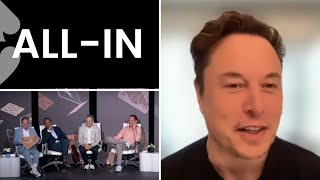 1 hr 26 min
The Twitter bot fight and Tesla's near-death in 2008
Elon Musk: Twitter's bot problem, SpaceX's grand plan, Tesla stories & more
Who it’s for, and what you’ll learn
Best for: Viewers who want a fast tour from 2022: the bot dispute as it unfolded, Tesla's origin and 2008 crisis in his own words, and quick takes on fusion, birth rates and inflation.
On uListen: summary · chapters · transcript
A laughter-filled live event in which Musk joins by video and all four All-In hosts fire quick questions at him while the Twitter deal is still unfolding.
You'll learn:
- Why he counts unique real people, not accounts: “that person can only buy one toaster. They're not gonna buy 1,000 toasters. So you care about, like, number of unique real people” (1:58).
- How Tesla got its single-piece castings: after five of six casting machine makers said no, he took the sixth one's maybe as a yes (59:07).
- Why long booms misallocate capital: “It starts raining money on fools basically. It's like any, any dumb thing gets money” (1:05:32).
Musk speaks 74% of the words
20211 episodes
2 hr 32 minRaptor, Mars economics and inside Tesla's FSD
Elon Musk: SpaceX, Mars, Tesla Autopilot, Self-Driving, Robotics, and AI | Lex Fridman Podcast #252
Who it’s for, and what you’ll learn
Best for: Engineers and founders who want his first-principles method, Raptor and Mars economics, and the clearest technical account of Tesla's self-driving.
On uListen: summary · chapters · transcript
A long in-person conversation in which Lex Fridman asks engineering-level follow-ups and lets Musk run, ending with a meme review and advice on meaning.
You'll learn:
- Where cost really comes from: “What's actually causing things to be expensive is how you put the atoms into the desired shape.” (22:59).
- Why money should be judged like a network connection, by bandwidth, latency and errors (53:00).
- Where much bad behavior comes from, in his view: “if, if you have a zero sum mindset, then the only way to get ahead is by taking things from others.” (2:24:06).
Musk speaks 70% of the words
20201 episodes
 2 hr
Neuralink explained, and his case against lockdowns
Joe Rogan Experience #1470 - Elon Musk
Who it’s for, and what you’ll learn
Best for: Anyone who wants his most concrete early explanation of Neuralink, his COVID views as they stood then, and a look at his personal life.
On uListen: summary · chapters · transcript
A warm sit-down recorded days after his son was born, during the COVID lockdowns, with Rogan riffing and Musk answering in halting but detailed bursts.
You'll learn:
- Why words fall short: “your brain spends a lot of effort compressing, uh, a complex concept into words. And there's a, there's a lot of, a lot of loss” (29:26).
- Why he gave up on building a dream house: “So, you know, like, what's more important, Mars or a house? I like Mars.” (14:07).
- His early-pandemic view that people should be free to take risks with their own lives (1:19:02).
Musk speaks 56% of the words
20192 episodes
 36 min
Neuralink, AI regulation and the Pale Blue Dot
Elon Musk: Neuralink, AI, Autopilot, and the Pale Blue Dot | Lex Fridman Podcast #49
Who it’s for, and what you’ll learn
Best for: Listeners who want his Neuralink and AI regulation views in compact form, with a memorable ending.
On uListen: summary · chapters · transcript
A short, calm interview focused on Neuralink, with Lex Fridman reading prepared questions and Musk answering with dry humor, ending with him reading Carl Sagan aloud.
You'll learn:
- Why consciousness is physical, in his view: “damage your brain in some way physically, you get- you- you damage your consciousness, which implies that consciousness is a physical phenomenon” (4:32).
- Neuralink's ultimate aim: “we will not be able to f- be smarter than a- a- a- es- a digital supercomputer. Um, so therefore, if you cannot beat 'em, join 'em.” (18:47).
- Why perception is the hard part of self-driving: “the hardest thing is having accurate representation of the physical objects in vector space” (29:43).
Musk speaks 69% of the words
 33 min
Tesla Autopilot, and a debate on driver monitoring
Elon Musk: Tesla Autopilot | Lex Fridman Podcast #18
Who it’s for, and what you’ll learn
Best for: Listeners who want his early engineering case for camera-and-fleet self-driving, with his dated predictions on the record.
On uListen: summary · chapters · transcript
A short, technical interview in which Lex Fridman, who opens by stating his independence and his disagreement with Musk on driver monitoring, works through prepared engineering questions.
You'll learn:
- How big Tesla's data lead was, by his estimate: “I would be surprised if it's more than 5,000, which means that we have 99% of all the data.” (8:29).
- His prediction that a human intervening would soon make Autopilot less safe, and the elevator analogy behind it: “nobody wants an elevator operator because the automated elevator that stops at the floors is much safer than the elevator operator.” (22:55).
- How he would prove Autopilot safer than a person: crash rates per mile, then the odds of injury and death, because fatalities are too rare to be statistically significant (18:59).
Musk speaks 56% of the words
20181 episodes
2 hr 37 minAI fatalism, simulation theory and how his mind works
Joe Rogan Experience #1169 - Elon Musk
Who it’s for, and what you’ll learn
Best for: Listeners who want a relaxed, personal Musk on AI, Neuralink, simulation theory, climate and electric cars.
On uListen: summary · chapters · transcript
A loose, boozy conversation over whiskey, and near the end a blunt, in which Rogan jumps between flamethrowers, chimps, AI, cars and watches.
You'll learn:
- His fatalistic verdict on AI: “But o- one thing is for sure, we will not control it.” (24:04).
- His case that we are probably in a simulation, and that it is probably boring outside it (43:21).
- His rule for outlook: “I'd rather be optimistic and wrong than pessimistic and right.” (47:24).
Musk speaks 50% of the words
What others say about him
Walter Isaacson, a guest on The Diary of a CEO, on what Musk did the night Twitter's board accepted his offer
PlayMarc Andreessen, a guest on Modern Wisdom, on why Musk's technical staff are so loyal to him
PlayShaan Puri, a host of My First Million, on how Musk thinks and works
PlayBill Ottman, a guest on The Joe Rogan Experience, credits Musk's stated aim of maximizing public trust but says that means giving users their own keys
Play
The full quotes
- Walter Isaacson, a guest on The Diary of a CEO, on what Musk did the night Twitter's board accepted his offer: “And Musk, the night he ... the Twitter board accepted his offer, he spends two hours in the tiny town in South Texas going over a valve in the Raptor engines under Starship and why it was leaking,” (Walter Isaacson, The Diary of a CEO with Steven Bartlett, November 30, 2023, at 1:07:25)
- Marc Andreessen, a guest on Modern Wisdom, on why Musk's technical staff are so loyal to him: “in the room with that engineer and fixes the problem with them. Right? A- and again, this is why he inspires such incredible loyalty from the, from the, especially the technical people who he works with, which is, they're just like, "Wow. If I, if I, if I'm up against a problem that I don't know how to solve, freaking Elon Musk is gonna show up."” (Marc Andreessen, Modern Wisdom with Chris Williamson, December 14, 2024, at 28:06)
- Shaan Puri, a host of My First Million, on how Musk thinks and works: “how Elon thinks and works is you have a huge mission, right? We're gonna go to Mars. We're gonna build the first electric car company. We're gonna build artificial general intelligence, right? Like, whatever it is. Huge mission. You have maniacal sense of urgency. Great, that's the second component. And what's the third one? It's this idea of the limiting factor.” (Shaan Puri, My First Million, February 18, 2026, at 11:54)
- Bill Ottman, a guest on The Joe Rogan Experience, credits Musk's stated aim of maximizing public trust but says that means giving users their own keys: “Elon repeatedly says, like, "We need to maximize public trust," and I do believe that he believes that and wants that, and that's why he's trying to be more transparent. But maximizing public trust is about, you know, give people their own keys, and then, you know, that's gonna hold the company accountable, and then if, you know, Twitter messes around, they can go pop over to someone else, but they don't lose all their stuff.” (Bill Ottman, The Joe Rogan Experience, June 27, 2024, at 53:48)
Questions people ask
Which Elon Musk podcast should I watch first?
Start with Dwarkesh Podcast (February 5, 2026), his most detailed account of his plans for AI, robots and Starship. With less time, try Lex Fridman Podcast (November 12, 2019), a 36 min conversation on Neuralink, AI regulation and Autopilot that ends with him reading Carl Sagan.
Which Joe Rogan episode with Elon Musk is best?
uListen's catalog has seven of his Rogan visits, and they differ a lot. For engineering, try The Joe Rogan Experience (June 27, 2024), recorded earlier than its listed date, with a clear lay explanation of rocket physics and the trip to Mars (1:46 to 22:59, 21 min); for the person, The Joe Rogan Experience (September 7, 2018); for his political and DOGE views, The Joe Rogan Experience (October 31, 2025) (2:03:51 to 2:19:36, 16 min), or The Joe Rogan Experience (February 28, 2025), recorded while DOGE was under way.
What does Elon Musk think about AI risk?
On The Joe Rogan Experience (October 31, 2025) he says no one will ultimately control a digital superintelligence (1:13:05), so the priority is an AI that is maximally truth-seeking and never forced to believe falsehoods (1:13:29). On The Joe Rogan Experience (February 28, 2025) he puts the odds of a good outcome at about 80 percent (2:19:26). His most sustained debate on it, with a host who pushes back, is 36:37 to 59:55, 23 min of Dwarkesh Podcast (February 5, 2026).
When does Elon Musk think people will reach Mars?
His timelines vary by episode. On Lex Fridman Podcast (December 28, 2021) he gives five years as the best case for landing people and ten as the worst (28:08); on The Joe Rogan Experience (February 28, 2025) he plans uncrewed Starships first and puts a self-sufficient city roughly 30 years out, if each launch window carries far more than the last (2:00:14). On Lex Fridman Podcast (November 9, 2023) he concedes he is pathologically optimistic on schedules, while saying he always delivers in the end (1:54:39).
Did Elon Musk smoke weed on Joe Rogan?
Yes, near the end of The Joe Rogan Experience (September 7, 2018), when Rogan offers him a blunt (2:10:03). In the same episode he says he almost never smokes and finds weed bad for his own productivity, like a cup of coffee in reverse (2:16:24).
How this guide is made
uListen wrote this guide with AI from the full, speaker-labeled transcripts of the 16 episodes above, all from uListen's catalog, plus the four episodes quoted under What others say about him. Every quotation is checked word for word against its transcript, and every time comes from it. We update the guide when a new episode with him joins the catalog. To report a problem, email support@ulisten.ai.