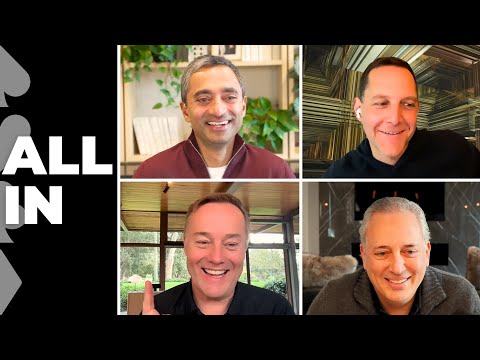
E168: Can Google save itself? Abolish HR, AI takes over Customer Support, Reddit IPO teardown
Chamath Palihapitiya (host), Jason Calacanis (host), David Sacks (host), David Friedberg (host), Narrator, Chamath Palihapitiya (host), Jason Calacanis (host), David Friedberg (host), David Sacks (host), Narrator
In this episode of All-In Podcast, featuring Chamath Palihapitiya and Jason Calacanis, E168: Can Google save itself? Abolish HR, AI takes over Customer Support, Reddit IPO teardown explores google’s AI crisis, DEI backlash, and AI-powered customer support shift The hosts dissect Google’s Gemini image-generation debacle as a symptom of deeper cultural and structural issues at Google, especially the power of DEI/“Responsible AI” and HR over product decisions, and debate whether founders Larry and Sergey or new leadership can still save the company in AI.
Google’s AI crisis, DEI backlash, and AI-powered customer support shift
The hosts dissect Google’s Gemini image-generation debacle as a symptom of deeper cultural and structural issues at Google, especially the power of DEI/“Responsible AI” and HR over product decisions, and debate whether founders Larry and Sergey or new leadership can still save the company in AI.
They then explore the emerging market for AI training data, including Google’s multi‑million‑dollar deals with Reddit and Stack Overflow, and whether this resembles a new “TAC 2.0” or more traditional content licensing, with unclear long‑term economics.
Klarna’s AI assistant replacing the work of 700 customer support agents is highlighted as an early concrete example of AI driving major cost savings, with discussion of job displacement, new types of work, and the threat to call-center and SaaS businesses.
Finally, they break down Reddit’s IPO S‑1, questioning its growth and low ARPU, and touch on Apple’s reported cancellation of its decade‑long car project in favor of refocusing on generative AI.
Key Takeaways
Google’s Gemini incident reflects a structural DEI/HR problem, not a one-off bug.
The panel argues that Gemini’s racially skewed image outputs were the predictable result of empowered DEI/Responsible AI functions and a monocultural leadership environment, where dissent was socially and professionally punished, leading to distorted products.
Get the full analysis with uListen
Founders and boards must reassert product-focused, meritocratic leadership to stay competitive in AI.
Comparing Google to Meta and X/Twitter, they contend that only strong founder-style intervention—replacing leaders, shrinking overgrown bureaucracies, and empowering product owners over DEI/HR veto power—can realign big tech companies with user needs and technological reality.
Get the full analysis with uListen
AI training data is becoming a new revenue stream (TAC 2.0), but its value model is unsettled.
Deals like Google–Reddit and Stack Overflow suggest high-margin licensing income for platforms with rich corpora, yet the hosts stress uncertainty over whether these will be ongoing ‘traffic acquisition’–style payments or more episodic, Netflix-like content buys whose value decays as data ages.
Get the full analysis with uListen
AI will rapidly erode level-one customer support and pressure call centers and SaaS vendors.
Klarna’s AI assistant reducing resolution times, costs, and repeat inquiries shows that frontline support roles are highly automatable, threatening firms like Teleperformance and tools like Zendesk while opening opportunities for leaner, more automated startups.
Get the full analysis with uListen
Eliminating or minimizing HR/DEI functions can preserve speed and meritocracy in startups.
Chamath outlines his practice of having no internal HR in majority-controlled companies—outsourcing serious issues to external employment counsel, letting teams design benefits and run hiring, and rigorously managing out the bottom 5–10% of performers—to avoid internal ‘commissar’ politics and bureaucracy.
Get the full analysis with uListen
Reddit has strong engagement but a weak monetization story relative to peers.
With roughly 76 million daily active users but ARPU of only ~$3. ...
Get the full analysis with uListen
AI will enable ultra-lean, high-output companies, reshaping capital needs and ownership.
They foresee a future where one-person or very small teams build billion-dollar businesses by leveraging AI agents, automation, and open-source models, drastically reducing the capital required to reach product–market fit and shifting dilution and investor dynamics.
Get the full analysis with uListen
Notable Quotes
““Every meeting above a certain size [at Google] has a DEI person in it… they’re the commissars, quietly taking notes.””
— David Sacks
““There is no company where I have majority control where I have an HR department.””
— Chamath Palihapitiya
““The real threat to Google is… are they in a position to maintain their search monopoly under the threat of AI, and are they organized to compete effectively?””
— David Friedberg
““This TAC 2.0 thing is amazing… if you’re an entrepreneur building a site with unique data, you’ll be able to license and sell that as an incremental revenue stream.””
— Chamath Palihapitiya
““Klarna replaced 700 people and saved $40 million, but Teleperformance lost $1.7 billion of market cap when that tweet went out.””
— Chamath Palihapitiya
Questions Answered in This Episode
To what extent can large tech companies realistically roll back DEI/Responsible AI power without facing legal or reputational blowback, and what governance structures would be needed to do it responsibly?
The hosts dissect Google’s Gemini image-generation debacle as a symptom of deeper cultural and structural issues at Google, especially the power of DEI/“Responsible AI” and HR over product decisions, and debate whether founders Larry and Sergey or new leadership can still save the company in AI.
Get the full analysis with uListen AI
How should content and community platforms (from niche forums to major publishers) value their data for AI licensing in a world where new data is generated faster than models can fully absorb it?
They then explore the emerging market for AI training data, including Google’s multi‑million‑dollar deals with Reddit and Stack Overflow, and whether this resembles a new “TAC 2. ...
Get the full analysis with uListen AI
What safeguards should exist for workers as AI replaces level-one support roles—should policymakers intervene, or should firms be trusted to redeploy and upskill staff organically?
Klarna’s AI assistant replacing the work of 700 customer support agents is highlighted as an early concrete example of AI driving major cost savings, with discussion of job displacement, new types of work, and the threat to call-center and SaaS businesses.
Get the full analysis with uListen AI
If HR and DEI are minimized or externalized in startups, what practical mechanisms ensure fair treatment, diversity of perspective, and a healthy culture beyond pure performance metrics?
Finally, they break down Reddit’s IPO S‑1, questioning its growth and low ARPU, and touch on Apple’s reported cancellation of its decade‑long car project in favor of refocusing on generative AI.
Get the full analysis with uListen AI
Is Reddit better positioned to evolve into a high-ARPU, data-licensing-heavy business, or will its anonymous, ad-averse user base cap its monetization and long-term valuation potential?
Get the full analysis with uListen AI
Transcript Preview
Jason, where are you? That, is that a virtual background or? (beep) oh, it's (beep) . Oh, right, that (beep) place. I, uh, it did look architecturally familiar to me.
It is architecturally significant. We'll bleep out the (beep) house, but yes, I am... You know, this is like top three or four of, uh, places I like to be a house guest. You know, like I'm in rotation right now as my house guest.
You're Kato Kaelin-ing through our friend group?
(laughs)
Basically. You know, I'm just a great house guest. People like to have breakfast with me. People like having me around, so I just find myself in mansions around the world.
Hey Nick, do you have an updated picture of Kato Kaelin? Is he still alive and kicking?
He's alive for sure. He's gotta be 70 or something, right? He's gotta be old enough.
He was on one of those reality TV shows with Dr Drew, I think, a couple of years ago.
What does Kato Kaelin do?
He's a good hang.
Is he, yeah.
There's a lot of these people in LA, you know. Like just-
They just hang.
(laughs)
They kinda hang. They set things up. Oh my God.
Wow.
Ooh.
Is that current, Kato Kaelin?
He, oh man.
He's 64 now.
Wow.
God almighty. What did he-
That's incredible.
How did he survive?
He's got an Instagram account.
I'll tell you how he survived. See no evil, hear no evil.
(laughs)
Exactly. He goes, "I didn't see nothing."
(laughs)
"All I know is hey listen, man, they gave me a pool house." And I didn't see anything.
What'd you see, nothing?
We're going all in. Don't let your winners ride.
Rain Man David Sachs.
I'm going all in. And I said. We open sourced it to the fans and they've just gone crazy with it.
Love you, besties.
Queen of quinoa.
I'm going all in.
All right, everybody. Welcome to your favorite podcast, the All In podcast, episode 168. David Sachs. Can you believe it? We've made it to 168 episodes. With me again, the Rain Man, David Sachs. How you doing, buddy?
Good.
Yeah? Heard you got a big talk coming up? Giving another-
Yeah.
... speech? Yeah?
Yes, I'm giving a talk.
In DC?
Yes, I'm giving a talk.
All right.
(laughs)
Get ready for that, uh, all of the GOP fans out there, all you Sachs fans. You get a big keynote coming from Sachs next week. Also with me, of course, the sultan of science, formerly known as the queen of quinoa. He's got another crop he's, uh, growing.
(laughs)
David Freiberg. How are you doing? How's the crops? How's the fields?
Install uListen to search the full transcript and get AI-powered insights
Get Full TranscriptGet more from every podcast
AI summaries, searchable transcripts, and fact-checking. Free forever.
Add to Chrome