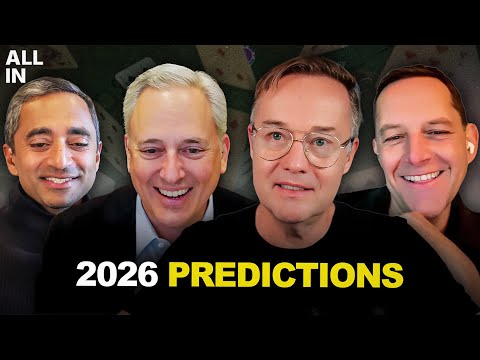
All-In's 2026 Predictions
David Friedberg (host), Jason Calacanis (host), Chamath Palihapitiya (host), David Sacks (host), David Sacks (host)
In this episode of All-In Podcast, featuring David Friedberg and Jason Calacanis, All-In's 2026 Predictions explores all-In besties forecast 2026 politics, markets, AI, and megadeals ahead The hosts open by debating California’s proposed wealth/“asset seizure” tax, predicting signature-gathering drama, potential ballot placement, and an exodus risk that could reshape California’s budget and tech politics.
All-In besties forecast 2026 politics, markets, AI, and megadeals ahead
The hosts open by debating California’s proposed wealth/“asset seizure” tax, predicting signature-gathering drama, potential ballot placement, and an exodus risk that could reshape California’s budget and tech politics.
They then run a structured 2026 predictions draft: political winners/losers, business winners/losers, biggest “deal,” contrarian beliefs, and best/worst-performing assets—anchored by expectations of strong U.S. GDP growth, rate cuts, and renewed capital markets activity.
AI is framed as both a productivity engine and a political lightning rod: it may disrupt the SaaS “maintenance/migration” economy, shift labor markets, and fuel populist backlash against tech on both left and right.
The episode ends with lighter predictions (media) and a meta-discussion about the show’s growth, while reinforcing two through-lines: a “Trump doctrine” geopolitical reset and a coming wave of IPOs/deal-structures that circumvent antitrust scrutiny.
Key Takeaways
California’s wealth tax fight is viewed as a multi-year saga, not a one-off vote.
Sacks argues even if the measure fails in 2026, a version likely returns in 2028, driving preemptive relocation and sustained uncertainty—especially with punitive treatment of super-voting shares.
Get the full analysis with uListen
Super-voting share valuation is portrayed as the most explosive design flaw.
Sacks claims the proposal would multiply perceived ownership by voting control, potentially treating founders’ stakes as far larger than liquid value—making a 5% wealth tax effectively far higher and incentivizing flight.
Get the full analysis with uListen
A strong-growth 2026 is a central shared bet (roughly ~4.6% to 6% GDP).
Sacks, Chamath, and Friedberg cite falling inflation, productivity spikes, rate cuts, and tax changes as tailwinds; they frame this as a “coiled spring” economy aided by AI productivity and labor-market tightening.
Get the full analysis with uListen
Tech may become a bipartisan populist target, even as it aligns more with MAGA.
Friedberg predicts an anti-tech referendum as AI/wealth become scapegoats; Chamath notes GOP senators’ distrust of certain tech leaders, while Sacks says tech’s “natural ally” is the right due to property-rights politics.
Get the full analysis with uListen
AI is forecast to shrink the SaaS ‘maintenance and migration’ revenue pool.
Chamath calls the software industrial complex a multi-trillion-dollar economy where 90% of profits come from maintenance/migration; agents and automation could compress pricing power and boost disruptors.
Get the full analysis with uListen
AI may increase—not decrease—knowledge-worker demand (Jevons paradox).
Sacks’ contrarian view is that cheaper code/analysis expands the number of feasible projects and use cases; he analogizes to radiology where more scans drive more total demand despite automation.
Get the full analysis with uListen
Traditional M&A is expected to be constrained; IP-licensing deals will proliferate.
Chamath predicts ‘license + talent/IP’ structures (Google/Character AI, Microsoft-like patterns) will replace big acquisitions due to antitrust and national security/export-control friction across the U. ...
Get the full analysis with uListen
Notable Quotes
“I think there’s gonna be a rush to the exits.”
— David Sacks
“Democratic Socialists of America… I think the DSA is taking over the… Democratic Party.”
— David Friedberg
“The Trump boom is gonna be the biggest political winner of 2026.”
— David Sacks
“My biggest political loser of 2026 is the tech industry.”
— David Friedberg
“AI will increase demand for knowledge workers, not decrease it.”
— David Sacks
Questions Answered in This Episode
On the California measure: what specific language/features (e.g., super-voting valuation, illiquid stock treatment) are most likely to doom it legally or politically, and what revisions would make it viable?
The hosts open by debating California’s proposed wealth/“asset seizure” tax, predicting signature-gathering drama, potential ballot placement, and an exodus risk that could reshape California’s budget and tech politics.
Get the full analysis with uListen AI
Sacks and Chamath both forecast ~5–6% GDP growth—what are the top three measurable leading indicators you’d track monthly to confirm or falsify that call?
They then run a structured 2026 predictions draft: political winners/losers, business winners/losers, biggest “deal,” contrarian beliefs, and best/worst-performing assets—anchored by expectations of strong U. ...
Get the full analysis with uListen AI
Friedberg predicts a bipartisan ‘referendum against tech’—what concrete policy actions would that look like in 2026 (antitrust, AI licensing, censorship-related regulation, wealth taxes)?
AI is framed as both a productivity engine and a political lightning rod: it may disrupt the SaaS “maintenance/migration” economy, shift labor markets, and fuel populist backlash against tech on both left and right.
Get the full analysis with uListen AI
Chamath claims 90% of SaaS economics is maintenance/migration—which public SaaS categories (HRIS, CRM, ITSM, security) are most exposed first, and what metrics would signal the compression is underway?
The episode ends with lighter predictions (media) and a meta-discussion about the show’s growth, while reinforcing two through-lines: a “Trump doctrine” geopolitical reset and a coming wave of IPOs/deal-structures that circumvent antitrust scrutiny.
Get the full analysis with uListen AI
How realistic is the ‘truth and reconciliation’ concept between tech leaders and conservative influencers—what would restitution or apology look like without triggering legal/PR blowback?
Get the full analysis with uListen AI
Transcript Preview
This is what we need. Let him go.
All right, here we go.
This is Jason-
In three-
-in the corner warming up
... two, shut the [beep] up, Friedberg, it's my show. [laughing] Three, two. All right, everybody, welcome back to the number one podcast in the world, the podcast I, Jason Calacanis, named, created-
[laughing]
-and I'm the executive producer for life. With me, my three miscreant friends, Chamath Palihapitiya, our dictator. Love you, brother. Good seeing you in Tokyo.
Love you.
Uh, David Friedberg, our sultan of science, and, yeah, the tsar, yeah, who's now made his way down to Austin. Welcome, brother. Let's go shooting. Let's get those beef ribs. David Sacks, how are you, how are you, uh, how are you settling in to the great state of Texas? Everybody wants to know, David.
I'm loving the 70-degree weather. Is it like this all year round? [chuckles]
You know, it's, uh, this is a very wonderful time of year. Uh, you miss the two weeks where it goes to freezing temperatures. We have 10 days of freezing temperatures, and then we have 80 days of 100-degree temperatures, but you'll be on a yacht or Italy or somewhere, uh, during that, like the rest of us. That's basically all you need to know about Austin. Just get out during the summers, 'cause it's brutal. That's it.
Yeah.
Everything else is fan-freaking-tastic. But in all seriousness, you're here. You're here. You're... Y- you've moved, you've domiciled in Texas.
Oh, yeah.
This is, this is, this has happened. Two or three Besties.
No, it happened, it happened in December.
Yes.
And so we closed on a new house, moved in, went to the DMV.
Wow.
I signed a lease for an Austin office for Craft.
Nice!
It's done.
It's done?
It's done.
Okay. I'm gonna... I, I'll get you a dentist and whatever else you need.
[chuckles] I got a doctor, too. I've been-
Okay. Does this mean I have to bring Moose back?
[chuckles]
This has been the big discussion in our house. Does this mean we lose Moose, or-
No, he needs-
... do we have joint custody?
He needs a significant acreage to run around. We know that.
Oh, he does. He does.
Yeah.
But he misses you, and I... And we'll definitely bring him by-
Oh, okay
... for a visit, and we'll, we'll be playing some backgammon, smoking some cigars.
Yeah, you gotta come by.
Cannot wait.
I can't believe you haven't come by yet.
Cannot wait. Friedberg and Chamath, what about you guys? You guys gonna come down? Two of four Besties.
Matt and I started the process in December. We are coming to check things out. We have not made any final decisions, though.
Okay. Shout-out to our boy Ro Khanna for driving everybody out of the state.
So here's the funniest thing, is we're all in the chat group discussing the California wealth tax, whether people are gonna leave or not.
Install uListen to search the full transcript and get AI-powered insights
Get Full TranscriptGet more from every podcast
AI summaries, searchable transcripts, and fact-checking. Free forever.
Add to Chrome