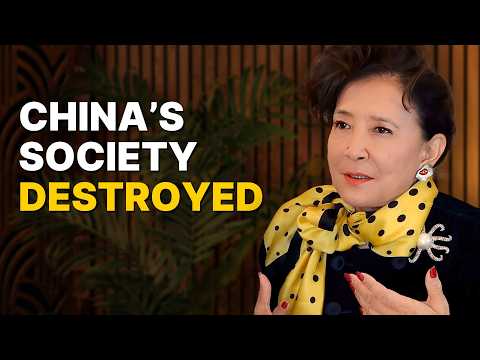
Jung Chang (Wild Swans author) — Living through history's largest man-made famine
Jung Chang (guest), Dwarkesh Patel (host)
In this episode of Dwarkesh Podcast, featuring Jung Chang and Dwarkesh Patel, Jung Chang (Wild Swans author) — Living through history's largest man-made famine explores jung Chang recalls Mao’s terror: famine, brainwashing, and survival Jung Chang recounts her upbringing in Maoist China, from a privileged communist household to exile as a peasant, barefoot doctor, and factory worker after her father criticized Mao and was tortured and driven insane. She describes how total control, propaganda, and terror produced genuine worship of Mao and made dissent or organized resistance almost impossible, even for top officials such as Liu Shaoqi and Deng Xiaoping.
Jung Chang recalls Mao’s terror: famine, brainwashing, and survival
Jung Chang recounts her upbringing in Maoist China, from a privileged communist household to exile as a peasant, barefoot doctor, and factory worker after her father criticized Mao and was tortured and driven insane. She describes how total control, propaganda, and terror produced genuine worship of Mao and made dissent or organized resistance almost impossible, even for top officials such as Liu Shaoqi and Deng Xiaoping.
Chang explains the Great Leap Forward famine as a deliberate policy of extracting grain from peasants to fund heavy industry, magnified by Mao’s profound economic ignorance and catastrophic campaigns such as backyard steel furnaces and the extermination of sparrows. She details the Cultural Revolution as a psychological war on the population, using youth violence, forced self‑criticism, and the breaking of family bonds to atomize society.
The conversation also explores why today’s Chinese regime still venerates Mao, the role of ideology versus pure power-seeking, why Deng protected the Party rather than denouncing Mao, and why Western intellectuals have often excused or romanticized communist regimes. Chang reflects on how she eventually became a writer in Britain, using her mother’s stories to write Wild Swans and later a critical biography of Mao.
Key Takeaways
Totalitarian control depends on both isolation and terror.
Chang emphasizes that Maoist brainwashing worked because China was sealed off from alternative information and dissent was punished with extreme violence, making even private doubts about Mao psychologically difficult and physically dangerous.
Get the full analysis with uListen AI
The Great Leap Forward famine was driven by deliberate grain extraction, not just ‘policy mistakes’.
Mao exported food to buy Soviet and Eastern European industrial equipment, fully aware peasants would starve, while communes and travel controls prevented rural flight and revolt; backyard furnaces and anti‑sparrow campaigns compounded the disaster.
Get the full analysis with uListen AI
Communes were designed primarily as instruments of control, not efficiency.
Collectivization allowed the Party to organize hundreds of millions of peasants into a manageable number of units, control food allocation, approve marriages and travel, and quickly suppress any attempt at resistance.
Get the full analysis with uListen AI
Self‑criticism and forced confessions were tools to break people and prevent organization.
Maoist denunciation and self‑criticism sessions humiliated individuals, turned friends and colleagues against each other, and made people doubt their own moral instincts, thereby destroying trust and making conspiracy against the regime nearly impossible.
Get the full analysis with uListen AI
Even high-ranking victims like Deng Xiaoping chose to protect the Party over truth about Mao.
Despite personal tragedy, Deng avoided a Khrushchev-style denunciation of Mao because he believed exposing Mao’s crimes could collapse communist rule in China, prioritizing Party survival—and associated privilege—over historical reckoning.
Get the full analysis with uListen AI
Mao used young people’s worst impulses as a political weapon, then discarded them.
During the Cultural Revolution he licensed student violence against teachers and ‘class enemies’ to create chaos and terror, later reining in Red Guards with the army and sending the most radical youth to remote regions once they had served his purpose.
Get the full analysis with uListen AI
Erasing history and banning critical narratives enables Mao’s continued veneration.
Chang notes that her books are banned, historical research is tightly controlled, and parents often avoid telling children about past suffering, so new generations grow up with sanitized textbooks, state-promoted Mao worship, and few countervailing stories.
Get the full analysis with uListen AI
Notable Quotes
“China was literally a cultural desert without books, cinemas, theaters, museums for ten years.”
— Jung Chang
“I was always writing in my head with an imaginary pen.”
— Jung Chang
“If this is paradise, what then is hell?”
— Jung Chang, recalling her 16-year-old thoughts about ‘socialist paradise’
“Mao basically seized this food to export to Russia and Eastern Europe, knowing his people would die of starvation.”
— Jung Chang
“Deng Xiaoping could not have denounced Mao without endangering the rule of the Party.”
— Jung Chang
Questions Answered in This Episode
If Mao’s system relied so heavily on isolation and terror, what concrete measures in today’s China most closely mirror those mechanisms of control?
Jung Chang recounts her upbringing in Maoist China, from a privileged communist household to exile as a peasant, barefoot doctor, and factory worker after her father criticized Mao and was tortured and driven insane. ...
Get the full analysis with uListen AI
How might Chinese society and politics have evolved if Deng Xiaoping had openly denounced Mao in the 1980s, as Khrushchev did with Stalin?
Chang explains the Great Leap Forward famine as a deliberate policy of extracting grain from peasants to fund heavy industry, magnified by Mao’s profound economic ignorance and catastrophic campaigns such as backyard steel furnaces and the extermination of sparrows. ...
Get the full analysis with uListen AI
What responsibilities do Western intellectuals and institutions have when assessing or teaching about regimes like Mao’s, given the history of romanticization and denial?
The conversation also explores why today’s Chinese regime still venerates Mao, the role of ideology versus pure power-seeking, why Deng protected the Party rather than denouncing Mao, and why Western intellectuals have often excused or romanticized communist regimes. ...
Get the full analysis with uListen AI
How can Chinese families and writers preserve and transmit truthful memories of Mao’s era when official censorship and social pragmatism discourage open discussion?
Get the full analysis with uListen AI
To what extent is modern China’s economic success inseparable from, or in tension with, its unresolved relationship to Mao’s legacy and the Party’s monopoly on power?
Get the full analysis with uListen AI
Transcript Preview
And my father spoke up against Mao's policies. He was arrested, tortured, driven insane. And my mother was under tremendous pressure to denounce my father. She refused, and my mother was made to kneel on broken glass, um, she was paraded in the streets where children spat at her and threw stones at her. The desire to write never left me. So in the following years, when I was working as a peasant, and as a barefoot doctor, as a steel worker, and an electrician, I was always writing in my head with an imaginary pen.
Today, I have the pleasure of interviewing Jung Chang. Her first book, Wild Swans, has sold over 15 million copies worldwide. The US diplomat, George Kennan, described the Gulag Archipelago, he said, "This is the greatest and most powerful single indictment of a political regime ever to be leveled in modern times." And when I read that quote, I realized this is exactly how I describe your books. Um, Wild Swans obviously, but also your biography of Mao, titled Mao: The Unknown Story, both of which we'll talk about today. Um, it is a true honor to speak with you.
Thank you very much for having me.
So w- we will get into Mao and his atrocities in a second, but let us begin by, w- would you mind laying the scene for us? What was it like? Y- you grew up under, in China, under Mao. L- let's begin there, what was it like as you, as you started to grow up during this time?
I was born in China, in Sichuan, in 1952. So I grew up under Mao. Um, when I was a child, I led quite a privileged life because both my parents were communist officials and we lived in this compound with, um, uh, you know, servants, cooks, drivers. It was very class-driven society and I grew up so much taking, um, class and privilege for granted, that when I first came to Britain, I thought Britain was wonderfully classless. (laughs) And my, of course my views were slightly modified over the years. Um, and then in 1966, when I was 14, Mao launched his cultural revolution which was his Great Purge. And my father spoke up against Mao's policies. Um, so as a result, he was arrested, tortured, driven insane. He was exiled to a camp and died, um, tragically and prematurely. My mother was under tremendous pressure to denounce my father. She refused. As a result, she went through over 100 of these ghastly denunciation meetings, which were everyday features in China at the time. And basically the victims, uh, were put on the stage and their arms were ferociously twisted to the back and their heads were pushed down, um, they were kicked and beaten and my mother was m- once made to kneel on broken glass. Um, she was paraded in the streets where children spat at her and threw stones at her. Um, but she survived. And today, she still lives in Chengdu, at age 92. My family was scattered and I was exiled to the edge of the Himalayas and worked as a peasant and then as a barefoot doctor, uh, which was a doctor basically without any training, because Mao had said, "The more books you read, the more stupid you become." So schools were closed, you know, books were burned. Um, I mean China was literally a cultural desert without books, cinemas, theaters, museums for ten years. Um, and um then I became an electrician, and again there was no training so I had five electric shocks in one month. (laughs) Um, and then in 1973, mm, partly, if you know, after Nixon's visit to China, mm, I mean, uh, but more, more also because for the internal political reasons, and universities have began to reopen and I was able to get into Sichuan University to learn English. Uh, but you know, our teachers had never seen foreigners themselves, because China had been closed to the outside world after the communists took power in 1949. So our textbooks were written by these teachers who'd never been abroad. I remember the first lesson was long live Chairman Mao.
Install uListen to search the full transcript and get AI-powered insights
Get Full TranscriptGet more from every podcast
AI summaries, searchable transcripts, and fact-checking. Free forever.
Add to Chrome