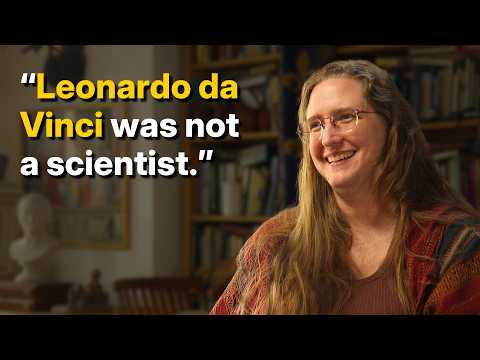
Why Leonardo was a saboteur, Gutenberg went broke, and Florence was weird – Ada Palmer
Dwarkesh Patel (host), Ada Palmer (guest)
In this episode of Dwarkesh Podcast, featuring Dwarkesh Patel and Ada Palmer, Why Leonardo was a saboteur, Gutenberg went broke, and Florence was weird – Ada Palmer explores renaissance humanism’s messy pipeline to science, power, printing, and progress Palmer argues the Renaissance wasn’t a simple “rediscover classics → get science” story but a long, stepwise process: building libraries, expanding access to texts, learning new ways to use information, and only later applying those habits to nature.
Renaissance humanism’s messy pipeline to science, power, printing, and progress
Palmer argues the Renaissance wasn’t a simple “rediscover classics → get science” story but a long, stepwise process: building libraries, expanding access to texts, learning new ways to use information, and only later applying those habits to nature.
She contrasts idealistic humanist goals (Petrarch’s dream of virtuous Roman-style rulers) with how elites used antiquity as propaganda and legitimacy, especially in socially “weird” Florence where merchants ruled without nobility.
The episode also reframes the printing press as an information revolution with delayed payoffs: Gutenberg and early printers went broke because mass production arrived before distribution networks, which later emerged via Venice’s hub logistics and book fairs.
Finally, Palmer stresses that historical actors rarely get the future they want; they create ecosystems that can “go well” in unexpected ways—an analogy the host connects to modern AI governance and unintended consequences.
Key Takeaways
Italian republics clustered where cities could self-sustain after Rome fell.
Palmer links republican survival to local agricultural capacity and urban wealth: strong cities could maintain security and governance; weaker ones gravitated toward lordly protection and monarchic structures.
Get the full analysis with uListen AI
Humanism began as a moral technology for training rulers, not a science program.
Petrarch and successors sought to recreate the educational environment of Rome (Plato, Cicero, Livy) to produce leaders who would serve the state over family—yet the first “classically trained” elites often became more effective warmakers.
Get the full analysis with uListen AI
Classical culture functioned as legitimacy and status-judo for upstarts.
The Medici and other non-noble powers used art, architecture, Greek-learning, and curated “Roman” symbolism to invert diplomatic hierarchies—making nobles feel culturally inferior and inducing alliances.
Get the full analysis with uListen AI
Machiavelli reframed classics as case studies—an early move toward social science.
After observing virtuous rulers fail and ruthless ones succeed, he rejects ‘virtue by osmosis’ and proposes comparing historical examples to infer what works—an analytic method later echoed in Baconian empiricism.
Get the full analysis with uListen AI
Florence was structurally ‘weird’: an anti-noble, merchant-oligarchic republic using sortition.
Unlike Venice/Genoa’s noble senates, Florence expelled or forced renunciation of nobility and lottery-selected guild elites to govern, locking officials in a tower for short terms to reduce capture—until the Medici learned to game the system.
Get the full analysis with uListen AI
The Medici’s rise shows how finance + patronage can capture republican institutions.
As papal bankers they controlled huge cash flows and networks; domestically, employing a large share of citizens meant “random” councils reliably included their clients, enabling de facto control without abolishing republican forms.
Get the full analysis with uListen AI
Printing succeeded only after distribution and trust infrastructure emerged.
Gutenberg’s mass output failed in a world lacking commodity distribution; Venice’s shipping hub and book fairs (e. ...
Get the full analysis with uListen AI
Censorship reliably targets the ‘wrong’ thing, and fast media is hardest to police.
Authorities could shape books via licensing but struggled with anonymous, rapidly replicated pamphlets—printers learned arrests were avoidable by moving. ...
Get the full analysis with uListen AI
The ‘Scientific Revolution’ depended on a new social norm: publish and share.
Palmer calls Leonardo a “saboteur” of progress because he hid discoveries; Bacon’s ideal scientist is the honeybee—collecting from nature, processing it, and producing shared, useful knowledge via academies and publication.
Get the full analysis with uListen AI
Italy’s lack of an Industrial Revolution reflects incentives, not capability.
Palmer suggests Italy’s agricultural/finance dominance reduced pressure to industrialize; political fragmentation, land value, and preference for luxury artisanal output also mattered—even when proto-industrial methods existed.
Get the full analysis with uListen AI
Notable Quotes
“He did not create a world that went as he wanted, but… he created a world that went well.”
— Ada Palmer
“This is based on an assumption that education is very much like osmosis, that if you're exposed to something, you'll imitate it.”
— Ada Palmer
“They’re cosplaying the Roman Republic… wearing a Florentine toga while in office.”
— Ada Palmer
“Printed books are a mass-produced commodity in a world that does not have distribution networks for mass-produced commodities.”
— Ada Palmer
“Leonardo da Vinci was not a scientist… he writes everything… in coded mirror writing so that nobody but him can possibly use it.”
— Ada Palmer
Questions Answered in This Episode
Florence’s lottery government sounds almost modern in its anti-corruption logic—what concrete evidence shows consensus-and-sortition worked better (or worse) than elections in practice?
Palmer argues the Renaissance wasn’t a simple “rediscover classics → get science” story but a long, stepwise process: building libraries, expanding access to texts, learning new ways to use information, and only later applying those habits to nature.
Get the full analysis with uListen AI
In your view, what specific “micro-technologies” of knowledge (footnotes, glossaries, vernacular translations) mattered most for turning classics into widely usable tools—and when did each become common?
She contrasts idealistic humanist goals (Petrarch’s dream of virtuous Roman-style rulers) with how elites used antiquity as propaganda and legitimacy, especially in socially “weird” Florence where merchants ruled without nobility.
Get the full analysis with uListen AI
You describe Medici control as a kind of ‘regulatory capture.’ Which levers mattered most: payroll patronage, bribing election administrators, or control of information/propaganda?
The episode also reframes the printing press as an information revolution with delayed payoffs: Gutenberg and early printers went broke because mass production arrived before distribution networks, which later emerged via Venice’s hub logistics and book fairs.
Get the full analysis with uListen AI
If pamphlets were effectively unpoliceable, what *did* successfully reduce their impact—price shocks, seizure of paper supplies, targeting distributors, or reputational countermeasures (early ‘fact-checking’)?
Finally, Palmer stresses that historical actors rarely get the future they want; they create ecosystems that can “go well” in unexpected ways—an analogy the host connects to modern AI governance and unintended consequences.
Get the full analysis with uListen AI
On the “Leonardo as saboteur” claim: how representative was secrecy among leading engineers/artists, and what changed culturally to make open publication morally prestigious by Bacon’s time?
Get the full analysis with uListen AI
Transcript Preview
Today I'm chatting with Ada Palmer, who is a Renaissance historian, a novelist, a composer based at the University of Chicago. And today we're discussing your book, Inventing the Renaissance. Ada, thanks for coming on the podcast.
Been looking forward.
First question. You've got in this period in the late fifteenth century, early sixteenth century in Italy, all these different republics, Venice, Florence, Genoa, um, and that seems unusual both for the time period and for the place.
Yeah.
What gives?
One of the big reasons that the Italian city republics are clustered in Italy is that when the Roman Empire dissolved in the West, individual cities then needed to self-govern. And this is true all across Europe, right? And those individual cities could no longer get the centralized Roman government to oversee supply routes, keep the roads free of bandits, uh, you could no longer import and export goods at scale, you could no longer rely on central infrastructure. You had to support things yourself. Larger, wealthier towns were able to make this transition because they could support themselves from the local resources and the farms attached to them. So the larger, wealthier towns surrounded by good agricultural land were more successful at converting over to, okay, let's have a senate like the old Roman Senate. Let's have our top families form a council. They will rule. We'll set up a republic. A weaker town that can't support itself as well is much more prone to one wealthy family realizes that they can get goons and take over and declare themselves the monarch of the area. Or worse, this town cannot self-sustain. It doesn't have enough. People there can't get food. They are scared. They're afraid of being robbed by people who are desperate. But outside of town, there is a wealthy villa that belongs to a noble family, and they have bodyguards. "Hey, noble family, if I move next to your villa and work for you, will you protect me with your bodyguards?" So towns emptied out and villages, as in villa and its environs-
Mm.
-developed as a result, and a village was a monarchal structure in this sense, that was the migration of people out of a town into the protection zone of a local lordling, right? And then those villages grew to different scales, some of them cities, some not. So Italy had great agriculture and great agricultural land, so more of Italy's cities were able to sustain themselves as towns and be republics.
I feel like the big take of your book is they were trying to resuscitate Roman virtues. What were the things that-- what were the virtues that the Roman emperors had which allowed this, you know, the safety and good government-
Stability.
-et cetera, to work? And, um, I don't understand the connection between reading Cicero and contemplating the virtues of a great emperor to dot, dot, dot science and technology.
[laughing]
Uh, maybe there isn't one, but d-do you think there is one, and what, what exactly is that connection?
Install uListen to search the full transcript and get AI-powered insights
Get Full TranscriptGet more from every podcast
AI summaries, searchable transcripts, and fact-checking. Free forever.
Add to Chrome