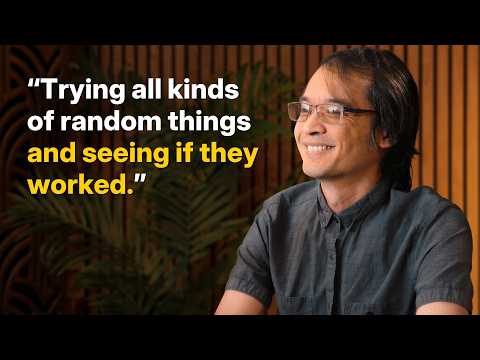
Terence Tao – Kepler, Newton, and the true nature of mathematical discovery
Dwarkesh Patel (host), Terence Tao (guest)
In this episode of Dwarkesh Podcast, featuring Dwarkesh Patel and Terence Tao, Terence Tao – Kepler, Newton, and the true nature of mathematical discovery explores terence Tao on AI math: verification, depth, and new workflows Kepler’s laws illustrate how massive hypothesis generation only matters when paired with high-quality data and rigorous verification, and AI similarly drives the cost of idea generation toward zero while shifting the bottleneck to validation and filtering.
Terence Tao on AI math: verification, depth, and new workflows
Kepler’s laws illustrate how massive hypothesis generation only matters when paired with high-quality data and rigorous verification, and AI similarly drives the cost of idea generation toward zero while shifting the bottleneck to validation and filtering.
Scientific and mathematical progress is not just about correctness but about adoption, narrative, and context over time, which makes it hard to algorithmically identify “unifying” ideas or score partial progress in the moment.
Current AI math successes (e.g., Erdős problems) are real but skewed by selection bias: systematic sweeps show low per-problem success rates, and recent “one-shot” breakthroughs plateaued after low-hanging fruit.
AI is already making mathematical work richer and broader (code, plots, literature search, formatting, experimental math), but it has not yet reliably improved the deepest step—creating new techniques that bridge the last resistant gaps.
Tao expects human–AI hybrids to dominate for a long time, with major gains coming from reorganizing research around AI’s breadth and building better semi-formal languages and benchmarks for strategies, plausibility, and intermediate progress.
Key Takeaways
AI makes hypotheses abundant; verification becomes the scarce resource.
Tao argues AI collapses the cost of generating theories, similar to how the internet collapsed communication costs, but science must scale evaluation, validation, and prioritization or drown in low-signal output.
Get the full analysis with uListen AI
High-quality data is the enabling constraint for meaningful “Kepler-like” pattern-finding.
Kepler’s success depended on Brahe’s extra decimal of accuracy; without strong datasets, mass ideation degenerates into “slop,” whether from humans or models.
Get the full analysis with uListen AI
Small datasets can create seductive but false laws—AI will amplify this failure mode.
Tao’s Bode’s-law example shows how fitting patterns to a few points can look profound until new data breaks it; AI’s speed increases the risk of overfitting and premature hype.
Get the full analysis with uListen AI
“Unifying concepts” are often only recognizable after adoption and downstream use.
Tao notes that ideas like deep learning architectures or numeric conventions gain importance through social standardization and future applications, not from an objective, context-free score at birth.
Get the full analysis with uListen AI
AI math progress is real but systematically overstated by spotlighting wins.
Across broad problem sweeps, Tao cites ~1–2% success per problem; social media highlights the solved subset, masking the large base rate of failures and stalled attempts.
Get the full analysis with uListen AI
Today’s tools improve breadth tasks more than the deepest creative steps.
Tao reports AI accelerates auxiliary work (plots, code, formatting, literature search) and makes papers “richer and broader,” but the hardest “last 20%” requiring new techniques remains mostly human-driven.
Get the full analysis with uListen AI
Formal proofs may be incomprehensible at first, but they’re analyzable artifacts.
Even if an AI produces a massive Lean proof, Tao expects a future ecosystem of refactoring, ablation, summarization, and “proof engineering” to extract the key lemmas and conceptual novelty.
Get the full analysis with uListen AI
Notable Quotes
“AI has basically driven the cost of idea generation down to almost zero.”
— Terence Tao
“It’s made the papers sort of richer and broader, but not necessarily deeper.”
— Terence Tao
“Whenever we do a systematic study, any given problem, an AI tool has a success rate of maybe one or 2%. It’s just that they can apply a scale, and if you just pick the winners, it looks great.”
— Terence Tao
“Often the ultimately correct theory initially is worse in many ways.”
— Terence Tao
“If there was some framework that sort of mimics how scientists talk to each other in a semi-formal way… we don’t know how to capture [the subjective aspect] in a way that we can insert AI into them in any useful way.”
— Terence Tao
Questions Answered in This Episode
In your Kepler/LLM analogy, what would be the modern equivalent of “Brahe-level data quality” for AI-driven science—what properties would a dataset need to prevent Bode’s-law-style overfitting?
Kepler’s laws illustrate how massive hypothesis generation only matters when paired with high-quality data and rigorous verification, and AI similarly drives the cost of idea generation toward zero while shifting the bottleneck to validation and filtering.
Get the full analysis with uListen AI
You suggest hypothesis generation isn’t the bottleneck anymore; in math specifically, what are the top 2–3 bottlenecks you’d prioritize engineering solutions for (verification, search, decomposition, literature, incentives)?
Scientific and mathematical progress is not just about correctness but about adoption, narrative, and context over time, which makes it hard to algorithmically identify “unifying” ideas or score partial progress in the moment.
Get the full analysis with uListen AI
What would a concrete “semi-formal language for strategies” look like—could you sketch a toy example of representing plausibility, partial progress, or a research program step-by-step?
Current AI math successes (e. ...
Get the full analysis with uListen AI
If Lean proofs become the primary artifact, what workflows (ablation tests, lemma importance scoring, proof compression) would best extract human-understandable insight from a giant AI-generated proof?
AI is already making mathematical work richer and broader (code, plots, literature search, formatting, experimental math), but it has not yet reliably improved the deepest step—creating new techniques that bridge the last resistant gaps.
Get the full analysis with uListen AI
On the Erdős problems plateau: is the limiting factor model capability, lack of good intermediate objectives, or missing infrastructure (benchmarks, datasets, toolchains) for iterative progress?
Tao expects human–AI hybrids to dominate for a long time, with major gains coming from reorganizing research around AI’s breadth and building better semi-formal languages and benchmarks for strategies, plausibility, and intermediate progress.
Get the full analysis with uListen AI
Transcript Preview
Okay. Today, I'm chatting with Terence Tao, who needs no introduction. Terence, I wanna begin by having you retell the story of how Kepler discovered the laws of planetary motion because I think this will be a great jumping off point to talk about AI for math.
Okay. Yeah. So I've always had an amateur interest in astronomy, and so I've, I've, I've loved stories of how the early astronomers worked out, um, the nature of the universe. Um, so, uh, Kepler was building on the work of Copernicus, um, who was himself building on the work of Aristarchus. Uh, so, uh, Copernicus very famously proposed the heliocentric model that, um, uh, instead of the planets and the Sun going around the Earth, that the Sun was at the center of the solar system and the other planets were, were going around, uh, the Sun. And Copernicus proposed that the orbits of the planets were perfect circles. And his theory kind of fit, uh, the observations that, um, the, the Greeks and the Arabs and the Indians had worked out over, over centuries. Um, I think, uh, Kepler got interested... Uh, like he learned about these, these theories, um, in his, in his studies and he made this observation that the ratios of the, uh, size of the orbits that Copernicus predicted seemed to have some geometric meaning. Um, I think, uh, uh, yeah, he, he started proposing that, uh, you know, if you, if you take, um, say the orbit of, of, um, say the Earth and you enclose it in I think maybe a cube, um, the, uh, the outer sphere of that, that encloses the cube almost matched perfectly the orbit of Mars and so forth. Um, and there were six planets known at the time, five gaps between them, and there were five perfect Platonic solids, uh, the cube, the tetrahedron, icosahedron, octahedron, and dodecahedron. And so he had this, this theory which he thought was absolutely beautiful, that he, he could inscribe these Platonic solids between the spheres of the planets and it seemed to fit and it, it, it seemed to be to him like, you know, God's design of the planets was, was matching this mathematical perfection of the Platonic solids. So he needed data to, um, confirm this theory. And at the time, there was only one really high-quality data set, um, [laughs] almost in existence, okay, which was the... So, uh, Tycho Brahe, this Danish astronomer, um, very wealthy, eccentric astronomer, had managed to convince the Danish government to fund this extremely expensive observatory, this, in fact, an entire island, um, where he had taken decades of observations of all the planets, Mars, Jupiter, um, every night, or at least every night for which the weather was clear, with the naked eye actually. This is, uh, he was the last of the, of the naked eye astronomers. And so he had all this data which Kepler could use to confirm his theory. And so Kepler started working with, with Tycho, but Tycho was very jealous of the data. He only gave him little bit, bits of it at a time. Um, and I think, uh, Ke-Kepler eventually just stole the data actually. He co- he copied it and, and, uh, had to have a fight with, with, uh, uh, Brahe's descendants. Um, but he did work out-- Uh, he did get the data, um, and then he worked out to kind of his disappointment that, um, his beautiful theory didn't quite work. Like the data was sort of off from his, um, Platonic solid theory by, you know, about 10% or something. And he tried all kinds of fudges, moving the circles around and things. And it, it, it didn't quite work. But he worked on this problem for, for, for years and years and eventually he figured out how to use the data to, to work out the actual orbits of, um, um, of the planets. Um, and that was an incredibly clever genius amount of data analysis, like actually. And, um, yeah, and then he eventually worked out that the, the, uh, uh, they also are actually ellipses, not circles, which was shocking to him. Uh, and then he worked out, um, uh, so he worked out the two laws of planetary, two laws of planetary motion, the ellipses also equal areas sweep out, uh, equal times. Um, and then 10 years later, yeah, after collecting a lot of data, the, the, the f- the, the furthest planets like, um, like Saturn and Jupiter were the hardest for him to, to work out, but then he, he finally worked out this third law also that, uh, um, uh, that the, uh, the orbits, the, the, the time it takes for a planet to complete its orbit was proportional to some power of, of the distance to the Sun. And these are the th- three famous Kepler's laws, laws of motion, um, and he had no explanation for them. It, it, uh, it, uh, it was just all driven by, by experiment and it took Newton a century late-later to give a theory that explained all three laws at once.
Install uListen to search the full transcript and get AI-powered insights
Get Full TranscriptGet more from every podcast
AI summaries, searchable transcripts, and fact-checking. Free forever.
Add to Chrome