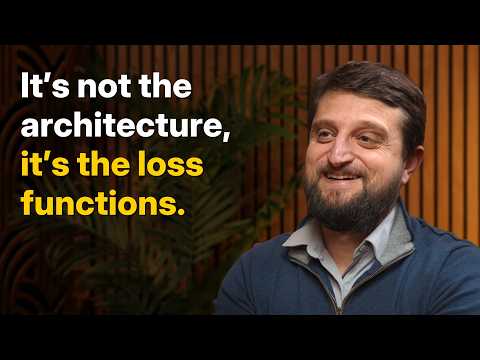
Adam Marblestone – AI is missing something fundamental about the brain
Dwarkesh Patel (host), Adam Marblestone (guest), Narrator, Narrator
In this episode of Dwarkesh Podcast, featuring Dwarkesh Patel and Adam Marblestone, Adam Marblestone – AI is missing something fundamental about the brain explores why brains outlearn AIs: hidden loss functions and steering systems Adam Marblestone argues that current AI systems miss several fundamental ingredients that make biological brains sample-efficient, aligned, and flexible. He distinguishes between a "learning subsystem" (cortex-like, general world model) and a "steering subsystem" (subcortical, innate rewards and reflexes) and suggests evolution poured most complexity into the latter—especially rich, developmentally-timed cost functions. This architecture may support omnidirectional probabilistic inference, continual learning, and the robust wiring of abstract learned concepts (like social status) to primitive drives (like shame or fear). Marblestone also discusses amortized vs non‑amortized inference, neuromorphic hardware tradeoffs, formal methods in math and software, and a concrete roadmap for large-scale connectomics to ground AI and alignment in actual brain mechanisms.
Why brains outlearn AIs: hidden loss functions and steering systems
Adam Marblestone argues that current AI systems miss several fundamental ingredients that make biological brains sample-efficient, aligned, and flexible. He distinguishes between a "learning subsystem" (cortex-like, general world model) and a "steering subsystem" (subcortical, innate rewards and reflexes) and suggests evolution poured most complexity into the latter—especially rich, developmentally-timed cost functions. This architecture may support omnidirectional probabilistic inference, continual learning, and the robust wiring of abstract learned concepts (like social status) to primitive drives (like shame or fear). Marblestone also discusses amortized vs non‑amortized inference, neuromorphic hardware tradeoffs, formal methods in math and software, and a concrete roadmap for large-scale connectomics to ground AI and alignment in actual brain mechanisms.
Key Takeaways
Brains likely use many rich, evolution-designed loss functions, not a single simple objective.
Modern ML prefers mathematically simple losses like next-token prediction, but Marblestone argues evolution encoded a complex curriculum of region-specific, developmentally-timed cost functions that dramatically boost sample efficiency and shape what is learned.
Get the full analysis with uListen AI
A separate "steering subsystem" wires high-level learned concepts into primitive reward and reflex circuits.
Subcortical areas (e. ...
Get the full analysis with uListen AI
The cortex may implement omnidirectional probabilistic inference rather than one-way next-token prediction.
Instead of computing only P(next token | past tokens), cortical areas may approximate the joint distribution over many variables, allowing any subset of inputs to predict any other subset—supporting flexible cross-modal prediction (e. ...
Get the full analysis with uListen AI
Understanding brain architecture means focusing on learning rules, cost functions, and connectivity, not decoding every neuron.
Marblestone suggests we should model the brain analogously to ML systems—by its architecture, learning algorithms, initializations, and training signals—rather than trying to interpret arbitrary learned microcircuits like “the Golden Gate Bridge neuron. ...
Get the full analysis with uListen AI
Neuroscience can realistically answer core AI questions if we invest billions in scalable tools like connectomics.
Technologies like optical, molecularly-annotated connectomes could drive the cost of a mouse connectome down from billions to tens of millions of dollars, enabling systematic mapping of learning vs steering subsystems across species within a decade if funded at low-billions scale.
Get the full analysis with uListen AI
Formal verification plus LLMs could transform both pure math and software safety.
Languages like Lean make proofs mechanically checkable, turning correctness into a perfect RL signal. ...
Get the full analysis with uListen AI
AI timelines matter for how much neuroscience will influence AGI’s final paradigm.
If transformative AI arrives in a few years via scaled LLMs, detailed brain-inspired designs may not land in time; if timelines are closer to a decade, large-scale connectomics and steering-subsystem insights could shape safer, more capable next-generation architectures.
Get the full analysis with uListen AI
Notable Quotes
““Evolution may have built a lot of complexity into the loss functions… a lot of Python code, basically, generating a specific curriculum for what different parts of the brain need to learn.””
— Adam Marblestone
““The steering subsystem has its own sensory system, which is kind of crazy… there’s a visual system with innate heuristics, and parts of cortex learn to predict those responses.””
— Adam Marblestone
““It’s kind of crazy that we don’t use value functions in LLMs… conceptually it’s a really dumb form of RL compared to what was being done ten years ago.””
— Adam Marblestone
““I want to describe the brain the same way we describe neural networks: architectures, learning rules, initializations, training data… not by finding the Golden Gate Bridge circuit.””
— Adam Marblestone
““If every iPhone was also a brain scanner, we would be training AI with brain signals.””
— Adam Marblestone
Questions Answered in This Episode
If evolution primarily encoded sophisticated reward functions and curricula, how could we systematically design analogous steering systems for artificial agents?
Adam Marblestone argues that current AI systems miss several fundamental ingredients that make biological brains sample-efficient, aligned, and flexible. ...
Get the full analysis with uListen AI
What concrete experiments could distinguish between the cortex implementing amortized inference vs explicit probabilistic sampling or energy-based models?
Get the full analysis with uListen AI
How minimal can a steering subsystem be while still supporting general intelligence—and does that make misaligned super-intelligent agents easier to build than human-like ones?
Get the full analysis with uListen AI
In what domains should we prioritize formal verification and Lean-style tooling first, given limited engineering resources but rising AI capabilities?
Get the full analysis with uListen AI
How should AI labs and governments balance investing in GPU scaling versus large-scale neuroscience infrastructure like connectomics, given different AI timeline scenarios?
Get the full analysis with uListen AI
Transcript Preview
The big million-dollar question that I have that, um, I've been trying to get the answer to through all these interviews with AI researchers, how does the brain do it, right? Like, we're throwing way more data at these LLMs, and they still have a small fraction of the total capabilities that a human does. So what's going on?
Yeah. I mean, this might be the quadrillion-dollar question-
(laughs)
... or something like that. It's, it's, it's arguably, you could make an argument this is the most important, you know, question in science. I don't claim to know the answer. I, I also don't really think that the answer will necessarily come even from a lot of smart people thinking about it as much as they are. I, my, my overall, like, meta-level take is that we have to empower the field of neuroscience to just make neuroscience a, a more powerful, uh, field, technologically and other otherwise, to actually be able to crack a question like this. But maybe the, the way that we would think about this now with, like, modern AI, neural nets, deep learning, is that there are sort of these, these cer- certain key components of that. There's the architecture. Um, there's maybe hyperparameters of the architecture. How many layers do you have or sort of properties of that architecture? There is the learning algorithm itself. How do you train it? You know, backprop, gradient descent, um, is it something else? There is how is it initialized, okay? So if we take the learning part of the system, it still may have some initialization of, of the weights. Um, and then there are also cost functions. There's like, what is it being trained to do?
Yeah.
What's the reward signal? What are the loss functions? Supervision signals. My personal hunch within that framework is that the, the field has neglected, uh, the role of this very specific loss functions, very specific cost functions. Uh, machine learning tends to like mathematically simple loss functions, right? Predict the next token. Um, you know, cross-entropy. The, you know-
Right.
... these, these, these, these, uh, s- simple kind of computer scientist loss functions. I think evolution may have built a lot of complexity into the loss functions. Actually, many different loss functions for different areas, turned on at different stages of development. A lot of Python code, basically, uh, generating, uh, a specific curriculum for what different parts of the brain need to learn. 'Cause evolution has seen many times what was successful and unsuccessful, and e- evolution could encode the knowledge of, of the learning curriculum. So, so in the, in the machine learning framework, maybe we can come back and we can talk about, yeah, where do the loss functions of the brain come from. Can that, can loss fun- different loss functions lead to different efficiency of learning?
You know people say, like, the cortex has got the universal human learning algorithm, the special sauce-
Install uListen to search the full transcript and get AI-powered insights
Get Full TranscriptGet more from every podcast
AI summaries, searchable transcripts, and fact-checking. Free forever.
Add to Chrome