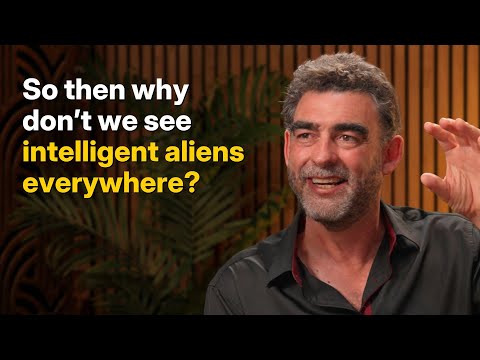
“I find it almost disturbing that the universe favors life this strongly” – Nick Lane
Nick Lane (guest), Dwarkesh Patel (host), Narrator
In this episode of Dwarkesh Podcast, featuring Nick Lane and Dwarkesh Patel, “I find it almost disturbing that the universe favors life this strongly” – Nick Lane explores nick Lane argues life is inevitable, complex life astonishingly rare Nick Lane explains his energy-centric view of life’s origin: on wet, rocky planets, geochemistry in alkaline hydrothermal vents almost deterministically produces carbon-based metabolism, cell-like structures, and eventually proto-cells powered by proton gradients. Because the same elements, minerals, and thermodynamics recur, he expects basic life, nucleotides, and even RNA/DNA-like systems to be common across the galaxy. The profound rarity, in his view, lies in one singular evolutionary event on Earth: the endosymbiotic origin of eukaryotes via mitochondria, which uniquely solved the energy and genome-size constraints blocking complex multicellular organisms. Lane and Patel then explore implications for astrobiology, sex and the two-sex system, genome architecture, and even consciousness, tying many of these puzzles back to mitochondria and energy flow. Lane finds it “almost disturbing” how strongly the universe’s laws seem to favor life, while still leaving complex, intelligent life extremely improbable.
Nick Lane argues life is inevitable, complex life astonishingly rare
Nick Lane explains his energy-centric view of life’s origin: on wet, rocky planets, geochemistry in alkaline hydrothermal vents almost deterministically produces carbon-based metabolism, cell-like structures, and eventually proto-cells powered by proton gradients. Because the same elements, minerals, and thermodynamics recur, he expects basic life, nucleotides, and even RNA/DNA-like systems to be common across the galaxy. The profound rarity, in his view, lies in one singular evolutionary event on Earth: the endosymbiotic origin of eukaryotes via mitochondria, which uniquely solved the energy and genome-size constraints blocking complex multicellular organisms. Lane and Patel then explore implications for astrobiology, sex and the two-sex system, genome architecture, and even consciousness, tying many of these puzzles back to mitochondria and energy flow. Lane finds it “almost disturbing” how strongly the universe’s laws seem to favor life, while still leaving complex, intelligent life extremely improbable.
Key Takeaways
On wet rocky planets, life-like chemistry is highly constrained and likely common.
Given the ubiquity of carbon, water, CO₂, hydrogen, and minerals like olivine, Lane argues that alkaline hydrothermal vents and CO₂–H₂-driven metabolism will repeatedly emerge, producing similar small organics, fatty acids, membranes, and ultimately proto-cells on a large fraction of planets.
Get the full analysis with uListen AI
Chemiosmotic proton gradients are a fundamental, conserved solution to life’s energy problem.
Across bacteria, archaea, and eukaryotes, cells power growth with membrane potentials and ATP synthase nano-motors; Lane sees this as a deep continuity from vent geochemistry, implying that analogous charge-based systems will likely underpin alien life too.
Get the full analysis with uListen AI
Mitochondria enabled large genomes and complex cells, making eukaryotes the major bottleneck.
Bacteria stay small or become giant only via extreme polyploidy, which is energetically costly and doesn’t yield complex internal structures; mitochondria offload energy production and shrink their own genomes, freeing host cells to expand nuclear genomes and evolve intricate compartmentalization and multicellularity.
Get the full analysis with uListen AI
Eukaryotic complexity may have arisen only once on Earth and is probabilistically rare.
Despite trillions of bacteria and archaea over billions of years and many likely failed endosymbioses, only one lineage produced full eukaryotic architecture; Lane infers that successful, stable endosymbiosis is an extremely low-probability event, even if basic life is common.
Get the full analysis with uListen AI
Mitochondria help explain why there are exactly two sexes and maternal inheritance.
Because mitochondrial genomes degenerate under relaxed selection, uniparental (typically maternal) inheritance and germline ‘mollycoddling’ of oocytes help purge mutations; this sets up a fundamental asymmetry—one sex passes on mitochondria, the other doesn’t—out of which two sexes and their divergent reproductive strategies emerge.
Get the full analysis with uListen AI
Bacterial lateral gene transfer cannot scale to maintain huge genomes; sex can.
Bacteria keep small, streamlined genomes and tap large ‘pan-genomes’ via sporadic gene uptake, which works only when genomes are small; once eukaryotes have large genomes, systematic whole-genome pairing and recombination (sex) becomes necessary to maintain gene quality and adaptability.
Get the full analysis with uListen AI
Mitochondria may be central not just to metabolism but possibly to consciousness.
Lane notes anesthetics act strongly on mitochondria even in single-celled organisms; he speculates that electrochemical fields from mitochondrial respiration might encode an organism’s metabolic state relative to its environment, offering a possible physical substrate for primitive “feelings” and, in complex nervous systems, conscious experience.
Get the full analysis with uListen AI
Notable Quotes
““I find it almost disturbing that the universe favors life this strongly.””
— Nick Lane
““Wet rocky planets are common; you’re going to keep seeing the same constraints again and again.””
— Nick Lane
““The only way you can have a large genome is by having mitochondria and having a eukaryotic cell.””
— Nick Lane
““If you’ve got 1,000 planets with life on, maybe life is gonna be the same way 999 out of 1,000 times.””
— Nick Lane
““There’s so many beautiful ideas killed by ugly facts. There’s no good believing that you’re right; you’ve got to believe you’re probably wrong and keep going anyway.””
— Nick Lane
Questions Answered in This Episode
If simple, prokaryote-like life is widespread, what specific observational signatures (in atmospheres, plumes, or spectra) should we prioritize looking for on exoplanets and icy moons?
Nick Lane explains his energy-centric view of life’s origin: on wet, rocky planets, geochemistry in alkaline hydrothermal vents almost deterministically produces carbon-based metabolism, cell-like structures, and eventually proto-cells powered by proton gradients. ...
Get the full analysis with uListen AI
Could there be fundamentally different energy and information architectures—neither mitochondria nor DNA/RNA-based—that still achieve complex life under non-Earth-like conditions, or are Lane’s constraints truly universal?
Get the full analysis with uListen AI
How might we experimentally distinguish between anesthetics acting as simple metabolic suppressors versus interfering with a deeper, field-based mechanism tied to conscious experience?
Get the full analysis with uListen AI
Given the centrality of mitochondria to genome size and complexity, how should this influence our search for biosignatures that hint specifically at eukaryote-level or multicellular life elsewhere?
Get the full analysis with uListen AI
If feelings and primitive decision-making are rooted in metabolic and electrochemical states, how should we rethink the boundary between ‘mere’ life, sentience, and full-blown consciousness across different organisms?
Get the full analysis with uListen AI
Transcript Preview
(instrumental music plays) If you've got a thousand planets with life on, maybe life is gonna be the same way 999 out of 1,000 times, 'cause it's gonna be carbon-based, it's gonna be water, it's gonna be cells, it's gonna be charges, it's gonna be hydrogen and CO2, and you're gonna face the same constraints.
If life is not only abundant, but almost inevitable, the bottleneck to not seeing aliens everywhere-
Well, there's probably more than one bottleneck, but eukaryotes is, in my own mind-
Right.
... the big one.
You could have had, imagine there's like Frankenstein-like moment where a thing zaps alive.
Hmm, I hate, I hate that as an idea.
If I was a God-fearing person-
Mm-hmm.
... I would hear this and I'd be like, "Wow, this is a vindication of intelligent design."
I mean, I agree with you. It- it- I find it a little, uh, almost disturbing.
Today, I'm chatting with Nick Lane, who is an evolutionary biochemist at University College London, and he has many books and papers which help us reconceptualize life's 4 billion years in terms of energy flow, and helps explain everything from how life came to be in the first place to the origin of eukaryotes to many, uh, contingencies we see today in how life works. So, Nick, maybe a good place to start would be, why are eukaryotes so significant in your worldview of why life is the way it is?
Well, first, thanks for having me here.
(laughs)
This is- this is fun. Uh, I- I love talking about this kinda thing. So- so eukaryotes, what's a eukaryote? It's basically the cells that make us up, but also make up plants and make up things like amoeba or fungi, algae. So basically, everything that's large and complex that you can see is composed of this one cell type called the eukaryotic cell. And we have a nucleus where all the DNA is, where all the genes are, and then a- all this kind of machinery, cell membranes and things. There's just basically a lot of kit in- in- in these cells. And the weirdness is, if you look inside a plant cell or a fungal cell, it looks exactly the same under an electron microscope as one of our cells. But they have a completely different lifestyle. So why would they have all the same kit if they evolved to be a single-celled alga living in an ocean, doing photosynthesis? It's still got the same kit that our cells have. So, we know that because they share all of these things, they arose once in the whole history of life on Earth. There could've been multiple origins, but there's no evidence for that, that, you know, if there was, it disappeared without trace. So we've got this kind of singularity-
Mm.
... which happened about two billion years ago, about two billion years into the history of life on Earth, and this thing happens once that gives rise to all complex life on Earth.
Install uListen to search the full transcript and get AI-powered insights
Get Full TranscriptGet more from every podcast
AI summaries, searchable transcripts, and fact-checking. Free forever.
Add to Chrome