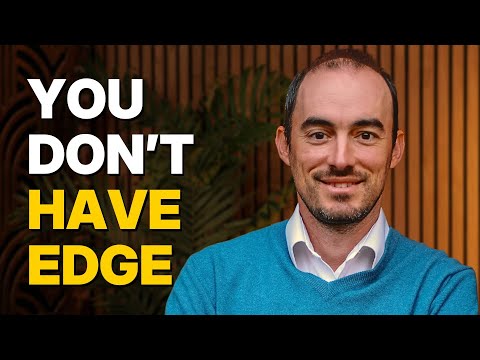
Agustin Lebron - Trading, Crypto, and Adverse Selection
Agustin Lebron (guest), Dwarkesh Patel (host)
In this episode of Dwarkesh Podcast, featuring Agustin Lebron and Dwarkesh Patel, Agustin Lebron - Trading, Crypto, and Adverse Selection explores why Most People Shouldn’t Trade: Edge, Hiring, Crypto, Rationality, Risk Agustin Lebron, former Jane Street trader and author of *The Laws of Trading*, explains why most people lack true edge in markets and why, in expectation, they should generally not trade. He uses concepts like adverse selection, edge, and technical debt to analyze hiring, tech-company bootcamps, and software organizations. The conversation explores finance’s social value, the future of trading in an AI world, and how crypto may integrate into traditional finance rather than replace it. Lebron also discusses talent arbitrage, rationalist culture at Jane Street, and career strategy built around “sequential excellence” across multiple deep specialties.
Why Most People Shouldn’t Trade: Edge, Hiring, Crypto, Rationality, Risk
Agustin Lebron, former Jane Street trader and author of *The Laws of Trading*, explains why most people lack true edge in markets and why, in expectation, they should generally not trade. He uses concepts like adverse selection, edge, and technical debt to analyze hiring, tech-company bootcamps, and software organizations. The conversation explores finance’s social value, the future of trading in an AI world, and how crypto may integrate into traditional finance rather than replace it. Lebron also discusses talent arbitrage, rationalist culture at Jane Street, and career strategy built around “sequential excellence” across multiple deep specialties.
Key Takeaways
Most individuals should not trade; lacking durable edge means negative expected value.
Lebron agrees the “strawsonian” reading of his book is that if you’re smart and hardworking enough to succeed at trading, there are usually easier, more reliable ways to make money; retail traders typically underestimate costs, risks, and the true sophistication of marginal counterparties.
Get the full analysis with uListen AI
Adverse selection is central to both markets and hiring; design around it consciously.
Employers are often bidding against each other for talent where the marginal candidate on the market is weaker, and applicants with many offers pick the best, leaving firms systematically adverse-selected; similarly, retail traders and naive liquidity providers are routinely on the wrong side of trades.
Get the full analysis with uListen AI
Hire for ability and potential, not narrow skills; train via intensive bootcamps.
Lebron argues tech firms over-index on legible skills (e. ...
Get the full analysis with uListen AI
Motivation quality matters: love the game and problem-solving, not just money.
While wanting to “win the game” is necessary in trading, a pure desire to maximize income correlates with bad behaviors and short-termism; the best traders are intensely curious, enjoy competitive environments, and are driven to get very good at obscure, difficult things even without guaranteed payoffs.
Get the full analysis with uListen AI
Technical debt should be treated like real financial debt with explicit trade-offs.
Startups should consciously take on technical debt (like non‑recourse debt) to move fast, expecting rewrites if successful; mature firms end up with huge “interest payments” in the form of migration, refactoring, and maintenance, often absorbing the bulk of their engineering headcount.
Get the full analysis with uListen AI
Finance’s size may be wasteful at the margin, but market making still provides real services.
Lebron is ambivalent about finance being ~9% of GDP, noting much of trading is zero-sum competition; yet market makers like Jane Street genuinely provide liquidity, risk-bearing, and execution services (e. ...
Get the full analysis with uListen AI
Crypto’s success likely looks like deep integration with traditional finance, not replacement.
He is skeptical that constant-function market makers are sustainable for naive LPs and that “laser-eyes” revolution narratives will fully pan out; instead, he expects crypto rails and ideas to be absorbed into mainstream financial plumbing, killing legacy inefficiencies (e. ...
Get the full analysis with uListen AI
Notable Quotes
“If you're smart enough and hardworking enough to make a living at trading, there's probably an easier way to make money.”
— Agustin Lebron
“Software development is fundamentally an exercise in sociology, in organizing teams and creating processes and culture around the building of software.”
— Agustin Lebron
“I would love to talk to the person who is the third-best player in the world at some weird, obscure chess variant.”
— Agustin Lebron
“Life is not short, life is long. You should think of yourself as having many opportunities to learn things, and try things, and do things.”
— Agustin Lebron
“Success for crypto definitely looks like integration into the financial system… we end up with something that's kind of a hybrid of the best of both.”
— Agustin Lebron
Questions Answered in This Episode
If most individuals should not trade, what is the smartest way for a quantitatively-inclined person to get exposure to markets without falling prey to adverse selection?
Agustin Lebron, former Jane Street trader and author of *The Laws of Trading*, explains why most people lack true edge in markets and why, in expectation, they should generally not trade. ...
Get the full analysis with uListen AI
How could a tech company practically redesign its hiring pipeline to focus on global talent, raw ability, and bootcamp training rather than conventional CV filters?
Get the full analysis with uListen AI
Where is the line between healthy technical debt that accelerates learning and deadly debt that locks a startup into unmaintainable systems?
Get the full analysis with uListen AI
In what concrete ways might AI and better tooling change the daily work of market makers over the next 10–20 years, beyond what’s already happened?
Get the full analysis with uListen AI
If crypto’s best outcome is integration with traditional finance, which legacy financial institutions or business models are most vulnerable to being displaced or reshaped?
Get the full analysis with uListen AI
Transcript Preview
I tell my kids this all the time, like, life is not short, life is long. And what that means is, you should think of yourself as having many opportunities to learn things, and try things, and do things. Software development is fundamentally an exercise in sociology, like, in organizing teams and in creating processes and culture and conventions around the building of software.
I think finance is 9% of GDP. Is that too high a price to be paying for liquidity and price discovery? Okay. Today, I have the pleasure of speaking with Augustin Lebrun, who is the author of The Laws of Trading: A Trader's Guide to Better Decision Making for Everyone. Um, this is one of those books, uh, you know Tyler Cowen calls these quake books that completely, um, shift the models you have of the world. Um, I- I- I really, really enjoyed reading this book. Um, so yeah, I- I'll let you describe your, uh, your background, Augustin. But before that, let me just, um, let me ask this question. So, um, Peter Thiel says that the Strawsonian reading of Zero to One is that you shouldn't start a startup. And I think that, uh, k- k- tell me what you think about this. I think the Strawstinian reading of The Laws of Trading is that you shouldn't trade, right? Because, um, you probably don't have edge, uh, because you're not better than a marginal trader. And if you think you have edge, it's probably 'cause you haven't factored in risks and other costs, um, so don't trade. Is- is that- is that what I should take away from this book?
I think you- you pretty much hit the nail on the head. I think a lot of the times that- that people, um, sort of start thinking about trading seriously, they start realizing more and more how- how- how hard a job it really is to do well. And, uh, and the answer is probably, look, if you're smart enough and- and good enough and hardworking enough to- to make a go at it and make a living at it in financial markets, there's probably an easier way to- to make money and, you know, have a satisfying life most of the time.
Okay, yeah. So d- do you wanna, do you wanna talk about, um, your background, and then how, w-what you've been working on in the past and what you're working on now?
Yeah. So- so my background is engineering. That's kind of what I did in university. Uh, I did engineering for about, uh, six years professionally. I was a chip designer. Um, at the time, I was playing a lot of online poker, back when that was a profitable and arguably legal thing to do. Um, and so engineering was getting kind of boring and I wanted to do something else. And- and so I thought, well, what's- what's halfway between engineering and poker? And of course, that's quant trading. Um, so January 2008, walked into my boss's office and I said, "I want to quit." Uh, and- and he said, "Oh, where are you going?" And I said, "I'm gonna go into finance." And he's like, "Are you sure this is a good time to be doing that?" Um, and said, "Yep. No, I'm dead set on it." Um, and a few months later, uh, managed to get a job at Jane Street and- and rode out the implosion of Western civilization (laughs) -
Install uListen to search the full transcript and get AI-powered insights
Get Full TranscriptGet more from every podcast
AI summaries, searchable transcripts, and fact-checking. Free forever.
Add to Chrome