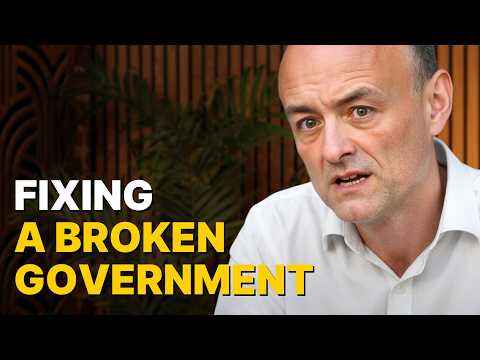
Dominic Cummings — Inside the collapse of western government
Dominic Cummings (guest), Dwarkesh Patel (host), Narrator
In this episode of Dwarkesh Podcast, featuring Dominic Cummings and Dwarkesh Patel, Dominic Cummings — Inside the collapse of western government explores dominic Cummings dissects why Western governments keep failing catastrophically Dominic Cummings argues that core Western institutions—especially the UK state—are structurally incapable of prioritization, execution, and learning, which turns every major crisis into a preventable disaster. He describes Number 10 and Whitehall as outdated, HR‑obsessed bureaucracies where the prime minister’s time is squandered on media, ceremonies, and firefighting, while no one steadily drives long‑term priorities like productivity, technology, or defense reform.
Dominic Cummings dissects why Western governments keep failing catastrophically
Dominic Cummings argues that core Western institutions—especially the UK state—are structurally incapable of prioritization, execution, and learning, which turns every major crisis into a preventable disaster. He describes Number 10 and Whitehall as outdated, HR‑obsessed bureaucracies where the prime minister’s time is squandered on media, ceremonies, and firefighting, while no one steadily drives long‑term priorities like productivity, technology, or defense reform.
Using COVID, Brexit, defense procurement, civil service structure, and intelligence failures as case studies, he shows how responsibility is never matched with authority, incentives reward process‑compliance over outcomes, and anyone who moves fast or succeeds—like the Vaccine Taskforce—is quickly shut down or reabsorbed by the system. He contends that similar dysfunction afflicts critical domains like nukes, biosecurity, cyber, and China policy, hidden behind secrecy and legalism.
Cummings concludes that most politicians optimize for status within an insider media‑political caste, not for solving problems, and that both elites and institutions are locked into self‑reinforcing decay. He believes history suggests collapse and bloodshed are the default, but still argues for building parallel structures, new political parties, and a different kind of elite—technically competent, operationally focused, and morally committed—to attempt a non‑violent regime change in how Western states are run.
Key Takeaways
Prime ministerial time is the system’s scarcest resource and is systematically wasted.
Because almost no part of Whitehall can move quickly or act autonomously, only the PM can cut through legal, bureaucratic, and interdepartmental deadlocks—yet their day is consumed by media management, photo‑ops, and performative crises. ...
Get the full analysis with uListen AI
Responsibility and authority are deliberately separated in the British state.
Ministers are described as ‘running’ departments but can legally fire at most a handful of personal staff; real personnel power lies with permanent secretaries and ultimately only the PM. ...
Get the full analysis with uListen AI
The bureaucracy optimizes for process compliance, not outcomes—even when people are dying.
During COVID, officials tried to force the Vaccine Taskforce and rapid testing teams back under normal HR, procurement, and EU/UK rules, and later sued them for moving too fast. ...
Get the full analysis with uListen AI
Media and insider status games drive political behavior more than voter preferences.
Cummings argues that most MPs and ministers care primarily about their position in the Westminster–media social hierarchy—getting on flagship shows, pleasing journalists, avoiding controversy—rather than solving problems or serving voters. ...
Get the full analysis with uListen AI
Critical national security systems are decaying behind secrecy and accounting tricks.
He claims the UK’s nuclear weapons infrastructure, cyber posture, and exposure to Chinese‑controlled data systems are far worse than Parliament realizes, with rotting facilities, hidden unfunded liabilities, and chronic safety issues. ...
Get the full analysis with uListen AI
Western defense establishments are misaligned with technological reality.
Despite clear evidence from conflicts like Ukraine that cheap drones and software‑centric systems can neutralize multi‑billion‑dollar platforms, the UK continues to double down on vulnerable assets like aircraft carriers and failing drone programs. ...
Get the full analysis with uListen AI
Reform requires parallel institutions and a new elite culture, not incremental tweaks.
Cummings argues you cannot ‘fix’ existing bureaucracies from within; you must create new entities with unified responsibility and authority (like the Vaccine Taskforce), exempt them from legacy rules, and protect them politically. ...
Get the full analysis with uListen AI
Notable Quotes
“In a normal system, nobody really is in charge of anything. Lots of people can veto; almost nobody has the authority just to build something or do something.”
— Dominic Cummings
“The people in politics are almost never actually trying to solve the problem and don’t care about solving the problem.”
— Dominic Cummings
“COVID showed how much faster you can do things if the PM’s authority is used—and it also showed that even when thousands are dying, large parts of the bureaucracy will still say, ‘No, we are optimizing for sticking to the old rules.’”
— Dominic Cummings
“Everything to do with operations and actually getting things done is the lowest‑status thing in Whitehall. The highest‑status thing is bullshit about political strategy and media.”
— Dominic Cummings
“My overall assumption is failure. The Western world will go the same way everyone else goes in history—failure, collapse, and bloodshed. But still, you’ve got to try.”
— Dominic Cummings
Questions Answered in This Episode
If responsibility and authority are structurally separated in modern states, what concrete constitutional changes would be required to reunite them without enabling authoritarian abuse?
Dominic Cummings argues that core Western institutions—especially the UK state—are structurally incapable of prioritization, execution, and learning, which turns every major crisis into a preventable disaster. ...
Get the full analysis with uListen AI
How could a new political party or movement realistically attract top technical and operational talent when the existing system punishes effectiveness and rewards conformism?
Using COVID, Brexit, defense procurement, civil service structure, and intelligence failures as case studies, he shows how responsibility is never matched with authority, incentives reward process‑compliance over outcomes, and anyone who moves fast or succeeds—like the Vaccine Taskforce—is quickly shut down or reabsorbed by the system. ...
Get the full analysis with uListen AI
What governance model or institutional design could keep a high‑performing taskforce like the UK Vaccine Taskforce from being reabsorbed and neutered by legacy bureaucracy?
Cummings concludes that most politicians optimize for status within an insider media‑political caste, not for solving problems, and that both elites and institutions are locked into self‑reinforcing decay. ...
Get the full analysis with uListen AI
Given Cummings’s claims about nuclear, bio, and cyber vulnerabilities, what mechanisms—parliamentary, journalistic, or technological—could bring meaningful transparency without compromising security?
Get the full analysis with uListen AI
If the default historical pattern is decay → crisis → violent regime change, what would a plausible non‑violent ‘regime change in how government works’ actually look like in a democracy like the UK or US?
Get the full analysis with uListen AI
Transcript Preview
So, I have to get all the people back in the same room with the country's most senior official and say, "Who the fuck have we got to fire around here..."
(laughs)
"... to make clear that these people doing testing-"
Oh.
"... don't have to do all of your bullshit HR." You have a person whose time is the single most precious asset, yet they're actually standing with, you know, the ambassador from Tongazonga, whatever-
(laughs)
... country. The whole Brexit thing was, um, it's such an incredible missed opportunity, because we could leverage off du- winning the referendum, the chaos that that created, the collapse of both the old parties in 2019, one of the parties coming to us begging for us to save them. There's no way that that would happen. There's no way that they would transfer data between A and B about this information and then find out later that that was actually controlled by China. That would be fucking mental.
Okay, today I have the pleasure of speaking with Dominic Cummings, who was the chief advisor to Boris Johnson when he was prime minister, and before that, he masterminded the Brexit campaign. Let's start with talking with your time in Number 10, which is your time as chief advisor. What is the thing, uh, about the government and being in, uh, that- that famous ministry, what is it that most people don't understand?
When you go through that door, you're basically going into a sort of, a kind of rabbit warren of old townhouses that have been, um, kind of knocked together behind the scenes.
Yeah.
It's nothing like any kind of modern office building. Uh, it's a very, very odd, uh, physical environment, and I think probably you would be struck by, first of all, just the constant string of chaos. I think people, uh, don't really appreciate what it's like being in- in a building like that. Every day, you've got... No, so for example, um, on, uh, in one day on COVID, the day starts off with, uh, "Are we gonna have a lockdown?" Uh, it then proceeds to the Prime Minister's girlfriend going crazy about the m- media. It then involves Trump calling up saying, "We've got to go and bomb all these people in Iraq." It then goes to the deep state coming in saying, "We don't think we should because it's p- we're probably gonna bomb the wrong people." And then other parts of the system come in and say, "No, we should bomb them because we've got to stay friends with America." Then there's some other disaster on the news with, you know, something flooding and it's just constant and... Okay, obviously some days are more crazy than others, but I think it's very h- if it- and if you haven't been in that environment, it's extremely hard to appreciate that, um, you have these f- handful of people trying to come up with the right answers to extremely hard problems with all the weight of the news flooding in on you.
Install uListen to search the full transcript and get AI-powered insights
Get Full TranscriptGet more from every podcast
AI summaries, searchable transcripts, and fact-checking. Free forever.
Add to Chrome