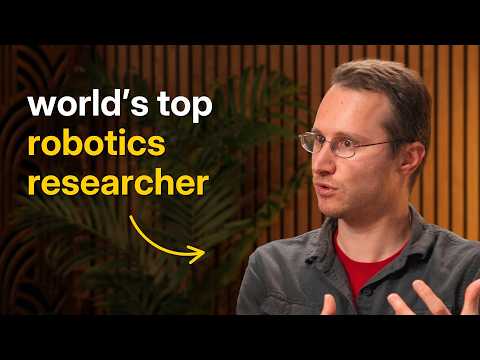
Fully autonomous robots are much closer than you think – Sergey Levine
Dwarkesh Patel (host), Sergey Levine (guest), Narrator, Narrator, Narrator, Narrator
In this episode of Dwarkesh Podcast, featuring Dwarkesh Patel and Sergey Levine, Fully autonomous robots are much closer than you think – Sergey Levine explores sergey Levine explains why practical household robots are five years away Sergey Levine describes Physical Intelligence’s effort to build a general-purpose robotic foundation model that can control many robots across many tasks, analogous to how LLMs generalize across language tasks.
Sergey Levine explains why practical household robots are five years away
Sergey Levine describes Physical Intelligence’s effort to build a general-purpose robotic foundation model that can control many robots across many tasks, analogous to how LLMs generalize across language tasks.
Current systems can already do dexterous manipulation—folding laundry, boxes, cleaning kitchens, making coffee—but these are seen as basic building blocks toward long-horizon, autonomous household and industrial work.
Levine argues the key ingredients are leveraging prior knowledge from large vision‑language models, collecting the right real‑world data to start a self-improving “flywheel,” and combining imitation learning with future reinforcement learning on the job.
He forecasts single‑digit‑year timelines—around five years median—for robots that can run a home or perform most blue‑collar tasks with humans in the loop, stressing that hardware cost, reliability, and a balanced robotics ecosystem will strongly shape deployment.
Key Takeaways
Robotic foundation models will mirror LLMs but add an ‘action expert’.
Physical Intelligence uses a vision‑language backbone (e. ...
Get the full analysis with uListen AI
Early impressive demos are just validation of the ‘basics,’ not the goal.
Tasks like folding shirts or cleaning tables mainly confirm that the representation and control stack is sound; the true target is long‑horizon autonomy where you give a months‑long, open‑ended household brief and the robot manages everything adaptively.
Get the full analysis with uListen AI
A practical ‘flywheel’ starts once robots do any real, valuable work.
Levine expects near‑term deployments in narrow but useful roles; once robots are in the wild, their ongoing experience, human feedback, and mixed‑autonomy operation can be turned into training data, accelerating capability without purely lab‑driven scaling.
Get the full analysis with uListen AI
Embodiment focuses perception and may make video and web data far more useful.
Unlike generic video prediction, a robot has a goal (e. ...
Get the full analysis with uListen AI
Compositional generalization gives rise to emergent physical skills.
With enough diverse demonstrations, models start to combine skills in new ways—e. ...
Get the full analysis with uListen AI
Real-world data is indispensable; simulation and synthetic data are accelerants, not substitutes.
High‑fidelity simulators and synthetic experience only become truly valuable once a model already understands the real world and can use simulation to rehearse or explore counterfactuals, much like pilots who train in sims but are evaluated on real flight.
Get the full analysis with uListen AI
Hardware cost and reliability will be as decisive as algorithms.
Arm costs have dropped from hundreds of thousands of dollars to a few thousand, and smarter AI lowers precision requirements; but scaling to millions or billions of robots still hinges on manufacturing, supply chains, and geopolitics, not just better models.
Get the full analysis with uListen AI
Notable Quotes
““What you really want from a robot is not to tell it, ‘Hey, please fold my T-shirt.’ What you want is, ‘Run my house for the next six months.’””
— Sergey Levine
““I think five is a good median [year] for a robot that can fully autonomously run a house.””
— Sergey Levine
““Making mistakes and correcting those mistakes is sounding an awful lot like what a person does when they’re trying to learn something.””
— Sergey Levine
““To make robotic foundation models really work, it’s more like the Apollo program than a science experiment.””
— Sergey Levine
““Deep down, the synthetic experience you create yourself doesn’t allow you to learn more about the world. It lets you rehearse, but the information has to come from reality.””
— Sergey Levine
Questions Answered in This Episode
What specific technical breakthroughs in representation or memory would most accelerate your five‑year timeline for a fully autonomous housekeeper robot?
Sergey Levine describes Physical Intelligence’s effort to build a general-purpose robotic foundation model that can control many robots across many tasks, analogous to how LLMs generalize across language tasks.
Get the full analysis with uListen AI
How do you plan to measure when the ‘robot data flywheel’ has truly started—what concrete deployment or metric would signal that inflection point?
Current systems can already do dexterous manipulation—folding laundry, boxes, cleaning kitchens, making coffee—but these are seen as basic building blocks toward long-horizon, autonomous household and industrial work.
Get the full analysis with uListen AI
Which domains beyond households (e.g., logistics, construction, elder care) do you expect to see meaningful robotic deployment in first, and why?
Levine argues the key ingredients are leveraging prior knowledge from large vision‑language models, collecting the right real‑world data to start a self-improving “flywheel,” and combining imitation learning with future reinforcement learning on the job.
Get the full analysis with uListen AI
How should policymakers balance investing in AI software versus domestic robot manufacturing capacity to avoid over‑reliance on foreign hardware supply chains?
He forecasts single‑digit‑year timelines—around five years median—for robots that can run a home or perform most blue‑collar tasks with humans in the loop, stressing that hardware cost, reliability, and a balanced robotics ecosystem will strongly shape deployment.
Get the full analysis with uListen AI
If robots become the default way we interact with and learn about the physical world, how might that change the design and training of future general AI systems, including purely digital ones?
Get the full analysis with uListen AI
Transcript Preview
Today, I'm chatting with Sergey LaVine, who is a co-founder of Physical Intelligence, which is a robotics foundations model company, and also a professor at UC Berkeley. And just generally, one of the world's leading researchers in robotics, RL, and AI. Sergey, thank you for coming on the podcast.
Mm-hmm. Thank you. And thank you for the kind introduction.
(laughs) Let's talk about robotics. So before I pepper you with questions, I'm wondering if you can give, uh, the audience a b- a summary of where Physical Intelligence is at right now. You guys started a year ago.
Yeah.
And what does the progress look like? What are you guys working on?
Yeah. So Physical Intelligence aims to build robotic foundation models, and that basically means general-purpose models that could, in principle, control any robot to perform any task. Uh, we care about this because we, we see this as a very fundamental, uh, aspect of the AI problem. Like, the robot is essentially, uh, encompassing all A- AI technology, so if you can get a robot that's truly general, then you can, uh, do, uh, you know, hopefully a- a large chunk of what people can do. And where we're at right now is I think we've kind of gotten to the point where we've, uh, built out a lot of the basics. (laughs)
(laughs)
And, you know, I think those basics actually are pretty cool. Like, they work pretty well. We can get a robot that will, like, fold laundry and that will go into a new home and, like, try to clean up the kitchen. But in my mind, what we're doing at Physical Intelligence right now is really the very, very early beginnings, just, like, putting in place the basic building blocks on top of which we can then tackle all these, like, really tough problems.
And what's the year-by-year vision? So, um, one year in, now I got a chance to watch some of the robots, and they can do pretty dexterous tasks like folding a box using grippers, and it's, like, I don't know. It's, like, uh, pretty hard to fold a box even with, like, my hands. Um, if you gotta go year by year until we get to the full, like, robotics explosion, wh- what is happening every single year? What is a thing that needs to be unlocked, et cetera?
So there are a few things that we need to get right. Uh, I mean, dexterity, obviously, is one of them, and in the beginning, we really wanted to make sure that we, um, understand whether the methods that we're developing have the ability to tackle, like, the kind of intricate tasks that people can do.
Yeah.
So as you mentioned, like, folding a box, uh, folding different articles of laundry, cleaning up a table-
Yeah.
... uh, making a coffee, that sort of thing, and that's, like, that's good. Like, that works. Uh, you know, I think that the results we've been able to show are pretty cool, but again, like, the end goal of this is not to fold a nice T-shirt. The end goal is to just, like, confirm our initial hypothesis that, like, the basics are kinda solid.
Install uListen to search the full transcript and get AI-powered insights
Get Full TranscriptGet more from every podcast
AI summaries, searchable transcripts, and fact-checking. Free forever.
Add to Chrome