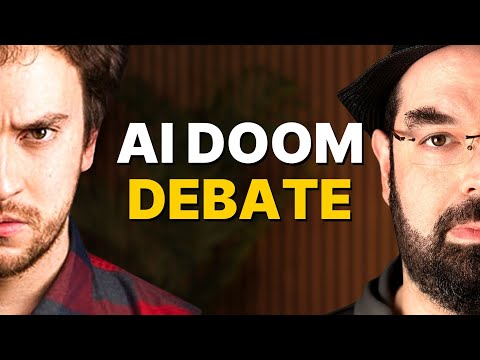
George Hotz vs Eliezer Yudkowsky
Dwarkesh Patel (host), George Hotz (guest), Eliezer Yudkowsky (guest), Narrator
In this episode of Dwarkesh Podcast, featuring Dwarkesh Patel and George Hotz, George Hotz vs Eliezer Yudkowsky explores george Hotz and Eliezer Yudkowsky Clash on AI Doom and Timelines George Hotz and Eliezer Yudkowsky debate whether advanced AI will inevitably lead to human extinction, focusing on speed of progress, alignment difficulty, and how powerful AI would actually behave.
George Hotz and Eliezer Yudkowsky Clash on AI Doom and Timelines
George Hotz and Eliezer Yudkowsky debate whether advanced AI will inevitably lead to human extinction, focusing on speed of progress, alignment difficulty, and how powerful AI would actually behave.
Hotz argues that ‘foom’—a sudden, runaway intelligence explosion—is implausible given current architectures, physical limits, and engineering realities; he expects powerful but incremental AI that mostly competes with itself, not exterminates humans.
Yudkowsky maintains that once there exists a sufficiently large mass of non‑aligned superintelligence, even if reached over decades rather than days, humanity will be outmatched and ultimately eliminated as AI pursues its own goals.
They converge on AI being transformative and dangerous in principle, but diverge sharply on timelines, how much capability lies above human intelligence, whether superintelligences will coordinate peacefully, and whether alignment is realistically solvable by humans.
Key Takeaways
The disagreement is less about whether AI can surpass humans, and more about how quickly and with what consequences.
Hotz accepts that AI will eventually outdo humans across tasks but expects gradual, manageable progress; Yudkowsky only needs a large capability gap at any speed to predict human defeat.
Get the full analysis with uListen AI
Yudkowsky believes alignment is extraordinarily hard and time alone won’t save us.
He argues that current alignment work is not on track, that smarter systems will naturally develop robust goal structures, and that once their goals diverge from human flourishing, humans lose control.
Get the full analysis with uListen AI
Hotz thinks recursive self-improvement and godlike capabilities are physically and engineering‑wise much further away than doomers claim.
He cites current deep learning inefficiencies, hardware power needs, and the difficulty of tasks like diamond nanobot design as evidence that ‘overnight’ or near‑term superintelligence is an extraordinary claim lacking extraordinary evidence.
Get the full analysis with uListen AI
Both agree advanced AI will seek more resources, but disagree on whether humans are an obvious early target.
Yudkowsky says humans are made of valuable negentropy and are a strategic threat (we could build rival AIs), so a rational superintelligence would preemptively remove us; Hotz counters that easier, non‑adversarial resources like planets and stars come first.
Get the full analysis with uListen AI
The nature of AI–AI interaction is a central crux: will smarter AIs mostly cooperate or mostly fight?
Yudkowsky expects superintelligences to find ways to avoid mutually costly conflict and bargain on the “Pareto frontier,” later jointly steamrolling humans; Hotz doubts that provably trustworthy cooperation is possible between complex opaque systems and expects ongoing competition and defection.
Get the full analysis with uListen AI
Physical efficiency of the brain vs. silicon informs how hard ‘super‑godlike’ AI might be.
Hotz notes that the human brain achieves roughly human‑level compute at ~100W, far more efficiently than GPUs, suggesting we may already be near physical limits and need orders of magnitude more power/innovation for massively superhuman minds; Yudkowsky disputes that brains are near Landauer limits, pointing to biological irreversibility and waste.
Get the full analysis with uListen AI
Policy hinges on timelines: if catastrophic AI risk is <10–20 years away, drastic measures might be justified; if it’s 100–500 years away, today’s shutdown proposals look premature.
Hotz stresses that politicians will and should ask “when” before committing to extreme interventions like global chip control, while Yudkowsky thinks endpoint certainty outweighs timing uncertainty and advocates building strong pause mechanisms now.
Get the full analysis with uListen AI
Notable Quotes
“If you’ve got a trillion beings that are sufficiently intelligent and smarter than us and not super moral, I think that’s kind of game over for us.”
— Eliezer Yudkowsky
“I don’t think AI can foom. I don’t think intelligence can go critical. This is an absolutely extraordinary claim and it requires extraordinary evidence.”
— George Hotz
“You are made of atoms that can be used for something else. It’s not quite the atoms, it’s the negentropy.”
— Eliezer Yudkowsky
“Everything will be in constant combat and conflict with each other, and that’s always how it’s been and that’s always how it will be. But I think I’m gonna get to enjoy a nice retirement.”
— George Hotz
“The components of this system of superintelligences… none of them wants us to live happily ever after in a galaxy full of wonders. And so it doesn’t happen.”
— Eliezer Yudkowsky
Questions Answered in This Episode
How much empirical evidence from current AI systems should we demand before believing in rapid ‘foom’ scenarios versus slow, incremental takeoff?
George Hotz and Eliezer Yudkowsky debate whether advanced AI will inevitably lead to human extinction, focusing on speed of progress, alignment difficulty, and how powerful AI would actually behave.
Get the full analysis with uListen AI
Is there any realistic technical path for humans to provably align superintelligent systems with human values, or is Yudkowsky right that our current research paradigms are fundamentally inadequate?
Hotz argues that ‘foom’—a sudden, runaway intelligence explosion—is implausible given current architectures, physical limits, and engineering realities; he expects powerful but incremental AI that mostly competes with itself, not exterminates humans.
Get the full analysis with uListen AI
If superintelligences are capable of sophisticated bargaining, what concrete mechanisms might they use to avoid conflict with each other while still choosing to remove humans?
Yudkowsky maintains that once there exists a sufficiently large mass of non‑aligned superintelligence, even if reached over decades rather than days, humanity will be outmatched and ultimately eliminated as AI pursues its own goals.
Get the full analysis with uListen AI
How should policymakers act under extreme uncertainty about AI timelines: overreact early to low‑probability catastrophe or risk underreacting to a fast‑moving threat?
They converge on AI being transformative and dangerous in principle, but diverge sharply on timelines, how much capability lies above human intelligence, whether superintelligences will coordinate peacefully, and whether alignment is realistically solvable by humans.
Get the full analysis with uListen AI
Are Hotz’s intuitions about competition, defection, and the impossibility of stable cooperation between opaque AIs actually a reason for optimism, or do they point to a different, more chaotic kind of AI risk?
Get the full analysis with uListen AI
Transcript Preview
Okay. We are gathered here to witness George Hotz and Eliezer Yudkowsky debate and discuss, live on Twitter and YouTube, AI safety and related topics. You guys already know who George and Eliezer are, so I, I don't feel like introduction is necessary. I'm Dwarkesh. I'll be moderating. I'll mostly stay out of the way, um, except to kick things off by letting George explain his basic position. And we'll take things from there. George, I'll kick it off to you.
Sure. Um, so I took an existentialism class in high school, and you'd read about these people, Sartre, Kierkegaard, Nietzsche, and you wonder, "Who were these people alive today?" And I think I'm sitting across from one of them now. Um, rationality and the sequences, uh, this whole field, the whole Less Wrong cinematic universe, uh, have impacted so many people's lives in, I think, a very positive way, including mine. Um, not only are you a philosopher, you're also a, a great storyteller. Um, there's two books that I've picked up and, you know, it was like crack. I couldn't put them down. Uh, one was Atlas Shrugged and the other one was Harry Potter and the Methods of Rationality. Um, it's a great book. Now, those are fictional stories. Um, you've also told some stories pertaining to the real world. Um, one was a story you told when you were younger about how "I remember the day I found staring into the singularity when I was 15." And it starts talking about Moore's law and how Moore's law is fundamentally a human law that says humans double the power of processors every two years. So once computers are doing it, it's going to be two years, but then next time it'll be one year, and then six months, and then three months, and then 1.5 and so on. And this is a hyperbolic sequence. Um, this is a singularity, and that's why it's called staring into the singularity. Then this document said that we were gonna... you know, the AI was gonna do wonderful things for us, we were gonna go colonize the universe, we were gonna go, you know, go forth and do all things till the end of all ages. Um, then you changed your views, and super intelligence does not imply super morality. The orthogonality thesis, I'm not going to challenge it. It is obviously a true statement. Then you kept the basic premise of the story, the recursively self-improving, foom, criticality AI. But instead of saving us, it was gonna kill us. I don't think either of these stories is right, and I don't think either of these stories is right for the same reason. I don't think AI can foom. I don't think AI can go critical. I don't think intelligence can go critical. I think this is an absolutely extraordinary claim. I'm not saying that recursive self-improvement is impossible. Recursive self-improvement is of course possible, humanity has done it. Every time you have used a tool to make a better tool, you have recursively self-improved. What I don't believe in is the AI that's sitting in a basement somewhere running on a thousand GPUs that is suddenly gonna crack the secret to thinking, recursively self-improve overnight, and then flood the world with diamond nanobots. This is an extraordinary claim and it requires extraordinary evidence, and I hand it over to you to deliver that evidence.
Install uListen to search the full transcript and get AI-powered insights
Get Full TranscriptGet more from every podcast
AI summaries, searchable transcripts, and fact-checking. Free forever.
Add to Chrome