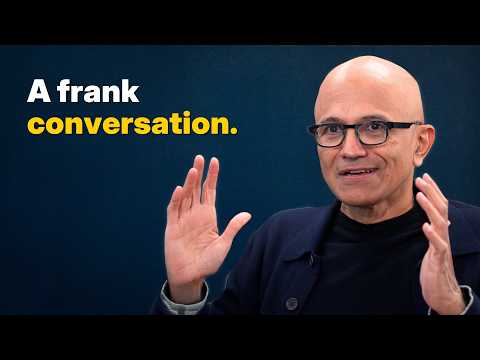
Satya Nadella – How Microsoft thinks about AGI
Satya Nadella (guest), Dwarkesh Patel (host), Scott Guthrie (guest), Dylan Patel (guest), Dylan Patel (guest), Narrator
In this episode of Dwarkesh Podcast, featuring Satya Nadella and Dwarkesh Patel, Satya Nadella – How Microsoft thinks about AGI explores satya Nadella explains Microsoft’s long-game strategy in the AI race Satya Nadella discusses how Microsoft is repositioning itself from a pure software company to a capital‑ and knowledge‑intensive industrial player building massive AI data centers and infrastructure. He argues that long‑term value won’t accrue solely to model makers, but will be shared across infrastructure, “scaffolding” (tools, agents, control planes), and application layers like Office, GitHub, and Azure. Nadella outlines why Microsoft paused some U.S. capacity, focuses on fungible global infrastructure, and avoids being a single‑customer host for any one lab, even OpenAI. He also emphasizes sovereignty, trust in U.S. tech, and Microsoft’s bet on agents, multi‑model ecosystems, and its own MAI lab while deeply leveraging OpenAI’s models and system IP.
Satya Nadella explains Microsoft’s long-game strategy in the AI race
Satya Nadella discusses how Microsoft is repositioning itself from a pure software company to a capital‑ and knowledge‑intensive industrial player building massive AI data centers and infrastructure. He argues that long‑term value won’t accrue solely to model makers, but will be shared across infrastructure, “scaffolding” (tools, agents, control planes), and application layers like Office, GitHub, and Azure. Nadella outlines why Microsoft paused some U.S. capacity, focuses on fungible global infrastructure, and avoids being a single‑customer host for any one lab, even OpenAI. He also emphasizes sovereignty, trust in U.S. tech, and Microsoft’s bet on agents, multi‑model ecosystems, and its own MAI lab while deeply leveraging OpenAI’s models and system IP.
Key Takeaways
Microsoft is building fungible, multi‑model AI infrastructure instead of optimizing for a single model or customer.
Nadella stresses that a hyper-scaler can’t afford to tune its entire network topology to one architecture or lab; breakthroughs like MoE or new chips would strand that capital, so Azure is designed to support many model families and workloads (training, data gen, inference) across regions.
Get the full analysis with uListen AI
Long‑term value won’t be captured only by model labs; scaffolding and applications matter.
He argues that models risk a “winner’s curse” because they are one copy away from commoditization, while control planes, agents, domain integrations (like Excel Agent), observability, and data liquidity create durable moats and economics closer to traditional software.
Get the full analysis with uListen AI
GitHub is Microsoft’s strategic anchor in the AI coding ecosystem, even amid share loss.
Although competitors like Claude Code and Cursor have quickly gained revenue, GitHub’s repo growth, developer influx, and new ‘Agent HQ’ / Mission Control vision give Microsoft multiple shots on goal—from its own Copilot to hosting third‑party agents and models.
Get the full analysis with uListen AI
Microsoft is repositioning per‑user SaaS economics into a “per‑user plus per‑agent” world.
Nadella expects companies will provision computers, identity, security, and observability not just for humans but for autonomous agents, turning M365 and Windows 365 into infrastructure for agents doing work, with pricing and margins tied to consumption and agent count.
Get the full analysis with uListen AI
The OpenAI partnership gives Microsoft deep model and system leverage, but it’s building its own MAI lab for independence.
Microsoft has seven more years of exclusive stateless API rights and IP access to OpenAI’s system design and chip program, yet it is simultaneously assembling a “world‑class superintelligence team” (MAI) focused on its own omni models and product‑tuned capabilities.
Get the full analysis with uListen AI
CapEx pacing and generation risk drive Microsoft’s cautious build‑out compared to some rivals.
Nadella defends the 2023 ‘pause’ by citing rapid chip cycles (GB200→GB300→Vera Rubin), power and cooling shifts, and the need to spread gigawatts across geos and workloads rather than overbuilding one generation in one country or for one lab.
Get the full analysis with uListen AI
Sovereignty and trust in U.S. tech will be decisive advantages in global AI adoption.
He frames U. ...
Get the full analysis with uListen AI
Notable Quotes
““If you’re a model company, you may have a winner’s curse… it’s kinda like one copy away from that being commoditized.””
— Satya Nadella
““Our business, which today is an end user tools business, will become essentially an infrastructure business in support of agents doing work.””
— Satya Nadella
““You can’t build an infrastructure that’s optimized for one model… you’re one tweak away from some MoE breakthrough that happens when your entire network topology goes out of the window.””
— Satya Nadella
““The thing that you have to think through is not what you do in the next five years, but what do you do for the next 50?””
— Satya Nadella
““The most important feature may not be the model capability; it may be: can I trust you, your company, your country, and its institutions to be a long-term supplier?””
— Satya Nadella
Questions Answered in This Episode
If models increasingly learn continuously on the job, how realistic is Nadella’s claim that value won’t concentrate overwhelmingly in a single leading model or lab?
Satya Nadella discusses how Microsoft is repositioning itself from a pure software company to a capital‑ and knowledge‑intensive industrial player building massive AI data centers and infrastructure. ...
Get the full analysis with uListen AI
What concrete product or financial metrics over the next 3–5 years would validate Microsoft’s bet that scaffolding and agents are as valuable as the model layer?
Get the full analysis with uListen AI
How might Microsoft’s MAI lab avoid duplicating OpenAI’s work while still becoming competitive enough to lead if the OpenAI partnership ended?
Get the full analysis with uListen AI
Could Microsoft’s cautious CapEx pacing cause it to miss a window where sheer training scale produces a decisive capability gap?
Get the full analysis with uListen AI
How will rising sovereignty and data residency demands reshape the economics and architecture of global hyperscale clouds over the next decade?
Get the full analysis with uListen AI
Transcript Preview
... maybe after the industrial revolution, this is the biggest thing. But at the same time, I'm a little grounded in the fact that this is still early innings. If you're a model company, you may have a winner's curse. You may have done all the hard work, done unbelievable innovation, except it's kinda like one copy away from that being commoditized. We didn't want to just be a host star for one company and have just a massive book of business with one customer. That- that's not a business. You can't build an infrastructure that's optimized for one model. If you do that, you're one tweak away from some MoE, like, breakthrough that happens when your entire network topology goes out of the window. Then that's a scary thing. Our business, which today is an end user tools business, will become essentially an infrastructure business in support of agents doing work. The thing that you have to think through is not what you do in the next five years, but what do you do for the next 50?
Today, we are interviewing Satya Nadella, we being me and Dilin Patel, who is founder of SemiAnalysis. Satya, welcome.
Thank you. It's great. Thanks for comin' over to Atlanta.
Yeah. Thank you for giving us the tour of, uh, the new facility. It's been really cool to see.
Absolutely.
Satya and Scott Guthrie, Microsoft's EVP of Cloud and AI, give us a tour of their brand new Fairwater 2 data center, the current most powerful in the world.
We try to 10X the training capacity every 18 to 24 months. And so this would be, effectively, a 10X increase, 10X from what GPT-5 was trained with. And so to put it in perspective, the number of optics, the network optics in this building, is almost as much as all of Azure across all our data centers two and a half years ago.
It's kinda, what, five million network connections.
You've got all this bandwidth between different sites in a region and between the two regions. So is this like a big bet on scaling in the future, that you anticipate in the future there's gonna be some huge model that needs to require two whole different regions to train?
The goal is to be able to kind of aggregate these FLOPs for a large training job and then put these things together across sites.
Right.
And the reality is you'll use it for, uh, training, and then you'll use it for data gen, you'll use it for inference in all sort of ways.
Yeah.
It's not like it's going to be used only for one workload forever.
Fairwater 4, which you're gonna see under construction nearby-
Mm-hmm.
... yeah, will also be on that one peta- petabits network-
Yep.
... so that we can actually link the two at a very high rate. And then basically we do the AI WAN connecting to Milwaukee, where we have multiple other Fairwaters being built.
Install uListen to search the full transcript and get AI-powered insights
Get Full TranscriptGet more from every podcast
AI summaries, searchable transcripts, and fact-checking. Free forever.
Add to Chrome