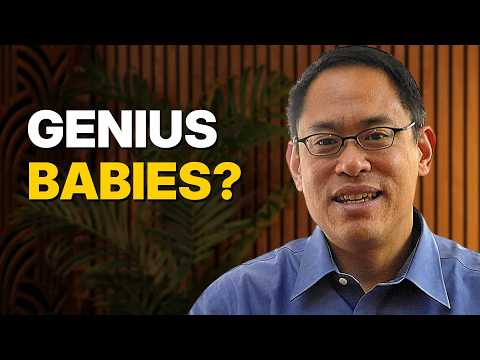
Steve Hsu - Intelligence, Embryo Selection, & The Future of Humanity
Steve Hsu (guest), Dwarkesh Patel (host), Narrator
In this episode of Dwarkesh Podcast, featuring Steve Hsu and Dwarkesh Patel, Steve Hsu - Intelligence, Embryo Selection, & The Future of Humanity explores genetic Prediction, IVF, and Engineering Intelligence: Steve Hsu’s Vision Steve Hsu discusses how advances in genomics, AI, and IVF enable embryo selection based on polygenic predictors for disease risk, health, and eventually traits like height and intelligence. He explains the mathematical and evolutionary foundations of polygenic scores, emphasizing that most complex traits are surprisingly additive and highly polygenic, making them predictable with enough data. Hsu outlines his company Genomic Prediction’s role in IVF clinics worldwide, where embryo genotyping already helps parents avoid embryos with extreme disease risks, and sketches how future CRISPR editing and better data could allow far more ambitious trait optimization. The conversation also ranges into ethical and societal implications—inequality, regulation, national strategies—plus digressions on Feynman, elite education, talent, and the strengths of physics-style quantitative thinking.
Genetic Prediction, IVF, and Engineering Intelligence: Steve Hsu’s Vision
Steve Hsu discusses how advances in genomics, AI, and IVF enable embryo selection based on polygenic predictors for disease risk, health, and eventually traits like height and intelligence. He explains the mathematical and evolutionary foundations of polygenic scores, emphasizing that most complex traits are surprisingly additive and highly polygenic, making them predictable with enough data. Hsu outlines his company Genomic Prediction’s role in IVF clinics worldwide, where embryo genotyping already helps parents avoid embryos with extreme disease risks, and sketches how future CRISPR editing and better data could allow far more ambitious trait optimization. The conversation also ranges into ethical and societal implications—inequality, regulation, national strategies—plus digressions on Feynman, elite education, talent, and the strengths of physics-style quantitative thinking.
Key Takeaways
Embryo selection for health is already a real, scaled medical service.
Millions of IVF cycles happen globally each year; clinics routinely biopsy embryos and send samples to labs like Genomic Prediction, which provide polygenic risk reports so parents can avoid embryos with outlier risks for major diseases.
Get the full analysis with uListen AI
Most complex human traits are highly polygenic yet mostly additive and predictable.
Traits like height, disease risk, and likely cognitive ability are influenced by thousands of variants; using high-dimensional regression and compressed sensing, simple additive models (weighted sums of SNPs) can capture much of the heritable variance once datasets reach hundreds of thousands to millions of genomes.
Get the full analysis with uListen AI
There is far more selectable genetic variance than evolution has used.
Because traits depend on thousands of loci, changing the equivalent of only √N variants can shift a trait by a full standard deviation; this implies a deep “well” of unused variation that breeding, embryo selection, or future editing could exploit to extend healthspan or alter traits substantially beyond current human norms.
Get the full analysis with uListen AI
Cross-population prediction is limited today but solvable with more and better data.
Polygenic scores trained on Europeans degrade in accuracy for other ancestries due to different LD/tagging structures; combining diverse biobanks and cross-group machine learning can progressively localize truly causal variants and improve portability.
Get the full analysis with uListen AI
Future capabilities likely include predicting appearance and many independent traits from DNA.
Face-recognition embeddings are highly heritable; inverting such models using genomic data plus training could allow reconstruction of likely faces from embryo DNA, alongside independent control of hundreds to ~1,000 trait dimensions (health, morphology, psychology) given the information content in human genetic variation.
Get the full analysis with uListen AI
Genetic enhancement risks amplifying inequality but can also be socialized.
If only the rich access advanced selection/editing, they may pull away in health and capability; conversely, states could fold IVF and genetic screening into national healthcare (as Denmark and Israel already do for IVF), or even preferentially support below-average families to reduce inequality.
Get the full analysis with uListen AI
Intelligence prediction is scientifically blocked more by politics than by math.
Hsu argues that with ~1–2 million well-genotyped individuals and decent cognitive measurements, current methods could already build useful IQ predictors, but researchers often avoid collecting or using such data due to social and career risks around intelligence and group differences.
Get the full analysis with uListen AI
Notable Quotes
““We’re gonna start navigating in this high-dimensional space as we like.””
— Steve Hsu
““The ways that I differ from you are merely just ‘cause I have more of something and you have less of something.””
— Steve Hsu
““There’s clearly a lot of variance available to be selected on or edited. That’s just… there’s no question about that.””
— Steve Hsu
““If you’re more of a left guy… you can forcibly give more genomic prediction resources to people who need them.””
— Steve Hsu
““People who criticize this have no idea how sophisticated the work is.””
— Steve Hsu
Questions Answered in This Episode
If polygenic prediction and editing become cheap and global, what governance structures could prevent extreme genetic stratification between social classes or nations?
Steve Hsu discusses how advances in genomics, AI, and IVF enable embryo selection based on polygenic predictors for disease risk, health, and eventually traits like height and intelligence. ...
Get the full analysis with uListen AI
How should societies decide which traits (beyond disease risk) are ethically acceptable targets for embryo selection or gene editing?
Get the full analysis with uListen AI
What are the most realistic timelines and technical bottlenecks for moving from today’s health-focused embryo selection to reliable selection for cognitive traits?
Get the full analysis with uListen AI
How might public attitudes shift once parents see concrete, multi-year health or lifespan benefits from existing embryo selection, and will that soften opposition to enhancement?
Get the full analysis with uListen AI
Given the additive architecture Hsu describes, what unforeseen biological or social risks might arise if we push multiple traits—like intelligence, height, and longevity—simultaneously to extremes?
Get the full analysis with uListen AI
Transcript Preview
(instrumental music plays) The, the big future AI in the, in the singularity looks back and says, "Hey, who gets the most credit for this genomics revolution that happened in the early 21st century?" That AI's gonna find these papers on the archive in which we prove-
(laughs)
... this was possible.
What advice did Richard Feynman give you about picking up girls?
(laughs) It, it's very funny because most wokest people today hate this stuff, but most progressives, like Margaret Sanger or you know (laughs) well, in some sense, forebearers of today's wokest, in the early 20th century, they were all what we would call today eugenicists.
Today, I have the pleasure of speaking with Steve Hsu. Steve, thanks for coming on the podcast. I'm excited about this.
Hey, it's my pleasure. I'm excited too. And I, I just wanna say, I've, I've listened to some of your earlier interviews and thought you were very insightful, which is why I was really excited to have a conversation with you.
That means a lot for me to hear, uh, hear you say because I'm a big fan of your podcast. My first question is, what advice did Richard Feynman give you about picking up girls?
(laughs) Wow. Um, so one day in the spring of my senior year, I was walking across campus, and I see Feynman coming toward me. And we knew each other from various things. And it's a small campus, (clears throat) and I was a physics major, and he was my hero, so I guess I had known him since probably freshman year. Um, so he sees me, and, uh, you know, he's got this... I don't know if it's Long... I guess it's a Long Island or it's, it's some kind of New York borough accent, and he says, uh, "Hey, Hsu." This is how he says my name. "Hey, Hsu." And I'm like, "Hi, Professor Feynman." And, uh, so we start talking. And he says to me, um, "Wow, you're kind of a big guy." And I was a lot bigger then 'cause I played on the... I was a linebacker on the Caltech football team, so I was about almost 200 pounds. Uh, I'm a little... just over six feet tall. And, um, so I was pretty, like, a gym rat at that time. And so he's like... I was much bigger than him obviously. He's like, "Wow, you're a big guy, Steve. Uh, I gotta ask you something." And Feynman was born in, like, 1918, so he, he's not really, like, from the modern era. Like, he was, he was, uh... I guess he was going through graduate school when, uh, the Second World War started. And so, to him, the whole concept of a health club, a gym, was like totally... you know, he couldn't understand it. And, um, that was the era... This was the '80s, so that was the era when Gold's Gym was, like, becoming a world w- a national franchise, and so there were gyms all over the place, 24 Hour Fitness and stuff like this. So he didn't know what it was, and he's a very interesting guy. So he, he... his suspicion... He says to me, "What do you guys do there? Is that... Is it just a thing to meet chicks, to meet girls, or do you guys actually tr-... is it really for training? Do you guys really go there to get buff, uh, to get big?" You know, and, and so I started explaining to him. I said, "Yes, uh, you know, people are there to get big, but people are all- also checking out the girls, and there is a lot of stuff happening, (laughs) you know, at the, at the health club or in the weight room." And so, you know, he grills me on this for a long time. And one of the famous things about Feynman is that he, he has this laser-like focus so if there's something he really doesn't understand and he wants to get to the bottom of it, he will just focus in on you and just start questioning you and get to the bottom of it. That's the way his brain works. So he did that to me (laughs) for, like, I don't know how long. We were talking about lifting weights and, uh, everything 'cause he didn't know anything about it. And, um, at the end, he says to me, "Wow, Steve, I really appreciate that, you know. Uh, let me, you know, l- let me, let me give you some good advice." And, um, so then he starts telling me, uh, about how to pick up girls and... which I guess he... you know, he's a (laughs) kind of an expert on.
Install uListen to search the full transcript and get AI-powered insights
Get Full TranscriptGet more from every podcast
AI summaries, searchable transcripts, and fact-checking. Free forever.
Add to Chrome