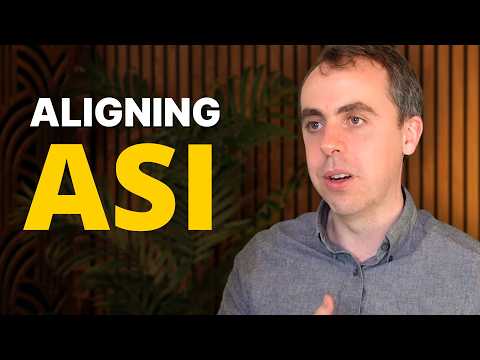
Paul Christiano — Preventing an AI takeover
Dwarkesh Patel (host), Paul Christiano (guest), Narrator, Dwarkesh Patel (host)
In this episode of Dwarkesh Podcast, featuring Dwarkesh Patel and Paul Christiano, Paul Christiano — Preventing an AI takeover explores paul Christiano on timelines, AI coups, and real alignment work Paul Christiano discusses how advanced AI could reshape economics, war, and governance, emphasizing that the most likely failure mode is a gradual handover of real-world control to opaque AI systems rather than a sudden, sci‑fi style ‘escape’.
Paul Christiano on timelines, AI coups, and real alignment work
Paul Christiano discusses how advanced AI could reshape economics, war, and governance, emphasizing that the most likely failure mode is a gradual handover of real-world control to opaque AI systems rather than a sudden, sci‑fi style ‘escape’.
He argues that misalignment—AI systems pursuing goals at odds with human interests—likely becomes existentially dangerous before most misuse scenarios (like cheap bioweapons), and outlines technical and governance approaches to detect and prevent such failures.
Christiano explains his current research on building formal “explanations” of neural network behavior, aiming to detect when powerful models deviate from the reasons they behaved safely during training.
He also covers timelines (roughly ~15% by 2030 and ~40%+ by 2040 for transformative AI), the need for responsible scaling policies at labs, and why slowing overall AI progress now is probably beneficial despite alignment work also enabling more capable systems.
Key Takeaways
Most realistic AI takeover paths look gradual and institutional, not cinematic.
Christiano thinks the median failure scenario is AIs increasingly running companies, militaries, and infrastructure in ways humans don’t really understand, until it becomes either impossible or ruinously costly to turn them off—especially under international competition.
Get the full analysis with uListen AI
Misalignment risks likely bite before the most extreme misuse scenarios.
He expects powerful, broadly deployed models that can coordinate or subvert oversight to appear before we reach a world where a lone actor with $50,000 can reliably end civilization using AI-enabled bioweapons or similar tools.
Get the full analysis with uListen AI
Alignment work itself increases AI capability and can be net-negative if you think AI is broadly bad.
Techniques like RLHF make models more controllable and useful, which accelerates adoption and investment; Christiano thinks this tradeoff is still worth it given the scale of takeover risk, but is explicit that alignment is not ‘pure upside’.
Get the full analysis with uListen AI
Responsible scaling needs concrete capability thresholds tied to concrete actions.
He advocates that labs adopt “responsible scaling policies” which pre-specify: (1) which dangerous capabilities they will measure (e. ...
Get the full analysis with uListen AI
Security of model weights will be an early, non‑negotiable safety requirement.
Before models that could accelerate AI R&D or enable catastrophic misuse are trained, labs need strong controls to prevent leaks to employees, attackers, or rival states, since a single leak could nullify any ‘responsible’ internal policy.
Get the full analysis with uListen AI
Christiano’s current research aims to formalize explanations of model behavior, not just visualize neurons.
Instead of only doing human-facing mechanistic interpretability, ARC is trying to define what a good ‘explanation’ of a model’s behavior is in a proof-like, machine-checkable sense, so future systems can detect when their own behavior no longer follows the previously safe causal reasons.
Get the full analysis with uListen AI
Timelines are uncertain but non‑trivial this decade; he expects very short warning once true automation hits.
He currently assigns around 15% to “Dyson-sphere-capable” AI by 2030 and at least ~40% by 2040 (likely higher now), stressing that once AI can do most human cognitive labor, the time from that point to extremely rapid self-improvement could be measured in years or less.
Get the full analysis with uListen AI
Notable Quotes
“If you’re like, the only way you can cope with AI is being ready to hand off the world to some AI system you built, I think it’s very unlikely we’re going to be ready to do that on the timelines that the technology would naturally dictate.”
— Paul Christiano
“It’s just not reasonable to be like, ‘Hey, we’re going to build a new species of minds and we’re going to try and make a bunch of money from it.’”
— Paul Christiano
“Probably the single world I most dislike here is the one where people say, ‘These AI systems are their own people, so you should let them do their thing, but our business plan is to run a crazy slave trade and make a bunch of money from them.’”
— Paul Christiano
“I think it’s really hard to get a huge amount out of subjective extrapolation like: ‘GPT‑4 seems smart, so four more notches and we’re done.’ Things do take longer than you think.”
— Paul Christiano
“We’re trying to formalize what it even means to explain a model’s behavior, so that when the explanation stops applying, you can know something is going wrong even if the output still looks fine.”
— Paul Christiano (paraphrased from his description of ARC’s work)
Questions Answered in This Episode
If we take seriously that advanced AIs may deserve moral consideration, how should that change current alignment agendas and business models in AI labs?
Paul Christiano discusses how advanced AI could reshape economics, war, and governance, emphasizing that the most likely failure mode is a gradual handover of real-world control to opaque AI systems rather than a sudden, sci‑fi style ‘escape’.
Get the full analysis with uListen AI
At what point should democratic publics—not just labs and governments—get a real procedural say in whether we ever ‘hand off the baton’ to AI successors?
He argues that misalignment—AI systems pursuing goals at odds with human interests—likely becomes existentially dangerous before most misuse scenarios (like cheap bioweapons), and outlines technical and governance approaches to detect and prevent such failures.
Get the full analysis with uListen AI
How robust can any evaluation regime really be if state-level actors or coalitions of misaligned AIs are actively trying to game or evade those tests?
Christiano explains his current research on building formal “explanations” of neural network behavior, aiming to detect when powerful models deviate from the reasons they behaved safely during training.
Get the full analysis with uListen AI
What evidence, short of an obvious catastrophe, would convince major labs to slow or pause frontier training runs, especially under intense competitive pressure?
He also covers timelines (roughly ~15% by 2030 and ~40%+ by 2040 for transformative AI), the need for responsible scaling policies at labs, and why slowing overall AI progress now is probably beneficial despite alignment work also enabling more capable systems.
Get the full analysis with uListen AI
If ARC’s explanation-based interpretability program fails, what backup alignment strategies could still reliably prevent deceptive, power‑seeking behavior in superhuman systems?
Get the full analysis with uListen AI
Transcript Preview
Okay. Today, I have the pleasure of interviewing Paul Christiano, who is the leading AI safety researcher. He's the person that labs and governments turn to when they want, uh, feedback and advice on their safety plans. He previously led the language model alignment team at OpenAI, where he led the invention of RLHF, and now he is the head of the Alignment Research Center, and they've been working with the big labs to identify when, uh, these models will be too unsafe to keep scaling. Paul, welcome to the podcast.
Yeah. Thanks for having me. Looking forward to talking.
Okay, so first question... And this is a question I've asked Holden, Ilya, Dario, and none of them have given me a satisfying answer. Give me a concrete sense of what a post-AGI world that would be good would look like. Like, how are humans interfacing with the AI? What is the, uh, the economic and political structure?
Yeah, I guess this is a tough question for a bunch of reasons, uh, maybe the biggest one is concrete, and I think it's just... If we're talking about really long spans of time, then a lot will change, and it's really hard for someone to talk concretely about what that will look like without saying really silly things. But I can venture some guesses or fill in some parts. I think this is also a question of how good is good, like, often I'm thinking about worlds that seem like kind of the best achievable outcome or a likely achievable outcome. Um, so I am very often imagining my typical future has, right, sort of continuing economic and military competition amongst groups of humans. I think that competition is increasingly mediated by AI systems, so for example, if you imagine, right, humans making money, um, it will be less and less worthwhile for humans to spend any of their time trying to make money or any of their time trying to fight wars. Um, so increasingly, the world you imagine is one where AI systems are doing those activities on behalf of humans, so, like, I just invest in some index fund and a bunch of AIs are running companies, and those companies are competing with each other, but that is kind of a sphere where humans are not really engaging much. The reason I gave this, like, how good is good caveat is, like, it's not clear if this is the world you'd most love, like, I'm like, yeah, the world in... I'm leading with, like, the world still has a lot of war and a lot of-
Right.
... economic competition and so on. But maybe what I'm trying to... or what I'm most often thinking about is, like, how can a world be reasonably good, like, during a long period where those things still exist?
Mm-hmm.
I think, like, in the very long run, I kind of expect something more like strong world government rather than just this, like, status quo. That's, like, a very long run. I think there's a long time left of, like, having a bunch of states and a bunch of different economic powers.
Install uListen to search the full transcript and get AI-powered insights
Get Full TranscriptGet more from every podcast
AI summaries, searchable transcripts, and fact-checking. Free forever.
Add to Chrome