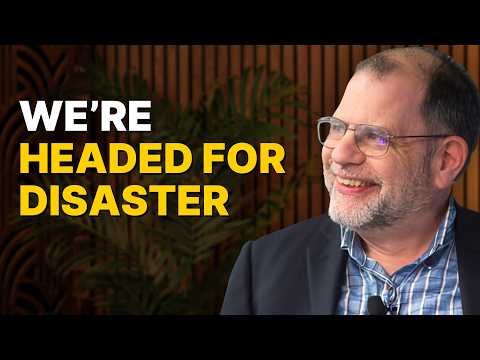
Tyler Cowen - Why Society Will Collapse & Why Sex is Pessimistic
Tyler Cowen (guest), Dwarkesh Patel (host), Narrator
In this episode of Dwarkesh Podcast, featuring Tyler Cowen and Dwarkesh Patel, Tyler Cowen - Why Society Will Collapse & Why Sex is Pessimistic explores tyler Cowen on Talent, Collapse, Sex, and Long-Term Civilization Risk Tyler Cowen discusses his new book *Talent* while ranging widely over topics including how to spot exceptional people, why talent clusters geographically, and how institutions evolve ideologically over time.
Tyler Cowen on Talent, Collapse, Sex, and Long-Term Civilization Risk
Tyler Cowen discusses his new book *Talent* while ranging widely over topics including how to spot exceptional people, why talent clusters geographically, and how institutions evolve ideologically over time.
He argues that intelligence has convex returns for a narrow set of high-leverage roles, that most people underestimate the value of context learned in education, and that great talent is both hard to predict and highly path‑dependent.
Cowen is bullish on near-term innovation but pessimistic about humanity’s ultra-long-run survival, emphasizing nuclear war and other tail risks that could permanently knock civilization back to feudal conditions.
He also reflects on effective altruism, the limits of longtermism, the sociology of public intellectuals, and why much of modern podcasting and intellectual consumption functions as a high‑class anesthetic.
Key Takeaways
Talent spotting is an art that relies heavily on contextual judgment.
Cowen argues that even sophisticated investors and grantmakers miss more than they hit; evaluations depend on nuanced, inarticulable intuition about context rather than formulaic checklists.
Get the full analysis with uListen AI
Exceptional intelligence yields convex returns, but only in a small subset of roles.
For inventors, founders, and frontier researchers, each extra bit of intelligence can matter enormously, but for most jobs Cowen prioritizes traits like stamina, reliability, and fit over raw IQ.
Get the full analysis with uListen AI
Higher education’s main value is context and socialization, not remembered facts.
Cowen accepts that students forget course content but insists college imparts world models, aspirations, networks, and social skills that shape long-run performance and identity.
Get the full analysis with uListen AI
Geography powerfully shapes where talent ends up, even in a digital world.
Cities like New York and London act as persistent talent sinks, while many regions are net sources whose best people eventually leave; shocks like war can destroy entire talent ecologies.
Get the full analysis with uListen AI
Better talent identification can increase income inequality while reducing inequality of well-being.
As firms more accurately recognize 10x performers, pay gaps likely widen, but Cowen expects their innovations to generate large spillover benefits for many who contribute little directly.
Get the full analysis with uListen AI
Existential risks matter, but practical levers look a lot like generic growth and competence improvements.
Cowen doubts we can micro‑manage AGI or nuclear tail risks via narrow interventions; he favors broad investments in science, governance, and prosperity rather than highly specific longtermist bets.
Get the full analysis with uListen AI
Near-term progress and long-term survival can diverge sharply.
Cowen is optimistic about innovation in the coming centuries yet believes that over very long horizons, compounding low annual probabilities of catastrophe make permanent civilizational decline plausible.
Get the full analysis with uListen AI
Notable Quotes
“The existence of sex is the most pessimistic thing there is.”
— Tyler Cowen
“I think it will always be an art, not a science.”
— Tyler Cowen (on talent spotting)
“If that keeps you down, I’m not so impressed by you.”
— Tyler Cowen (on woke ideology as an obstacle to ambition)
“I’m not making a big bet on ivermectin.”
— Tyler Cowen (on avoiding overleveraged single-idea careers)
“I think of my podcast as a very high‑class form of entertainment.”
— Tyler Cowen
Questions Answered in This Episode
If talent spotting is inherently artful and contextual, how much can books or frameworks genuinely improve the average person’s ability to identify exceptional people?
Tyler Cowen discusses his new book *Talent* while ranging widely over topics including how to spot exceptional people, why talent clusters geographically, and how institutions evolve ideologically over time.
Get the full analysis with uListen AI
How should societies balance the benefits of precise talent identification with the potential for increased income inequality and reduced slack for average performers?
He argues that intelligence has convex returns for a narrow set of high-leverage roles, that most people underestimate the value of context learned in education, and that great talent is both hard to predict and highly path‑dependent.
Get the full analysis with uListen AI
Given Cowen’s pessimism about very long-run survival, what concrete policies—beyond generic growth and science promotion—would he prioritize to reduce existential risk?
Cowen is bullish on near-term innovation but pessimistic about humanity’s ultra-long-run survival, emphasizing nuclear war and other tail risks that could permanently knock civilization back to feudal conditions.
Get the full analysis with uListen AI
Does the persistent clustering of talent in a few global cities undermine the promise of remote work and digital globalization, or simply change where and how clustering happens?
He also reflects on effective altruism, the limits of longtermism, the sociology of public intellectuals, and why much of modern podcasting and intellectual consumption functions as a high‑class anesthetic.
Get the full analysis with uListen AI
How might viewing podcasts and intellectual content as anesthetic rather than education change the way we choose what to consume and how much time we spend on it?
Get the full analysis with uListen AI
Transcript Preview
So the existence of sex is the most pessimistic thing there is.
(laughs)
I find that ironic. So I'm not the pessimist, sex is, right? So it could be Y Combinator is a bit stale, but stale in the good sense. Like Harvard is stale, right? It dates from the 17th century, but it's still amazing. We'll be permanently set back kind of forever, and in the meantime we can't build asteroid protection or whatever else.
Ah.
And it will just be like medieval living standards, super small population, feudal governance, lots of violence, rape, whatever. A lot of the IDW people have very clear peaks which now lie in the past. Uh, but they made extreme bets on very particular ideas, and maybe different people will disagree about those ideas, but I think a lot of them are, are losing ideas, even if they might be correct in some ways. I've done much less to bet on a single idea. To ask Brian about like early and late Kaplan, in which ways are they not consistent? That's the... It's a kind of friendly jab.
Okay, interesting.
Yeah. Garrett Jones has tweeted about this in the past. So like in the myth of the rational voter, education is so wonderful.
Uh, like it, it makes you more free market? I don't-
Yeah.
Yeah, yeah, yeah.
And like, A, it no longer seems to be true, though it was true from the data Brian took from.
Mm-hmm.
And second, Brian doesn't think education really teaches you much.
So then why is it making people free market? Yes. (laughs)
Yeah. Like it once did, even though it doesn't now. And if it doesn't now, it may teach them bad things.
Right.
But like it's teaching them something.
I, I have asked him this. So he thinks that, um, it doesn't teach him anything, therefore that wokeism can't be a result of colleges. And then I've asked him, okay, at some point these were like ideas in colleges-
Yes.
... that they're in the broader world. What, what, what do you think happened?
Yes.
Why, why did it transition from one to the other?
Yeah. Yeah.
I don't think he had a good answer to that.
Yeah. You can put this in the podcast if you want. It's up to you.
(laughs)
So I like the pre-podcast talk often better than the podcast.
Okay. Well, yeah, we can just start rolling. Okay. Today it is my great pleasure to once again speak to Tyler Cowen, now about his new book, Talent: How to Find Energizers, Creatives, and Winners Across the World. Tyler, welcome to The Lunar Society again.
Happy to be here. Thank you.
Okay, excellent. Um, I want to get to Talent in just a second, but I've got a few questions for you first.
Install uListen to search the full transcript and get AI-powered insights
Get Full TranscriptGet more from every podcast
AI summaries, searchable transcripts, and fact-checking. Free forever.
Add to Chrome