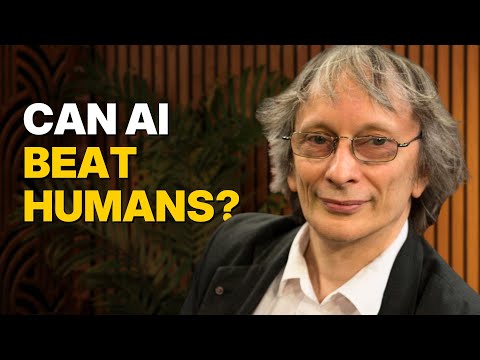
David Deutsch - AI, America, Fun, & Bayes
Dwarkesh Patel (host), David Deutsch (guest), Narrator
In this episode of Dwarkesh Podcast, featuring Dwarkesh Patel and David Deutsch, David Deutsch - AI, America, Fun, & Bayes explores david Deutsch challenges AI hype, human limits, Bayesianism, and fun David Deutsch argues that human and artificial general intelligences are fundamentally equivalent in potential cognitive range, with differences reducible to hardware (speed, memory) and software (knowledge, culture) rather than fixed biological ceilings. He disputes genetic or hardware-based explanations of most human IQ variance, emphasizing culture and software-like factors, and extends this to reject partial or ‘bounded’ creativity in animals and narrow AIs.
David Deutsch challenges AI hype, human limits, Bayesianism, and fun
David Deutsch argues that human and artificial general intelligences are fundamentally equivalent in potential cognitive range, with differences reducible to hardware (speed, memory) and software (knowledge, culture) rather than fixed biological ceilings. He disputes genetic or hardware-based explanations of most human IQ variance, emphasizing culture and software-like factors, and extends this to reject partial or ‘bounded’ creativity in animals and narrow AIs.
Deutsch defends a Popperian, explanation-centered epistemology against Bayesian credences, insisting that progress is about better arguments, not higher probabilities, and maintains that all interesting problems are in principle soluble, even if some specific attempts at declaring limits appeal to current ignorance. He applies his outlook to issues like AI risk, gain-of-function research, constitutional design, cosmological limits, and the recent apparent slowdown in innovation, which he attributes mostly to sociological stultification rather than exhausted ‘low-hanging fruit.’
He also develops his ‘fun criterion’ as a way to evaluate whether different kinds of knowledge within a person’s mind are in harmony without authoritarian subordination, and uses it to criticize certain life strategies, experiential ‘utopias,’ and the idea of evolving AGI via simulated suffering. Throughout, Deutsch defends open-ended scientific and moral progress while acknowledging non-zero existential risks and the moral importance of how we reach future states.
Key Takeaways
Human and AGI minds share the same potential explanatory range, constrained mainly by resources.
Deutsch claims brains are universal computers whose limits are speed and memory; any superior AI hardware can, in principle, be used to augment humans, so there is no category of concept or feeling (like love) forever inaccessible to humans but available to AGI.
Get the full analysis with uListen AI
Most observed human cognitive differences are better seen as ‘software’ and culture than fixed ‘hardware.’
He argues that low literacy, job choice, and test performance reflect cultural programs, attitudes, and learned knowledge—not immutable brain differences—except in cases of clear brain damage or extreme dysfunction.
Get the full analysis with uListen AI
Animal cleverness is sophisticated instinct, not incremental creativity.
Cats opening doors or wolves hunting in novel terrains demonstrate highly adaptive genetic programs that handle unseen situations, but Deutsch insists they lack the capacity to create and criticize explanations, which he views as the hallmark of creativity and personhood.
Get the full analysis with uListen AI
Narrow AIs cannot replace creative explanation in economics, science, or innovation.
He distinguishes pattern-finding or arbitrage systems (including deep nets) from genuine idea creation, arguing that economic value ultimately comes from human-originated explanations (e. ...
Get the full analysis with uListen AI
Progress in knowledge is about better explanations and criticism, not higher Bayesian credences.
Deutsch rejects the idea that experiments ‘raise credence’ in theories; instead, they enrich the repertoire of arguments and refutations, especially against rival explanations or mistaken methodologies like empiricism.
Get the full analysis with uListen AI
Existential risks grow safer as we gain knowledge, but bad choices can still destroy us.
He notes that humanity is far safer now (e. ...
Get the full analysis with uListen AI
The ‘fun criterion’ is a crucial, non-authoritarian guide to good lives and policies.
Fun, for Deutsch, is when explicit, inexplicit, conscious, and unconscious knowledge are in harmony and not forcibly subordinated; any system (personal, political, or ethical) that overrides this harmony—by dogma, authority, or uncompensated suffering—blocks error correction and progress.
Get the full analysis with uListen AI
Notable Quotes
“All limitations on us, hardware limitations on us, boil down to speed and memory capacity.”
— David Deutsch
“Animals can enact a story that’s more complicated than the one the human is telling, but they can’t tell a story.”
— David Deutsch
“The thing that made you a fortune was not the arbitrage machine. It was your idea.”
— David Deutsch
“Every white ball you take out and have reduces the number of black balls in the jar.”
— David Deutsch
“I can contribute to the world arguments… I don’t claim that they are privileged over other arguments. I think it is immoral to have a relationship of authority.”
— David Deutsch
Questions Answered in This Episode
If human and AGI minds are fundamentally equivalent in range, how should this change current AI safety and governance strategies that assume superhuman, incomprehensible AI intelligence?
David Deutsch argues that human and artificial general intelligences are fundamentally equivalent in potential cognitive range, with differences reducible to hardware (speed, memory) and software (knowledge, culture) rather than fixed biological ceilings. ...
Get the full analysis with uListen AI
What empirical research program could genuinely distinguish between ‘hardware’ and ‘software’ explanations of human cognitive variation in a way Deutsch would accept?
Deutsch defends a Popperian, explanation-centered epistemology against Bayesian credences, insisting that progress is about better arguments, not higher probabilities, and maintains that all interesting problems are in principle soluble, even if some specific attempts at declaring limits appeal to current ignorance. ...
Get the full analysis with uListen AI
Are there plausible examples of animal behavior that might actually satisfy Deutsch’s explanatory creativity criterion, and what would follow if we found them?
He also develops his ‘fun criterion’ as a way to evaluate whether different kinds of knowledge within a person’s mind are in harmony without authoritarian subordination, and uses it to criticize certain life strategies, experiential ‘utopias,’ and the idea of evolving AGI via simulated suffering. ...
Get the full analysis with uListen AI
How could a Popperian, explanation-first epistemology be operationalized in today’s scientific institutions, which are heavily Bayesian and statistical in practice?
Get the full analysis with uListen AI
In practical policy terms, how might governments or societies implement the ‘fun criterion’ without slipping into paternalism or hidden authority?
Get the full analysis with uListen AI
Transcript Preview
Okay. Today, I'm speaking with David Deutsch. Now, this is a conversation that I've been, um, eagerly wanting to have for years, so this is very exciting for me. So first, let's talk about AI. Um, can you, uh, briefly explain why you anticipate that AIs will be no more fundamentally intelligent than humans?
Uh, I, I suppose you mean AGIs.
Yes.
Um, and, uh, by fundamentally intelligent, I suppose you mean capable of all the same types of cognition as humans are, in principle.
Yes.
So, uh, that would include, um, you know, doing science and doing art and, and in principle, also falling in love and, and, uh, being good and being evil and, and all that. So the reason, uh, it, it, it, it, um... The reason is twofold and, uh, one-half is about computation hardware, computation hardware, and the other is about, um, software. So if we take the hardware, um, eh we know that, uh, our, our brains are Turing-complete, um, bits of hardware, and therefore, can, uh, e- exhibit the functionality of running any computable, um, function, program for any computable function. Now, uh, when I say any, I don't really mean any, because you and I sitting here, you know, we're having a conversation and we could say, you know, we could have any conversation. Well, uh, we, we can assume that maybe in 100 years time, we'll both be dead, and therefore, uh, the number of conversations we could have is strictly limited, uh, and also some conversations, uh, depend on speed of computation, so, uh, you know, if, if, if we're gonna be solving the traveling salesman problem, then, uh, there are, there are many traveling salesman problems that we wouldn't be able to solve in the age of the universe. So, when I say any, I'm, uh, what I mean is that we're, we're not limited in the programs we can run apart from by speed and memory capacity. So, uh, all limitations on us, hardware limitations on us boil down to speed and memory capacity, and both those can be augmented to the level of any other entity that is in the universe. Because, you know, if somebody builds a, a computer that can think faster than the brain, then we can use that very computer or that very technology to make our thinking go just as fast as that. Uh, so that's the hardware. Um, as far as, uh, explanations go, can we, can we, uh, reach the same kind of explanations as any other entity? Let's say, uh, usually this is said not in terms of AGIs but in terms of, um, uh, extraterrestrial intelligences, but also it's said about AGIs, you know. What, what if they are to us as we are to ants? Um, and so on. Well, again, part of that is just hardware, which is easily fixable by adding more hardware, so let's, let's forget about that. Um, so really the, the idea is, is there, are, are there, are there, uh, concepts that we are inherently incapable of comprehending? I think, uh, Martin Reese believes this. Uh, he, he, he thinks that, uh, you know, we can comprehend quantum mechanics, apes can't, and maybe the extraterrestrials can comprehend, um, something beyond quantum mechanics which we can't comprehend, and, and no amount of, uh, uh, brain add-ons with extra hardware can give us that, because they have the hardware that is, that is, um, adapted to having these concepts which, which, uh, we haven't. The, the same kind of thing is said about maybe certain qualia that, that maybe w- we can experience love and an AGI couldn't experience love, because it has to do with our hardware. Not just memory and speed, but specialized hardware, and, um, I, I think that falls victim to the same argument. The, the thing is, this specialized hardware can't be anything except a, uh, a computer, and if there's hardware that, that, uh, is needed for love, let, let's say that somebody is born without that hardware, then that hardware, that bit of the brain that does love or that, or that does mathematical insight or whatever, is just a bit of the brain and it's connected to the rest of the brain in the same way that any other part of the brain is connected to the rest of the brain, namely by neurons, uh, passing electrical signals, and by chemicals, uh, th- whose concentrations are altered and so on. So therefore, an artificial device that computed which signals were to be sent and which, uh, uh, um, um, chemicals were to be adjusted, uh, could do the same job and it would be indistinguishable, and therefore, a person augmented with one of those who couldn't feel love could feel love after that au- augmentation. So th- those are, those are... An I think those two.... things are the only relevant ones. So that's why I think, um, that a- AGIs and, and humans have the same range in the sense I've defined.
Install uListen to search the full transcript and get AI-powered insights
Get Full TranscriptGet more from every podcast
AI summaries, searchable transcripts, and fact-checking. Free forever.
Add to Chrome