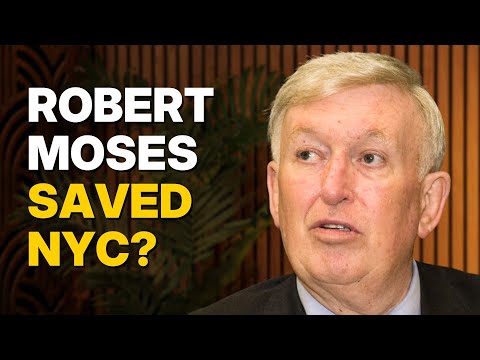
Kenneth T. Jackson - Robert Moses, Hero of New York?
Kenneth T. Jackson (guest), Dwarkesh Patel (host), Narrator, Narrator
In this episode of Dwarkesh Podcast, featuring Kenneth T. Jackson and Dwarkesh Patel, Kenneth T. Jackson - Robert Moses, Hero of New York? explores reassessing Robert Moses: Builder, Bully, and Savior of New York Historian Kenneth T. Jackson argues that Robert Moses, often vilified via Robert Caro’s *The Power Broker*, was the single most important builder in American urban history and a central force in New York’s rise, not its fall.
Reassessing Robert Moses: Builder, Bully, and Savior of New York
Historian Kenneth T. Jackson argues that Robert Moses, often vilified via Robert Caro’s *The Power Broker*, was the single most important builder in American urban history and a central force in New York’s rise, not its fall.
Jackson credits Moses with creating New York’s core infrastructure—bridges, highways, parks, housing, and major civic complexes—on time and under budget, in an environment where such projects are nearly impossible today.
He contends that many of Caro’s specific claims are factually wrong or incomplete, especially around transit decline and neighborhood destruction, and that Moses largely ‘swam with the tide’ of mid‑century car culture rather than uniquely distorting it.
The conversation contrasts Moses’ top‑down, power‑driven vision with Jane Jacobs’ human‑scale urbanism, and uses that tension to reflect on today’s NIMBYism, historic preservation, and our diminished capacity to build large public works.
Key Takeaways
Moses’ building program underpinned New York’s global dominance.
Jackson argues that without Moses’ bridges, expressways, parks, housing, and civic complexes, New York likely would have hollowed out like many Midwestern and Northeastern cities, instead of remaining a premier global capital.
Get the full analysis with uListen AI
Caro’s portrait is powerful but contains many factual and contextual errors.
While praising *The Power Broker* as an extraordinary achievement, Jackson says its details on topics such as the Cross‑Bronx Expressway, public transit decline, and low bridge clearances are often wrong or overstated, in part because Caro focused almost exclusively on Moses’ own papers and ignored national patterns.
Get the full analysis with uListen AI
Moses embodied a now‑vanished capacity to execute mega‑projects quickly.
He routinely delivered huge works—Whitestone Bridge, Jones Beach, the Triborough network—on time and under budget, using overlapping authorities, bond finance, and sheer will, in a dense, litigious city where similar projects now stall or bloat in cost.
Get the full analysis with uListen AI
His pursuit of power was personal, but not primarily for enrichment.
Moses worked for a token salary across multiple posts, died with less money than he started with, and used bond‑funding tricks mainly to keep building—not to siphon wealth—distinguishing his ‘corruption’ from more typical graft‑driven machines.
Get the full analysis with uListen AI
He helped entrench car‑centric urbanism even as New York stayed transit‑rich.
Moses prioritized highways and suburbanization, dismissed old neighborhoods as slums, and rejected rail add‑ons to roads—but Jackson notes that New York still ended up as the nation’s strongest transit city, with far higher relative transit use than anywhere else.
Get the full analysis with uListen AI
Neighborhood impacts were serious but not always uniquely catastrophic.
Jackson disputes Caro’s claim that the Cross‑Bronx uniquely ‘killed’ stable Jewish areas; he says census and FHA maps show those neighborhoods were already following broader patterns of white flight and demographic turnover seen across the Bronx and other cities.
Get the full analysis with uListen AI
Today’s preservationism and NIMBYism may be overcorrecting Moses’ excesses.
Where Moses could bulldoze with 90‑day eviction notices, contemporary New York and San Francisco often treat cities as untouchable museums, making housing scarce and infrastructure upgrades extraordinarily difficult despite urgent needs.
Get the full analysis with uListen AI
Notable Quotes
“By any standard, he's the greatest builder in American history. There's nobody really in second place.”
— Kenneth T. Jackson
“Had Robert Moses not lived, not done what he did, New York would have followed the trail of maybe Detroit.”
— Kenneth T. Jackson
“He was ruthless and arrogant and honest.”
— Kenneth T. Jackson
“We’ve gone too far in the ability to obstruct change. We need change… you can't run a city or a country [so] nothing will change.”
— Kenneth T. Jackson
“Moses didn't see people. He saw bridges, he saw highways, he saw tunnels… Jane Jacobs saw what Moses didn't see.”
— Kenneth T. Jackson
Questions Answered in This Episode
If we accept that Moses both harmed neighborhoods and saved New York overall, how should we morally evaluate his legacy?
Historian Kenneth T. ...
Get the full analysis with uListen AI
What kinds of institutional safeguards could allow a modern ‘Moses’ to build boldly without repeating his worst excesses?
Jackson credits Moses with creating New York’s core infrastructure—bridges, highways, parks, housing, and major civic complexes—on time and under budget, in an environment where such projects are nearly impossible today.
Get the full analysis with uListen AI
Where is the line between necessary disruption for long‑term public benefit and unacceptable short‑term harm to specific communities?
He contends that many of Caro’s specific claims are factually wrong or incomplete, especially around transit decline and neighborhood destruction, and that Moses largely ‘swam with the tide’ of mid‑century car culture rather than uniquely distorting it.
Get the full analysis with uListen AI
How can cities rebalance away from car‑centric planning today without dismantling the economically valuable infrastructure Moses helped create?
The conversation contrasts Moses’ top‑down, power‑driven vision with Jane Jacobs’ human‑scale urbanism, and uses that tension to reflect on today’s NIMBYism, historic preservation, and our diminished capacity to build large public works.
Get the full analysis with uListen AI
Is our contemporary bias toward historic preservation and local veto power a rational correction to figures like Moses, or a new form of self‑destructive paralysis?
Get the full analysis with uListen AI
Transcript Preview
... Robert Moses represented a past that's, you know, a time when we wanted to build bridges and super highways and things that pretty much is going on i-... We're not building super highways now. We're not building vast bridges like Moses built all the time. Essentially, all the big roads, all the bridges, all the parks, the United Nations, Lincoln Center, uh, the World's Fairs of 1939 and 1964, and hundreds of other things he built. Had Robert Moses not lived, not done what he did, New York would have followed the trail of maybe Detroit. And I think it was the best book I ever read. In broad strokes, it's correct. Robert Moses had more power than any urban figure in American history. He built incredible monuments. Uh, he was ruthless and arrogant and honest.
Okay. I am really, really excited about this one. Today, I have the pleasure of speaking with Professor Kenneth T. Jackson about the life and legacy of Robert Moses. Professor Jackson is the preeminent historian on S- New York City. He was the director of the Herbert H. Lehman Center for American History and the Jacques Barzun Professor Emeritus of History at Columbia University, where he has also chaired the Department of History, um, and we were discussing, um, Robert Moses. Professor Jackson is, uh, the author and editor of Robert Moses and the Modern City: The Transformation of New York. Uh, Professor Jackson, welcome to the podcast.
Well, thank you for having me.
Okay. So many people will have heard of Robert Moses, um, and be vaguely aware of him through that, uh, through the popular biography of him by Robert Caro, The Powerbroker, but most people will not be aware of the extent of his influence on New York City. Uh, can you give a, can you give a kind of a summary of the things he was able to get built in New York City?
One of the best comparisons I can think of is that R. Caro himself, when he compared him to, um, Christopher Wren in London, he said if you would see his monument, look around, it's almost more easier to talk about what Moses didn't do than what he did do. If you, um... All the roads, essentially all the big roads, all the bridges, all the parks, the United Nations, Lincoln Center, uh, the World's Fairs of 1939 and 1964, and hundreds of other things he built. And I mean, he didn't actually do it with his own two hands, but he was in charge. He got it done. And y-... R. Caro wrote a really great book. I think the book was flawed because I think, uh, Caro only looked at Moses's own documents, and Moses had a very narrow view of himself. I mean, he thought he was a great man, but I mean, he didn't pay any attention to what was going on in LA very much, for example.
Install uListen to search the full transcript and get AI-powered insights
Get Full TranscriptGet more from every podcast
AI summaries, searchable transcripts, and fact-checking. Free forever.
Add to Chrome