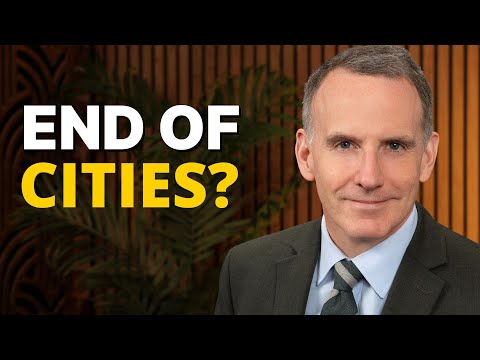
Edward Glaeser - Cities, Terrorism, Housing, & Remote Work
Edward Glaeser (guest), Dwarkesh Patel (host)
In this episode of Dwarkesh Podcast, featuring Edward Glaeser and Dwarkesh Patel, Edward Glaeser - Cities, Terrorism, Housing, & Remote Work explores edward Glaeser on cities: resilience, housing, remote work, and decline Edward Glaeser discusses how cities form, adapt, and sometimes decline, emphasizing the roles of transportation costs, housing markets, institutions, and local politics. He argues that cities are both targets and fortresses against terrorism, and explains why many Western capitals are less dominant than historic city-empires like Rome or Paris.
Edward Glaeser on cities: resilience, housing, remote work, and decline
Edward Glaeser discusses how cities form, adapt, and sometimes decline, emphasizing the roles of transportation costs, housing markets, institutions, and local politics. He argues that cities are both targets and fortresses against terrorism, and explains why many Western capitals are less dominant than historic city-empires like Rome or Paris.
A major focus is on housing constraints, reduced geographic mobility, and the growing problem of prime-age male non-employment, which he ties to both housing regulation and place-based informal safety nets. He is broadly pro-urban, pro-immigration, and pro-building, skeptical of over-localized veto power, and supportive of tools like land value taxation without treating them as panaceas.
Glaeser also assesses remote work, the metaverse, and tech hubs like Silicon Valley, arguing that face-to-face interaction will remain central to innovation even as digital tools expand, and he highlights emerging Sunbelt cities as promising startup locations.
He closes by stressing the unresolved challenge of protecting rapidly growing, low-lying cities in the developing world from climate-related risks.
Key Takeaways
Cities must be planned flexibly and allowed to evolve organically.
Glaeser advises that even on Mars, the best approach is a simple, flexible grid and limited top-down micromanagement, letting entrepreneurs and individual initiative determine land use over time.
Get the full analysis with uListen AI
Concentrated cities are both attractive targets and easier to defend.
Post‑9/11, cities like New York and London invested heavily in security infrastructure (e. ...
Get the full analysis with uListen AI
Housing regulation and informal safety nets are freezing Americans in place.
Rising housing costs in opportunity-rich regions and place-bound family support (e. ...
Get the full analysis with uListen AI
Local monopolies and political dynamics undermine urban K–12 schooling.
Unlike highly competitive urban universities, big-city public school systems are often local monopolies where politically powerful teachers’ unions and fragmented, overburdened parents weaken accountability and performance.
Get the full analysis with uListen AI
Land value taxes are efficient but not a cure-all.
Taxing land instead of structures avoids discouraging new construction and can improve urban development, but it cannot realistically replace all other taxes or single-handedly solve inequality and fiscal needs.
Get the full analysis with uListen AI
Remote work is a short-run substitute but a long-run complement to cities.
History—from the book to the telephone to Zoom—suggests that new communication tools initially substitute for in-person contact but ultimately generate more complex, knowledge-intensive interactions that increase demand for face-to-face meetings and urban agglomeration.
Get the full analysis with uListen AI
Joblessness is more socially damaging than low income and weakens UBI arguments.
Evidence from opioid use, deaths of despair, and negative income tax experiments leads Glaeser to argue that work provides purpose and social connection; generous unconditional transfers in rich countries risk increasing non-employment and misery.
Get the full analysis with uListen AI
Notable Quotes
“Cities are always shaped by the transportation costs that are dominant in the era in which they're created.”
— Edward Glaeser
“We have evolved to be an in-person species not just because we're productive and learn a lot face-to-face, but also because we just like it.”
— Edward Glaeser
“I don't know any economist who doesn't think that a land value tax is an attractive idea… A good idea, yes. A panacea, no.”
— Edward Glaeser
“When you look at human misery and opioid use…the difference between low-income earners and the jobless—unhappiness spikes enormously.”
— Edward Glaeser
“The largest unsolved problem in cities is what the heck we're gonna do about climate change and the cities of the developing world.”
— Edward Glaeser
Questions Answered in This Episode
If we granted significantly stronger property rights against local zoning, what political pathways actually exist to implement those changes in major U.S. metros?
Edward Glaeser discusses how cities form, adapt, and sometimes decline, emphasizing the roles of transportation costs, housing markets, institutions, and local politics. ...
Get the full analysis with uListen AI
How could we redesign safety nets to preserve a strong norm of work while still protecting people from economic shocks and automation?
A major focus is on housing constraints, reduced geographic mobility, and the growing problem of prime-age male non-employment, which he ties to both housing regulation and place-based informal safety nets. ...
Get the full analysis with uListen AI
What practical mechanisms could rich countries use to help safeguard low-lying developing-world cities like Mumbai or Manila from climate-driven flooding?
Glaeser also assesses remote work, the metaverse, and tech hubs like Silicon Valley, arguing that face-to-face interaction will remain central to innovation even as digital tools expand, and he highlights emerging Sunbelt cities as promising startup locations.
Get the full analysis with uListen AI
Given the rise of hybrid work, how should cities restructure their central business districts and transit investments over the next few decades?
He closes by stressing the unresolved challenge of protecting rapidly growing, low-lying cities in the developing world from climate-related risks.
Get the full analysis with uListen AI
What institutional or cultural changes would be needed to keep Silicon Valley from following a Detroit-like trajectory as a one-industry town dominated by behemoths?
Get the full analysis with uListen AI
Transcript Preview
I think the thing that many of us worry about in terms of Silicon Valley more recently is it feels much more like it's a one-industry town, which is dangerous, and it feels more like it's a bunch of industrial behemoths rather than a bunch of smart, scrappy startups. And that's, that's a recipe that feels much more like Detroit in the 1950s than it does like Silicon Valley in the 1960s. 100 years ago, that thing was called heroin. 200 years ago, that thing was called morphine. 300 years ago, that thing was called laudanum, right? We, we have these new drugs which have come in, and they've never been safe. It's just a very different thing if you're saying, "I'm gonna give $100 to a poor Congolese farmer," or, "I'm going to give, uh, you know, $10,000 to a long-term jobless pe- person in eastern Kentucky."
Okay. Today, I have the pleasure of speaking with Professor Edward Glaeser, who is the Chair of the Harvard Department of Economics, and he is the author of the best books and papers about cities. So Professor Glaeser, thanks for coming on The Lunar Society.
Oh, thank you so much for having me on, especially given that Lunar Society pays homage to one of my favorite moments in, uh, urban innovation in, uh, Birmingham in the 18th century.
Oh, wow. I- I- I- I didn't even, uh, I didn't even catch that theme, but actually, yeah, that's a (laughs) that's a great tie-in, yep. My first question, what advice would you give to Elon Musk about building the first cities on Mars?
(laughs) Um, that's a, that's a great question. Um, the, uh, I mean, I think, I think in fact demand for urbanism in Mars is going to be relatively limited. Um-
(laughs)
Cities are always shaped by the transportation costs that are dominant in the era in which they're created. Um, that both determines the sort of micro shape of the city and determines its, its macro futures. So, um, cities on Mars are of course gonna be limited by the likely to be prohibitive cost of traveling back and forth to the mother, to the mother, uh, planet. Um, but we also have to understand what cars are people going to be using on Mars. I assume these are all gonna be Teslas. I assume that everyone is gonna be-
(laughs)
... driving around in some sort of appropriate Tesla on, on Mars. So it's gonna be a very car-oriented, uh, living. I think probably the best strategy on this is to create a fairly flexible plan, um, much like the 1811 grid plan in New York that allows entrepreneurs to sort of change land use over time, um, to put a few bets on what's necessary in terms of infrastructure, and then just let the city evolve sort of organically. I think that's, that's usually the, the best way is to tru- trust more to individual initiative than to trust to central planning, at least in terms of micromanaging what goes where.
Install uListen to search the full transcript and get AI-powered insights
Get Full TranscriptGet more from every podcast
AI summaries, searchable transcripts, and fact-checking. Free forever.
Add to Chrome