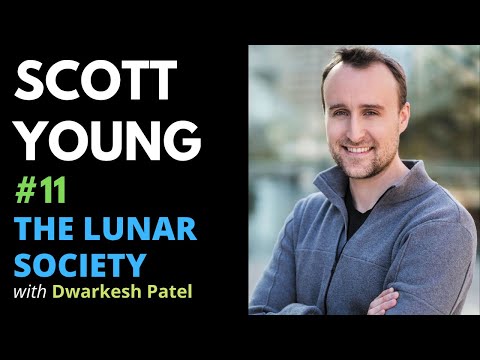
Scott Young - Ultralearning, The MIT Challenge
Scott Young (guest), Dwarkesh Patel (host), Narrator, Dwarkesh Patel (host), Narrator
In this episode of Dwarkesh Podcast, featuring Scott Young and Dwarkesh Patel, Scott Young - Ultralearning, The MIT Challenge explores scott Young Explores Ultralearning, Genius, Ambition, And Realistic Mastery Paths Scott Young discusses the ideas behind his book *Ultralearning*, contrasting structured, aggressive self-directed learning with the romanticized stories of geniuses like Einstein and outliers in academia or publishing.
Scott Young Explores Ultralearning, Genius, Ambition, And Realistic Mastery Paths
Scott Young discusses the ideas behind his book *Ultralearning*, contrasting structured, aggressive self-directed learning with the romanticized stories of geniuses like Einstein and outliers in academia or publishing.
He emphasizes the “narrow path” to success in competitive fields, arguing you should understand and usually follow the standard pathways rather than betting on being a one-in-a-million exception.
Young explains key learning principles—directness, retrieval, feedback, chunking, transfer, focus—and how age, cognitive limits, and environment shape what’s realistically possible, especially for ambitious projects like his MIT Challenge.
The conversation broadens into innovation, speedrunning, societal progress, and advice for young people: cultivate more ambition, work on big original projects, and invest early in skills and problems that matter over the long term.
Key Takeaways
Don’t plan your life around exceptions like Einstein; understand typical success paths.
In academia, publishing, and other elite fields, outcomes largely follow rigid filters and standard pipelines. ...
Get the full analysis with uListen AI
Research the standard path before pursuing any serious project or career.
Whether it’s getting a nonfiction book deal or an academic job, there is usually a well‑established, data-backed route. ...
Get the full analysis with uListen AI
Optimize learning for direct performance, not vague “transfer.”
The brain learns very specifically; skills often don’t transfer just because they’re loosely related. ...
Get the full analysis with uListen AI
Focus on deep understanding and chunking to enable real transfer and insight.
Experts see abstract principles (e. ...
Get the full analysis with uListen AI
Learning principles are age‑invariant, but constraints change with age.
Retrieval practice, feedback, and direct practice work at 17 or 79, but older learners face frontal-lobe decline (harder attention switching) and weaker binding between pieces of information. ...
Get the full analysis with uListen AI
Most growth follows S‑curves and diminishing returns, not endless compounding.
Early phases of learning or career development often yield rapid improvements; later, gains become incremental. ...
Get the full analysis with uListen AI
Ambitious, original projects in your 20s build long‑term opportunity.
Young people with some talent and grit are often too quick to optimize for short-term money or status. ...
Get the full analysis with uListen AI
Notable Quotes
“You shouldn’t be going into a poker game, ‘Well, if I get a royal flush, then I’ll be really good.’ You need to bet it on, ‘Given that I have probably an average hand, what’s the way I should play?’”
— Scott Young
“People really ought to do more research about what is the sort of typical way that these kinds of things succeed before they embark in projects.”
— Scott Young
“When you talk about learning skills, we tend to use fairly general labels… but to actually perform those skills quite well, you have to do something very, very precise.”
— Scott Young
“Most people are before the gains. They’re the people who’ve maybe jogged a couple times in their life, but they’ve never taken it seriously.”
— Scott Young
“I feel like people are just way too unambitious in general… they don’t think of big projects. They don’t work on them.”
— Scott Young
Questions Answered in This Episode
How can an ambitious student systematically research the “narrow path” to success in a field they care about before committing years to it?
Scott Young discusses the ideas behind his book *Ultralearning*, contrasting structured, aggressive self-directed learning with the romanticized stories of geniuses like Einstein and outliers in academia or publishing.
Get the full analysis with uListen AI
If the brain’s learning is so specific, what are concrete ways to design study plans that maximize directness without sacrificing breadth and creativity?
He emphasizes the “narrow path” to success in competitive fields, arguing you should understand and usually follow the standard pathways rather than betting on being a one-in-a-million exception.
Get the full analysis with uListen AI
Given aging-related cognitive changes, what would an ideal Ultralearning project look like for someone in their 50s or 60s compared to someone in their 20s?
Young explains key learning principles—directness, retrieval, feedback, chunking, transfer, focus—and how age, cognitive limits, and environment shape what’s realistically possible, especially for ambitious projects like his MIT Challenge.
Get the full analysis with uListen AI
How could we import the ‘speedrunning’ culture of transparent performance and shared techniques into domains like scientific research, programming, or entrepreneurship?
The conversation broadens into innovation, speedrunning, societal progress, and advice for young people: cultivate more ambition, work on big original projects, and invest early in skills and problems that matter over the long term.
Get the full analysis with uListen AI
For a talented 20‑year‑old torn between immediate income/status and a risky but meaningful long-term project, how should they decide which path to prioritize?
Get the full analysis with uListen AI
Transcript Preview
I feel like people are just way too unambitious in general, and not in, like, the ambition like, "I wanna be better than other people" way, but they just don't think of big projects. They don't work on them. They don't, they don't have, like, you know, big dreams to do cool things, or if they are, it's usually to something, like, I don't know, it usually boils down to something like social status, like, "I wanna be the, you know, the person that does this that's better than other people." And I don't know. I feel like I don't know how you change that, but I do think that, uh, rewarding kind of a culture where you wanna do kind of ambitious, original things that, um, are kinda interesting and you don't know where they're gonna lead, I think that that's, having that in you is, is kinda rare, and I think that cultivating it is probably good for yourself and society.
(Instrumental music) Okay. Today, I have the pleasure of speaking with Scott Young, who is the author of the book Ultralearning: Accelerate Your Career, Master Hard Skills, and Outsmart Your Competition. So Scott, I'll ask you some practical s- questions in a second, but, uh, first, let's talk about Einstein and Newton. So they both had an annus mirabilis, a miracle year within which their, many of their important contributions were concentrated. W- what explains this phenomenon of miracle years?
Well, I, I don't know. I think whenever you look at the sort of outlier people, like, and Newton and Einstein are certainly one, um, y- you have to realize that most people never have a year where they accomplish anything like that. So I think it's just... E- e- it's j- I think it's a lot of it's selection effect, that you have a smart person who just happens to be working on the problem that will lead to a huge breakthrough. And so, I mean, it, we could've lived in a world where Newton spent a lot of time on alchemy and then discovered a way to turn lead into gold and then, like, that worked, but that's not the world that we live in. And so I think that, you know, his work on, uh, physics and the Principia and stuff like that was what led to the breakthrough. And I think Einstein's a little rare that he had kind of a couple key insights that led to physics. Like, I mean, he discovers or sort of proves through Brownian motion the existence of atoms. He disc- the photoelectric effect, which is the thing he actually won the Nobel for, not his relativity, which is what he's, you know... The, the thing he revolutionized physics for, uh, is not really even what he, uh, got the, uh, Nobel Prize for was the photoelectric effect, which, I mean, I guess it started quantum mechanics, so it's not really (laughs) , can't downplay it too much, but... Then special relativity and then he struggles with the math for, like, eight years to get general relativity. So I think Einstein's a, you know, he's a little bit of an exception in that he, he did have, like, multiple huge breakthroughs. And so when people are talking about, like, lists of geniuses or people who are important, sometimes that list gets populated by people who don't really deserve to be there. But Einstein is definitely, like, not... He's like an accurately relate- rated genius that, uh, ex- is seen as being extremely smart and important b- and actually is extremely smart (laughs) and important.
Install uListen to search the full transcript and get AI-powered insights
Get Full TranscriptGet more from every podcast
AI summaries, searchable transcripts, and fact-checking. Free forever.
Add to Chrome