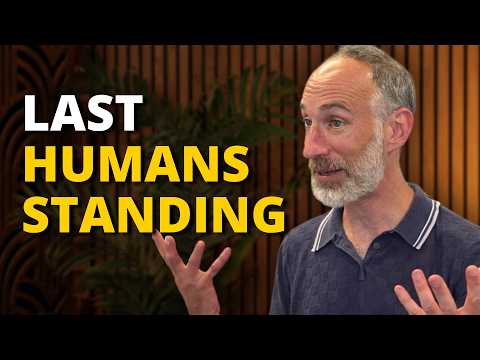
David Reich — How one small tribe conquered the world 70,000 years ago
David Reich (guest), Dwarkesh Patel (host)
In this episode of Dwarkesh Podcast, featuring David Reich and Dwarkesh Patel, David Reich — How one small tribe conquered the world 70,000 years ago explores ancient DNA upends human origins: small tribe, global takeover explained Geneticist David Reich explains how ancient DNA is overturning textbook models of human evolution, including the relationships between modern humans, Neanderthals, Denisovans, and other archaic groups.
Ancient DNA upends human origins: small tribe, global takeover explained
Geneticist David Reich explains how ancient DNA is overturning textbook models of human evolution, including the relationships between modern humans, Neanderthals, Denisovans, and other archaic groups.
He argues that standard "Out of Africa" and simple tree-like models are now low-probability, replaced by complex networks of gene flow, substructured populations, and repeated population replacements.
The conversation explores how a relatively small, rapidly expanding population 50–70,000 years ago came to dominate the globe, why other human species vanished, and how culture, disease, and randomness shaped that outcome.
Reich also discusses recent findings on selection over the last 10,000 years, the role of plague in demographic turnovers, parallels to AI and learning, and what breakthroughs in African ancient DNA could reveal next.
Key Takeaways
The standard, simple split between modern humans, Neanderthals, and Denisovans is likely wrong.
Mitochondrial DNA and Y-chromosome data show much more recent shared ancestry between Neanderthals and modern humans than whole-genome averages suggest, implying far more complex and extensive gene flow than the canonical “one split plus a few admixture events” model.
Get the full analysis with uListen AI
Modern humans and archaic humans formed a deeply interconnected, substructured global network.
Instead of large, continuous populations, the past was an archipelago of tiny, often-isolated groups that repeatedly mixed, merged, and went extinct; diversity today reflects the ensemble of many such groups, not a single, continuous lineage in one region.
Get the full analysis with uListen AI
Human global dominance likely hinged more on cultural breakthroughs than on new genetic hardware.
Brain size was already large before the split with Neanderthals, and some evidence points to later, human-specific changes in vocal-tract regulation and language-like capacities, suggesting that culturally-driven cumulative knowledge and social learning may have triggered the rapid expansion 50–70,000 years ago.
Get the full analysis with uListen AI
Human history is full of massive, often abrupt population replacements driven by migration and disease.
Ancient DNA shows repeated waves—farmers over hunter-gatherers, steppe pastoralists over farmers, Papuan males over early Austronesian settlers, etc. ...
Get the full analysis with uListen AI
The last 10,000 years saw intense selection on metabolism and immunity, but little on cognition.
Large-scale genomic time series in Europe reveal strong, polygenic selection against variants predisposing to higher body fat and type 2 diabetes, and strong selection on immune-related genes, while alleles tied to behavioral or cognitive traits show surprisingly little directional change.
Get the full analysis with uListen AI
The Indian subcontinent provides a clear example of ‘frozen’ admixture shaped by caste.
Most contemporary South Asians are mixtures of two synthesized ancestries (Ancestral North and Ancestral South Indians), themselves products of earlier hunter-gatherer, Harappan-like, and steppe-related populations; large-scale mixing occurred after Harappan decline, then effectively locked in a few thousand years ago with the emergence of the caste system.
Get the full analysis with uListen AI
Future breakthroughs hinge on ancient African DNA and decoding how genomes encode adaptation.
Reich stresses that obtaining 50–200,000-year-old genomes from across Africa could radically revise our picture of human origins, and that a major unsolved problem is learning to read genomes well enough to reconstruct how key human-specific traits, especially cognitive and social ones, actually evolved.
Get the full analysis with uListen AI
Notable Quotes
“Models that are considered to be standard dogma are now low probability.”
— David Reich
“Seventy thousand years ago, there are half a dozen different human species and then this group, initially like 1,000 to 10,000 people, explodes all across the world.”
— David Reich
“It’s not even obvious that non-Africans today are modern humans. Maybe they’re Neanderthals who became modernized by waves and waves of admixture.”
— David Reich
“The whole continent of Sub-Saharan Africa and probably Eurasia at this time is full of hundreds, thousands, tens of thousands of little groups… together there is enough recontact to recharge the diversity.”
— David Reich
“Ancient DNA is like opening a room that is still echoing with languages that are no longer spoken and recording the words thousands of years later.”
— David Reich (paraphrasing his book’s metaphor)
Questions Answered in This Episode
If the simple Out-of-Africa model is unlikely, what are the most promising alternative models for how modern humans and archaic humans intertwined across Africa and Eurasia?
Geneticist David Reich explains how ancient DNA is overturning textbook models of human evolution, including the relationships between modern humans, Neanderthals, Denisovans, and other archaic groups.
Get the full analysis with uListen AI
How far can we push the idea that cultural and linguistic innovations, rather than genetic upgrades, explain the decisive success of one small human group 50–70,000 years ago?
He argues that standard "Out of Africa" and simple tree-like models are now low-probability, replaced by complex networks of gene flow, substructured populations, and repeated population replacements.
Get the full analysis with uListen AI
To what extent did diseases like early Yersinia pestis fundamentally reshape the cultural and political trajectories of regions such as Europe, analogous to smallpox in the Americas?
The conversation explores how a relatively small, rapidly expanding population 50–70,000 years ago came to dominate the globe, why other human species vanished, and how culture, disease, and randomness shaped that outcome.
Get the full analysis with uListen AI
What would ancient DNA from 100,000–300,000-year-old African humans need to show to overturn our current view of where and how ‘modern’ humans evolved?
Reich also discusses recent findings on selection over the last 10,000 years, the role of plague in demographic turnovers, parallels to AI and learning, and what breakthroughs in African ancient DNA could reveal next.
Get the full analysis with uListen AI
How might a better understanding of how genomes encode developmental and cognitive traits change our expectations about the capabilities and limits of AI systems trained very differently from biological brains?
Get the full analysis with uListen AI
Transcript Preview
... there's just extinction after extinction after extinction of the Neanderthal groups, of the Denisovan groups, and of the modern human groups. But the last one standing is one of the modern human groups. It's not even obvious that non-Africans today are modern humans. Maybe they're Neanderthals who became modernized by waves and wave of admixture. Farmers who were just on the verge of encountering people from the steppe, a huge fraction of them have Black Death. It's killing, like, a scarily large fraction of the population. A lot of people I know dropped off the paper. They just didn't want to be associated with it because it was so weird and they just thought it might be wrong. But it's stood up as far as I can tell.
70,000 years ago, there are half a dozen different human species and then this group, initially, like, 1,000 to 10,000 people, explodes all across the world.
I think there's been an assumption where Africa has been at the center of everything. Models that are considered to be standard dogma are now low probability.
Today, I have the pleasure of speaking with David Reich, who is a geneticist at, of har- ancient DNA at Harvard. And, um, David's work and his lab's work and his field's work has transformed, like, really transformed our understanding of human history and human evolution. Uh, I mean, and it's really fascinating stuff from many perspectives. Uh, in its own light, it's very interesting. From the perspective of AI, which I plan on asking you about, it's interesting to understand human evolution and what that implies about what the future of AI might look like. Anyways, I'll stop doing the introduction. David, we were just chatting before we started recording about what new information you've been studying since the book came out about archaic humans and the relationship between modern humans and Neanderthals. Uh, can you, can you explain again what the, uh, what, what you're studying these days?
Well, I think what's very interesting is that what we have data from now are modern humans, the sequences of people living today, and we also have data from Neanderthals, who are archaic humans that lived in Western Eurasia for the last couple of 100,000 years, and we have now sequences from many Neanderthals. And we also have DNA from Denisovans. Denisovans are archaic humans who were discovered from the DNA, from a, a, a, a finger bone that was found in a cave in Siberia and not anticipated to be a new group of humans, but were sequenced. So we have DNA from these different sources, plus bits of DNA from these sources mixed into modern populations. And based on this, in the last 10 years or 14 years, we collectively have been piecing together a tr- an understanding of how, uh, modern humans are related to our closest relatives who are now no longer with us in unmixed form, the Neanderthals, Denisovans, and maybe others who are no longer, uh, not yet sampled.
Install uListen to search the full transcript and get AI-powered insights
Get Full TranscriptGet more from every podcast
AI summaries, searchable transcripts, and fact-checking. Free forever.
Add to Chrome