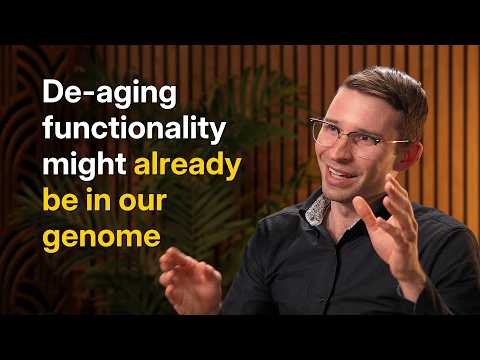
Evolution designed us to die fast; we can change that — Jacob Kimmel
Jacob Kimmel (guest), Dwarkesh Patel (host)
In this episode of Dwarkesh Podcast, featuring Jacob Kimmel and Dwarkesh Patel, Evolution designed us to die fast; we can change that — Jacob Kimmel explores why Evolution Neglected Longevity And How Epigenetics May Fix It Dwarkesh Patel interviews Jacob Kimmel, president and co‑founder of NewLimit, about why evolution did not optimize humans for long, healthy lifespans and how epigenetic reprogramming could partially reverse cellular aging.
Why Evolution Neglected Longevity And How Epigenetics May Fix It
Dwarkesh Patel interviews Jacob Kimmel, president and co‑founder of NewLimit, about why evolution did not optimize humans for long, healthy lifespans and how epigenetic reprogramming could partially reverse cellular aging.
Kimmel frames evolution as an inefficient optimizer constrained by high early-life mortality, kin selection, and mutation/population limits, arguing that longevity received little direct selection pressure compared to infectious disease resistance.
He explains NewLimit’s strategy: using large-scale perturbation experiments and AI models to find combinations of transcription factors that remodel the epigenome of specific human cell types to a more youthful, functional state.
The conversation broadens into delivery technologies, the idea of a ‘virtual cell’ foundation model for drug discovery, economic incentives in pharma, and how general aging therapies could reshape healthcare costs and industry structure.
Key Takeaways
Evolution optimized for reproduction under high hazard rates, not long healthspan.
For most of human and primate history, daily mortality from infection, predation, and accidents was so high that few individuals reached ages where late-life health mattered for selection, so genomes accumulated little signal to extend lifespan or preserve fluid intelligence into old age.
Get the full analysis with uListen AI
Aging is multi-causal and under-optimized, making it a promising engineering target.
Kimmel argues there is no single ‘aging gene’; instead multiple regulatory layers, especially epigenetics, degrade over time—and because evolution never deeply optimized lifespan, there may be relatively tractable “low-hanging fruit” for interventions compared to traits evolution did optimize hard.
Get the full analysis with uListen AI
Epigenetic reprogramming via transcription factors can substantially alter cell age and identity.
Four Yamanaka factors can revert adult cells to embryonic stem cells, proving that a tiny set of transcription factors can reset both cell type and age; NewLimit aims to find safer combinations that make old cells functionally young without changing their identity or triggering tumors.
Get the full analysis with uListen AI
Scaling Perturb‑seq-like experiments with AI is key to finding useful TF combinations.
Because there are roughly 1,000–2,000 TFs and combinatorial space is ~10^16, exhaustive lab screening is impossible; NewLimit uses single-cell transcriptomics and models (initialized with protein language models) to learn how TF combinations move cells in “state space” and to predict which combos rejuvenate cells.
Get the full analysis with uListen AI
Delivery constraints mean early longevity drugs will target specific organs and cell types.
Lipid nanoparticles and AAV vectors only reach certain tissues well, so initial reprogramming therapies will likely focus on tractable cells like hepatocytes or immune cells—but because organs are highly interconnected, rejuvenating one (e. ...
Get the full analysis with uListen AI
Future delivery may rely on engineered immune cells acting as programmable couriers.
Kimmel envisions using T or B cells—already evolved to patrol most of the body and execute logic on environmental cues—as long-lived, genome-scale “delivery platforms” that release nucleic acid payloads only where and when needed, analogous to a more programmable version of CAR‑T therapy.
Get the full analysis with uListen AI
A ‘virtual cell’ model could shift drug discovery from bespoke targets to general platforms.
By learning a mapping from gene perturbations to cell states across conditions, a foundational model could help identify interventions that move diseased or aged cells toward desired states, enabling compounding returns across indications in the way large language models do across tasks.
Get the full analysis with uListen AI
Notable Quotes
“You always have to start by asking yourself, ‘Did evolution spend a lot of time optimizing this? If yes, my job is going to be insanely hard. If no, potentially there are some low-hanging fruit.’”
— Jacob Kimmel
“You can reprogram a cell's type and a cell's age simultaneously just by turning on four genes. Out of the 20,000 genes in the genome... just four genes is enough. That's a shocking fact.”
— Jacob Kimmel
“TRIM5alpha once protected against an HIV-like pathogen... it's currently protecting against a virus which no longer exists, and you can edit it back to actually restrict HIV dramatically.”
— Jacob Kimmel
“Most of science is problem selection. You don't actually get better at pipetting after a certain age, but you do get better at picking what to do.”
— Jacob Kimmel
“Pharmaceuticals are the one place in healthcare where technology has made us more efficient… for a given dollar unit of expense, you can access more pharmaceutical technology today than has ever been possible in history.”
— Jacob Kimmel
Questions Answered in This Episode
If epigenetic reprogramming can rejuvenate specific cell types, how far can we extend healthspan before we hit hard biological limits elsewhere in the body?
Dwarkesh Patel interviews Jacob Kimmel, president and co‑founder of NewLimit, about why evolution did not optimize humans for long, healthy lifespans and how epigenetic reprogramming could partially reverse cellular aging.
Get the full analysis with uListen AI
What are the most plausible catastrophic failure modes of in vivo TF-based reprogramming, and how confidently can preclinical assays rule them out?
Kimmel frames evolution as an inefficient optimizer constrained by high early-life mortality, kin selection, and mutation/population limits, arguing that longevity received little direct selection pressure compared to infectious disease resistance.
Get the full analysis with uListen AI
How might a general ‘virtual cell’ model change regulatory standards for proving safety and efficacy compared to today’s target-by-target paradigms?
He explains NewLimit’s strategy: using large-scale perturbation experiments and AI models to find combinations of transcription factors that remodel the epigenome of specific human cell types to a more youthful, functional state.
Get the full analysis with uListen AI
Could widespread longevity treatments exacerbate or alleviate healthcare cost crises, given today’s payer structures and end-of-life spending patterns?
The conversation broadens into delivery technologies, the idea of a ‘virtual cell’ foundation model for drug discovery, economic incentives in pharma, and how general aging therapies could reshape healthcare costs and industry structure.
Get the full analysis with uListen AI
In practice, how should policymakers and ethicists think about editing or engineering transcription factor programs that have never existed in humans before?
Get the full analysis with uListen AI
Transcript Preview
You always have to start by asking yourself, "Did evolution spend a lot of time optimizing this?" If yes, my job is going to be insanely hard.
(laughs)
If no, potentially there are some low-hanging fruit. And so I think that puts human aging and longevity really in this category of problem in which it should be, relatively speaking, easy to try and intervene and provide health. We have a gene called TRIM5alpha.
Mm.
TRIM5alpha once protected against an HIV-like pathogen. It's currently protecting against a virus which no longer exists, and you can edit it back to actually restrict HIV dramatically. You can reprogram a cell's type and a cell's age simultaneously just by turning on four genes. Out of the 20,000 genes in the genome, the tens of millions of biomolecular interactions, just four genes is enough. That's a shocking fact.
Today, I have the pleasure of chatting with Jacob Kimmel, who is president and co-founder of NewLimit, where they epigenetically reprogram cells to their younger states. Jacob, thanks so much for coming on the podcast.
Thanks so much for having me. Looking forward to the conversation.
All right, first question, what's the first principles argument for why evolution just, like, uh, discards us so easily? Look, I know evolution cares about our kids, but if we have longer, healthier lifespans, we can have more kids, right? Or we can care for them longer, we can care for our grandkids. So is there some pleiotropic effect that anti-aging medicine would have which actually selects against you staying young for longer?
Mm-hmm. Yeah, so I think there, there are a couple different ways one can tackle this. One is you have to think about, what's the selective pressure that would make one live longer?
Right.
And encode for higher health over longer durations. Do you have that selective pressure present? There's another which is, are there any antiselective pressures that are actually pushing against that? And there's a third piece of this, which is something like the constraints of your optimizer. If we think about the genome as a set of parameters and the optimizer is natural selection-
Yeah.
... then you've got some constraints on how that actually works. You can only do so many mutations at a time. You have to kind of spend your steps that update your genome-
Right.
... in certain ways. So tackling those from a few different directions, like what would the positive possible selection be? As you highlighted, it might be something like, well, if I'm able to extend the lifespan of an individual, they can have more children, they can care for those children more effectively. That genome should propagate more, more readily into the population. And so one of the challenges then if you're trying to think back in sort of a thought experiment style of evolution, of, of, uh, evolutionary simulation here would be, what were the conditions under which a person would actually live long enough for that phenotype to be selected for, and how often would that occur? And so this brings us back to some very hypothetical questions, things like, what was the baseline hazard rate during the majority of-
Install uListen to search the full transcript and get AI-powered insights
Get Full TranscriptGet more from every podcast
AI summaries, searchable transcripts, and fact-checking. Free forever.
Add to Chrome