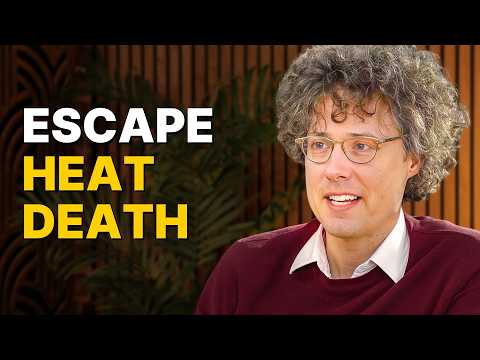
Adam Brown — Bubble universes, space elevators, & AdS/CFT
Adam Brown (guest), Dwarkesh Patel (host), Narrator
In this episode of Dwarkesh Podcast, featuring Adam Brown and Dwarkesh Patel, Adam Brown — Bubble universes, space elevators, & AdS/CFT explores vacuum decay, holographic universes, and AI that aces grad physics Dwarkesh Patel and physicist/AI researcher Adam Brown explore the far future of cosmology, including vacuum decay, bubble universes, and whether advanced civilizations could alter the cosmological constant to escape heat death.
Vacuum decay, holographic universes, and AI that aces grad physics
Dwarkesh Patel and physicist/AI researcher Adam Brown explore the far future of cosmology, including vacuum decay, bubble universes, and whether advanced civilizations could alter the cosmological constant to escape heat death.
They discuss black holes, entropy, and the holographic principle, leading into AdS/CFT as the clearest example of a consistent quantum gravity theory, and what it might imply for universes like ours with a positive cosmological constant.
Brown also examines physical limits on computation, energy extraction (black hole mining, black-hole-powered ‘batteries’), and galactic-scale civilizational constraints, then pivots to how rapidly AI is advancing in mathematical and physical reasoning.
Interwoven are concrete anecdotes—from nuclear weapons command failures to hitchhiking truck-stop therapy—used to illustrate risk, governance, human behavior, and how AI is already being used by working physicists.
Key Takeaways
Dark energy likely dooms us to heat death unless the cosmological constant can change.
An eternally positive cosmological constant drives accelerated expansion, permanently cutting us off from most of the universe and capping future free energy; if it can be bled down or transitioned to a lower-vacuum state, our descendants could avoid heat death.
Get the full analysis with uListen AI
Vacuum decay might be both a natural process and a future technology—with huge governance risks.
Quantum mechanics implies that if lower-energy vacua exist, spontaneous transitions (bubble universes) will eventually occur; advanced civilizations might deliberately trigger such transitions to reduce the cosmological constant, but any attempt effectively rewrites the future light cone for everyone, making “libertarian utopias” incompatible with physical reality.
Get the full analysis with uListen AI
Black holes define the maximum information density and motivate the holographic principle.
Bekenstein–Hawking entropy shows that the information in a region scales with surface area, not volume, suggesting that quantum gravity in N dimensions is dual to a non-gravitational theory in N–1 dimensions—realized concretely in AdS/CFT, our cleanest example of a well-defined quantum gravity theory.
Get the full analysis with uListen AI
You cannot rapidly ‘mine’ large black holes; material limits enforce slow evaporation.
Although proposals exist to scoop Hawking radiation with near-horizon “space elevators,” Brown shows the required tensile strength-to-mass ratio would exceed absolute physical bounds (set by relativity and the speed of sound in materials), so evaporation still scales ~mass³ in time and cannot be drastically sped up.
Get the full analysis with uListen AI
Black holes could, however, be near-perfect matter-to-energy converters for advanced civilizations.
Unlike electromagnetic or nuclear processes, black holes can in principle destroy baryon number and convert almost all rest mass (mc²) into radiation (photons, gravitons, neutrinos), enabling extremely efficient power plants if one can safely control small, hot black holes and capture the output.
Get the full analysis with uListen AI
LLMs are rapidly approaching high-end human performance on graduate physics tasks.
Brown reports that three years ago, models failed his Stanford GR final completely; a year ago they were weak-student level, and now they essentially ace it, while also serving as highly effective, non-judgmental tutors and literature guides for working physicists.
Get the full analysis with uListen AI
Many ‘fundamental’ limits—like the speed of light and finite error rates in computation—are likely to bind even super-advanced civilizations.
Brown assigns high probability that c remains an ultimate communication bound and argues that finite background temperature, Landauer limits, and gravitational effects will keep computation noisy and resource-constrained, shaping how galactic-scale computation and expansion can proceed.
Get the full analysis with uListen AI
Notable Quotes
“If it is possible for people just to wipe out their entire future light cone, libertarian fantasies can't really happen.”
— Adam Brown
“These are the two most beautiful theories of 20th century physics. These two theories seem to be inconsistent with each other.”
— Adam Brown (on quantum mechanics and general relativity)
“Three years ago, zero. A year ago, a weak student. And now they essentially ace the test.”
— Adam Brown (on LLM performance on his Stanford GR final)
“Nothing is ever a coincidence.”
— Adam Brown (on deep physical bounds like black hole mining limits)
“I can certainly imagine a scenario in which it's five years.”
— Adam Brown (on being automated as a physicist by AI)
Questions Answered in This Episode
If manipulating the cosmological constant becomes technologically feasible, what governance structures could realistically prevent catastrophic vacuum decay attempts?
Dwarkesh Patel and physicist/AI researcher Adam Brown explore the far future of cosmology, including vacuum decay, bubble universes, and whether advanced civilizations could alter the cosmological constant to escape heat death.
Get the full analysis with uListen AI
How might a future, fully developed holographic description of a de Sitter (positive cosmological constant) universe change our understanding of space, time, and locality?
They discuss black holes, entropy, and the holographic principle, leading into AdS/CFT as the clearest example of a consistent quantum gravity theory, and what it might imply for universes like ours with a positive cosmological constant.
Get the full analysis with uListen AI
In practice, would advanced civilizations prioritize centralized mega–quantum computers or highly distributed computation across many star systems, given redshift, error rates, and bandwidth constraints?
Brown also examines physical limits on computation, energy extraction (black hole mining, black-hole-powered ‘batteries’), and galactic-scale civilizational constraints, then pivots to how rapidly AI is advancing in mathematical and physical reasoning.
Get the full analysis with uListen AI
What concrete benchmarks besides exam performance should we watch for to know when AI is genuinely contributing new physics rather than just reassembling known results?
Interwoven are concrete anecdotes—from nuclear weapons command failures to hitchhiking truck-stop therapy—used to illustrate risk, governance, human behavior, and how AI is already being used by working physicists.
Get the full analysis with uListen AI
How should ethical frameworks account for many-worlds or cosmological multiverse scenarios when evaluating existential and ‘s-risk’ (suffering risk) trade-offs?
Get the full analysis with uListen AI
Transcript Preview
You could imagine our descendants deciding that they're not gonna just suffer the heat death, that they're gonna try and trigger a vacuum decay event to another vacuum with a lower cosmological constant. If it is possible for people just to wipe out their entire future light cone, libertarian fantasies can't really happen. Is it possible that 50% of all of the nuclear weapons ever dropped in combat were in fact dropped against direct orders? Take an exam I gave years ago in my graduate general activity class at Stanford, and give it to these models. Three years ago, zero. A year ago, a weak student. And now they essentially ace the test. These are the two most beautiful theories of 20th century physics. These two theories seem to be inconsistent with each other. There is, however, one fact about that merger that we are most confident about, and the answer to that involves black holes.
Today, I'm chatting with Adam Brown, who is a founder and lead of the Blue Chip team, which is cracking mass and reasoning at Google DeepMind, and a theoretical physicist at Stanford. Adam, welcome.
Delighted to be here. Let's do this.
Okay. We'll talk about AI in a second, but first, let's talk about physics.
Okay.
Um, first question, what is gonna be the ultimate fate of the universe and, h- how, you know, how much confidence should we have?
The ultimate fate is a really long time in the future, so you sh- probably shouldn't be that confident about the answer to that question.
Uh-huh.
Uh, in fact, our idea of the answer to what the ultimate fate is has changed a lot, uh, in the last 100 years. Ab- about 100 years ago, we thought that the universe was just static, wasn't growing or shrinking, was just sitting there statically. And then in the late '20s, Hubble and friends looked up at massive telescopes in the sky and noticed that distant galaxies were moving away from us and the universe is expanding. So, that's like big discovery number one. There was then, you know, a learned debate for many years about, you know, the universe is expanding, but is it expanding sufficiently slowly that it'll then recollapse in a big crunch, like a time reverse of the Big Bang, and that'll, that'll be super bad for us? Or is it gonna keep expanding forever, but just sort of ever more slowly, uh, as, as, you know, gravity pulls it back, but it, it keeps... it's fast enough that it keeps expanding? And there was a big debate around this question, and it turns out the answer to that question is, is neither. Neither of them is correct. In possibly the worst day in human history, sometime in the 1990s, we discovered that, in fact, not only is the universe expanding, it's expanding faster and faster and faster. It's what we call dark energy, or the cosmological constant is this, uh, you know, just a word for uncertainty, is making the universe expand, uh, at an ever faster rate, accelerated expansion, uh, as the universe grows. So, that's, that's a radical change in our understanding of the, the fate of the universe, and if true, is super-duper bad news.
Install uListen to search the full transcript and get AI-powered insights
Get Full TranscriptGet more from every podcast
AI summaries, searchable transcripts, and fact-checking. Free forever.
Add to Chrome