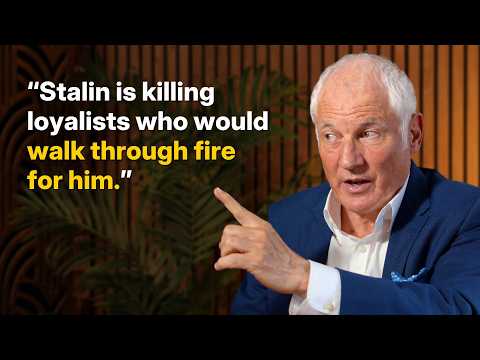
Stephen Kotkin — How Stalin became the most powerful dictator in history
Stephen Kotkin (guest), Dwarkesh Patel (host)
In this episode of Dwarkesh Podcast, featuring Stephen Kotkin and Dwarkesh Patel, Stephen Kotkin — How Stalin became the most powerful dictator in history explores stephen Kotkin explains Stalin’s genius, terror, and communist contradictions Stephen Kotkin and Dwarkesh Patel explore how Stalin built and sustained an extreme dictatorship that murdered elites, peasants, and even its own secret police without the system collapsing. Kotkin contrasts czarist Russia’s “vegetarian” repression with Stalin’s “carnivorous” terror, arguing that modernization under autocracy creates fatal tensions between economic progress and political control. They examine why communist revolutions succeeded in peasant societies like Russia and China, why Marxism-Leninism so often empowers brutal regimes, and why elites around Stalin never assassinated him despite knowing they might be next. The conversation closes by comparing late Soviet and contemporary Chinese dilemmas: Leninist regimes can liberalize the economy somewhat, but true political reform risks instant self-destruction.
Stephen Kotkin explains Stalin’s genius, terror, and communist contradictions
Stephen Kotkin and Dwarkesh Patel explore how Stalin built and sustained an extreme dictatorship that murdered elites, peasants, and even its own secret police without the system collapsing. Kotkin contrasts czarist Russia’s “vegetarian” repression with Stalin’s “carnivorous” terror, arguing that modernization under autocracy creates fatal tensions between economic progress and political control. They examine why communist revolutions succeeded in peasant societies like Russia and China, why Marxism-Leninism so often empowers brutal regimes, and why elites around Stalin never assassinated him despite knowing they might be next. The conversation closes by comparing late Soviet and contemporary Chinese dilemmas: Leninist regimes can liberalize the economy somewhat, but true political reform risks instant self-destruction.
Key Takeaways
Modernization under autocracy is inherently unstable.
To compete geopolitically, regimes like czarist Russia, Iran, China, and Putin’s Russia must import modern industry and educated elites—while simultaneously repressing workers and intellectuals whose political ideas threaten autocratic rule. ...
Get the full analysis with uListen AI
Peasant land hunger was decisive in making Russian and Chinese revolutions communist.
Where peasants lacked secure land (Russia, China), they became a radical force seizing estates and undermining the existing order, enabling socialist parties to seize and hold power. ...
Get the full analysis with uListen AI
Stalin’s terror succeeded because he combined ideological conviction with organizational genius.
All Bolshevik leaders wanted to abolish capitalist relations in the countryside, but only Stalin was willing and able to push through collectivization and mass killing at any cost—expanding the secret police as he went. ...
Get the full analysis with uListen AI
Marxism-Leninism is attractive because it promises justice and empowers intellectuals.
The ideology offers a simple, total solution to war, exploitation, and inequality, casting any dissent as complicity with evil capitalism. ...
Get the full analysis with uListen AI
Dictatorships rarely fall from internal coups because of distrust and collective-action problems.
In Stalin’s USSR and today’s Russia, China, and Iran, potential plotters know the leader uses provocateurs and dense surveillance; any move to conspire might be a trap. ...
Get the full analysis with uListen AI
Economic reform without political reform can generate growth but deepens long-term legitimacy problems.
Deng-era China liberalized markets while preserving the Communist Party’s monopoly and using Hong Kong, Taiwan, Japan, and U. ...
Get the full analysis with uListen AI
Leninist systems cannot be “half-pregnant” with political liberalization.
Experiences in Hungary 1956, Czechoslovakia 1968, and Gorbachev’s USSR show that once real political pluralism is allowed, the communist monopoly rapidly unravels. ...
Get the full analysis with uListen AI
Notable Quotes
“The thing about Stalin’s terror is, the police are also murdered while they are doing the murdering.”
— Stephen Kotkin
“Stalin goes into the underground, and for 20 years of his life, he's a penniless, jobless revolutionary dedicated to fighting the genuine injustices of the czar's regime. What he'll produce is a much more unjust regime than the one he's fighting against.”
— Stephen Kotkin
“Modernization is not a sociological process that just happens. It’s a geopolitical process—you modernize because you need to compete in the international system.”
— Stephen Kotkin
“Communism can fail at everything. It can starve the people, it can kill the people. It only has to do one thing to survive: suppress political alternatives.”
— Stephen Kotkin
“In the short run, potentially we’re all dead, because a world war with great powers would be a multiple of World War II. In the long run, we’re good, because our system is better.”
— Stephen Kotkin
Questions Answered in This Episode
If the core problem is the autocratic–modernization dilemma, what concrete institutional designs best help late-developing countries avoid both czarism-style repression and Stalinist catastrophe?
Stephen Kotkin and Dwarkesh Patel explore how Stalin built and sustained an extreme dictatorship that murdered elites, peasants, and even its own secret police without the system collapsing. ...
Get the full analysis with uListen AI
Given Kotkin’s emphasis on ideology, how should liberal democracies think about countering the enduring appeal of Marxism-Leninism among young intellectuals without simply dismissing it?
Get the full analysis with uListen AI
Is there any plausible scenario in which a Leninist regime like China’s could transition to a legitimate, pluralistic system without first suffering a major crisis or collapse?
Get the full analysis with uListen AI
How should we morally and analytically judge historical revolutionaries like Stalin who genuinely opposed injustice but produced far worse regimes—are their intentions at all mitigating?
Get the full analysis with uListen AI
Does the increasing use of AI-enabled surveillance in authoritarian states change Kotkin’s argument about the eventual defection of the repressive apparatus, or merely postpone it?
Get the full analysis with uListen AI
Transcript Preview
The thing about Stalin's terror is, the police are also murdered while they are doing the murdering. You're murdering your intellectuals, your scientists, your cultural figures. You're murdering your loyal party elites, and the whole thing doesn't collapse. The people around Stalin can see that he is unusually good at dictatorship. He is just carrying this entire system on his back, through thick and thin, liquidating the kulaks, collectivizing agriculture, building a military-industrial complex, defeating Hitler in war. How much better are you gonna do than Stalin? Stalin goes into the underground, and for 20 years of his life, he's a penniless, jobless revolutionary dedicated to fighting the genuine injustices of the czar's regime. What he'll produce is a much more unjust regime than the one he's fighting against.
My guest today is Stephen Kotkin, who is a senior fellow at the Hoover Institution and author of two-thirds of his three-volume Stalin biographies, um, the first one, Stalin: Paradoxes of Power, the second one, Stalin Waiting for Hitler. Thank you for coming on my podcast.
Thank you for the honor of the invitation.
Let's begin with the czar's regime. So first question: how repressive was the czar's regime actually? Because presumably, the motivation behind the revolution is to get rid of this autocracy, but y- you just have these examples of these... Lenin's brother tries to kill the czar, and he himself is writing these long manifestos about taking down capitalism and overthrowing the government, and him and people like Stalin are just in exile in Siberia living off government money, um, robbing banks, small shenanigans. I- it honestly sounds more forgiving than, uh, many countries today, so how, how bad was it really?
So you have to put yourself back in the time period to judge the level of repression based upon what norms were, what other regimes did, rather than take the 20th century regimes as the guide...
Yeah.
... and go back, but we need to widen the aperture a little bit here. So this is the czar's regime's problem. It needs to be able to compete in the international system. That means it needs a modern military and modern industry to underwrite that modern military.
Mm-hmm.
So it needs armaments. It needs steel. It needs chemicals. For that, you need workers. So you want the workers only to work in the industry. You don't want them, for example, to have a labor movement or to go on strike or to have ideas about how politics should be organized. Similarly, with the intellectual side, you need the engineers. You need the engineers in order to design and build the modern attributes that you need to compete as a global power, but you don't want those educated people to have their own ideas and values about politics, about whether you'd want an autocratic government like the Russian regime has or you'd want some other type of government. So all of these countries in the modern period have this dilemma, importing modernization but keeping out the political side, the value side that goes along with that.
Install uListen to search the full transcript and get AI-powered insights
Get Full TranscriptGet more from every podcast
AI summaries, searchable transcripts, and fact-checking. Free forever.
Add to Chrome