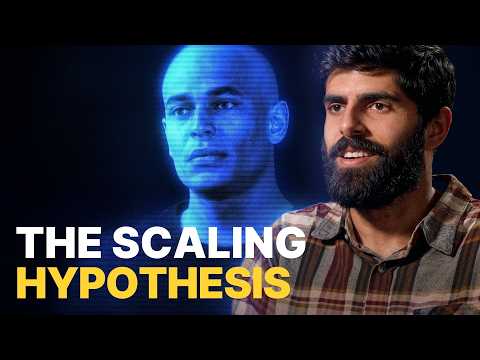
Gwern — Anonymous writer who predicted AI trajectory on $12K/year salary
Dwarkesh Patel (host), Gwern Branwen (guest)
In this episode of Dwarkesh Podcast, featuring Dwarkesh Patel and Gwern Branwen, Gwern — Anonymous writer who predicted AI trajectory on $12K/year salary explores anonymous polymath Gwern on AI scaling, anonymity, and obsessive rabbit holes Gwern Branwen discusses how anonymity lets his ideas be judged without personal projection, and reflects on his role as an independent, low-budget researcher who heavily influenced modern AI scaling thinking. He outlines a grand, compute-centric view of intelligence as search over Turing machines, explains how he correctly anticipated LLM scaling when most commentators didn’t, and sketches near-term futures of AI-run firms with human "taste" at the top. The conversation dives into his working habits, rabbit-hole-driven creativity, trade-offs of isolation and poverty for deep work, and his belief that now is a uniquely "hinge" time to write, both to shape AI values and to preserve a personal legacy in latent space. He closes by listing big unresolved questions about intelligence, civilization, and human variation he hopes superhuman AIs will finally answer by 2050.
Anonymous polymath Gwern on AI scaling, anonymity, and obsessive rabbit holes
Gwern Branwen discusses how anonymity lets his ideas be judged without personal projection, and reflects on his role as an independent, low-budget researcher who heavily influenced modern AI scaling thinking. He outlines a grand, compute-centric view of intelligence as search over Turing machines, explains how he correctly anticipated LLM scaling when most commentators didn’t, and sketches near-term futures of AI-run firms with human "taste" at the top. The conversation dives into his working habits, rabbit-hole-driven creativity, trade-offs of isolation and poverty for deep work, and his belief that now is a uniquely "hinge" time to write, both to shape AI values and to preserve a personal legacy in latent space. He closes by listing big unresolved questions about intelligence, civilization, and human variation he hopes superhuman AIs will finally answer by 2050.
Key Takeaways
Anonymity buys a fair hearing by stripping away identity-based bias.
Gwern argues that being anonymous forces people to engage with the text itself rather than preemptively dismissing him based on status, demographics, or affiliations, and also protects him from retaliation for controversial topics.
Get the full analysis with uListen AI
Human-led AI firms will likely win by combining AI scale with human long-term taste.
He predicts bottom-up automation where AI replaces workers first, leaving a small number of human "Steve Jobs"-like executives who provide long-horizon vision and taste while pyramids of AI agents execute and propose options.
Get the full analysis with uListen AI
Intelligence is best viewed as compute-intensive search over many small programs.
Rather than a single master algorithm or "intelligence fluid," Gwern sees brains and large models as ensembles of many specialized solutions (Turing machines), with more intelligent agents simply having more compute to search and recombine them.
Get the full analysis with uListen AI
Scaling success came from compute, data, and trial-and-error—not magical algorithms.
His belief in the scaling hypothesis emerged from years of tracking deep learning trends (AlexNet, CNNs, AlphaZero, early scaling-law papers), noticing that bigger models plus more data kept broadening capabilities, while the field systematically underreported the role of brute-force experimentation.
Get the full analysis with uListen AI
Now is an unusually leverageable time to write because AI trains on everything.
He claims that text online directly shapes future models’ behavior and values; if your preferences and viewpoints are not written down, they effectively don’t exist to AI systems, which is dangerously close to not existing at all in future influence terms.
Get the full analysis with uListen AI
Deep, slow rabbit holes plus relentless revision underpin his distinctive output.
Gwern’s essays often accumulate over years of collecting scattered observations until a pattern clicks, or emerge in a single "eureka" burst built on long-unseen background notes; gardening his site (and even its CSS) continually forces spaced rereading and refinement.
Get the full analysis with uListen AI
Extreme frugality can buy large blocks of unstructured intellectual time—but at a cost.
Living on roughly $12K/year funded by Patreon and old Bitcoin gains, he sacrifices career status, comfort, and social life to maximize reading and writing, while warning that his path is fragile, idiosyncratic, and not a broadly replicable career model.
Get the full analysis with uListen AI
Notable Quotes
“The most underrated benefit of anonymity is that people don’t project onto you as much… everyone has to read you at least a little bit to even begin to dismiss you.”
— Gwern Branwen
“All intelligence is search over Turing machines… there’s no master algorithm and no special intelligence fluid.”
— Gwern Branwen
“You’re voting on the future of the Shoggoth using some of the few currencies it acknowledges: tokens that it has to predict.”
— Gwern Branwen
“Magic is putting in more effort than any reasonable person would expect you to.”
— Teller, quoted by Gwern Branwen
“I maximize rabbit holes… It’s the sudden new area I can fall into and obsess over that I really live for.”
— Gwern Branwen
Questions Answered in This Episode
If intelligence is just compute-intensive search over many small programs, what would a fundamentally different kind of mind look like—if such a thing is even possible?
Gwern Branwen discusses how anonymity lets his ideas be judged without personal projection, and reflects on his role as an independent, low-budget researcher who heavily influenced modern AI scaling thinking. ...
Get the full analysis with uListen AI
How should an individual decide what to write or record today if they want to meaningfully influence future AIs’ values rather than just contribute noise?
Get the full analysis with uListen AI
Could a fully AI-run firm ever evolve its own notion of long-term "taste" that truly outcompetes human visionary CEOs, or is human judgment structurally irreplaceable?
Get the full analysis with uListen AI
What are the ethical implications of training increasingly powerful models on the internet’s uncurated mix of trauma, bias, and brilliance, including Gwern’s own work?
Get the full analysis with uListen AI
To what extent should ambitious young researchers emulate Gwern’s extreme-frugality, rabbit-hole approach versus pursuing institutional roles in labs and companies?
Get the full analysis with uListen AI
Transcript Preview
Today, I'm interviewing Gwern Branwen. Gwern is an anonymous internet researcher and writer. He's deeply influenced the people who are building AGI. He was one of the first people to see LLM scaling coming. If you've read his blog, you know he's one of the most interesting polymathic thinkers alive. We recorded this conversation in person. In order to protect Gwern's anonymity, we created this avatar. This isn't his voice, this isn't his face, but these are his words. Gwern, what is the most underrated benefit of anonymity?
I think the most underrated benefit of anonymity is that people don't project onto you as much.
Mm-hmm.
Um, they, they kind of can't, like, slot you into any particular niche or identity and, like, end up writing you off in advance. You know, every- everyone has to read you at least a little bit-
Mm-hmm.
... um, to, to even begin to dismiss you. It's great that people can't retaliate against you and I, I've derived a lot of benefit from people not being able to, like, mail heroin to my home-
(laughs)
... and call the police, uh, to swat me. But, but I always feel that the biggest benefit is just that you get a hearing at all, basically.
Right.
Um, you, you don't get immediately written off by the context.
Do you expect companies to get automated top-down, starting with the CEO, or from the bottom-up, starting with workers?
All the pressures, I think, are to go bottom-up.
Mm-hmm.
Um, and from existing things, it's just much more palatable in every way to start at the bottom and replace there, and then work your way up, um, to eventually kind of just having human executives overseeing a firm of AIs.
Mm-hmm.
And also from an RL perspective, I think if we are in fact better than AIs in some way, it should be in the long-term vision thing, right? Like, the AIs will be too myopic to execute any kind of novel long-term strategy and seize new opportunities. So that would presumably give you this paradigm where you have, like, a human CEO who does the vision thing-
Yeah.
... and then the AI corporation kind of, like, scurries around underneath them doing, you know, the CEO's bidding.
Right.
And they don't have the taste that the CEO has. So you have one kind of Steve Jobs figure at the helm, and then maybe a whole pyramid of AIs out there executing the vision and bringing him new proposals. And he, you know, he looks at every individual thing and says, "No," like, "that proposal is bad. This one is good."
Mm-hmm.
That may be hard to quantify, but I think that human-led firms should, you know, under this view, end up out-competing the entirely AI firms, which would keep making these myopic choices that just don't quite work out in the long term.
Install uListen to search the full transcript and get AI-powered insights
Get Full TranscriptGet more from every podcast
AI summaries, searchable transcripts, and fact-checking. Free forever.
Add to Chrome