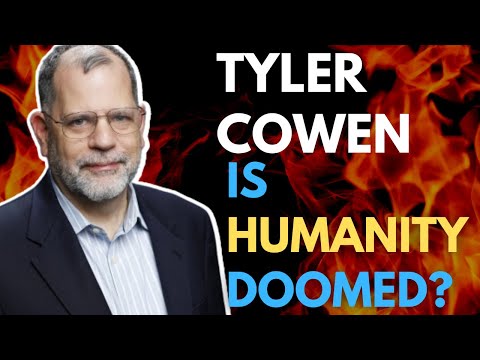
Tyler Cowen - The Great Reset
Dwarkesh Patel (host), Tyler Cowen (guest)
In this episode of Dwarkesh Podcast, featuring Dwarkesh Patel and Tyler Cowen, Tyler Cowen - The Great Reset explores tyler Cowen on great reset, growth, nukes, and mentoring futures Tyler Cowen discusses how his earlier book *The Complacent Class* anticipated a 'Great Reset' and argues that COVID-19 has triggered it sooner than expected, exposing institutional decay but unleashing major biomedical innovation. He reconciles his belief in long-run economic growth (*Stubborn Attachments*) with shorter-run cycles of stagnation, emphasizing how culture and institutions can sustain progress over centuries despite crises and war risks. Cowen is optimistic about tech and biomedicine but pessimistic about government performance, long-run peace, and the inevitability of future nuclear use, while remaining skeptical of strong space colonization optimism. He closes with practical advice for young people—prioritizing mentors, small high-quality peer groups, and post-18 talent development—and reflections on education, big business, aesthetics, and the future trajectory of freedom and autocracy.
Tyler Cowen on great reset, growth, nukes, and mentoring futures
Tyler Cowen discusses how his earlier book *The Complacent Class* anticipated a 'Great Reset' and argues that COVID-19 has triggered it sooner than expected, exposing institutional decay but unleashing major biomedical innovation. He reconciles his belief in long-run economic growth (*Stubborn Attachments*) with shorter-run cycles of stagnation, emphasizing how culture and institutions can sustain progress over centuries despite crises and war risks. Cowen is optimistic about tech and biomedicine but pessimistic about government performance, long-run peace, and the inevitability of future nuclear use, while remaining skeptical of strong space colonization optimism. He closes with practical advice for young people—prioritizing mentors, small high-quality peer groups, and post-18 talent development—and reflections on education, big business, aesthetics, and the future trajectory of freedom and autocracy.
Key Takeaways
COVID-19 is the early-arriving 'Great Reset' exposing U.S. institutional rot.
Cowen argues that while financial institutions like the Fed and Supreme Court functioned well, the regulatory state, executive branch, Congress, and public health systems failed basic tests like mask adoption and test-and-trace, validating his earlier warnings about societal complacency.
Get the full analysis with uListen AI
Expect a powerful burst of innovation in biomedicine, not across all sectors.
He predicts that intense COVID-related research in virology, immunology, vaccines, and pandemic preparedness will leave a lasting innovation legacy, whereas sectors like education, healthcare delivery, and government remain productivity laggards.
Get the full analysis with uListen AI
Long-run growth remains morally central despite short-run cycles and risks.
Cowen reconciles *The Complacent Class* with *Stubborn Attachments* by arguing that you can have periods of stagnation and crisis, yet still achieve strong compounding growth over centuries if liberal institutions persist and societies avoid extreme risk aversion.
Get the full analysis with uListen AI
Nuclear use is highly probable in our lifetimes, even without total war.
He criticizes Steven Pinker’s optimism, suggesting the evidence fits a 'ratchet' model where major wars become rarer but deadlier, and forecasts a >70% chance of at least one non-test nuclear detonation (terror, error, or limited exchange) within the interviewer’s lifetime.
Get the full analysis with uListen AI
Common-sense morality is an evolved, somewhat reliable guide—not easily discarded.
Cowen argues that moral systems wildly at odds with everyday common sense tend not to survive because they fail at basic group-level viability, so radical ethical theories that ignore this (e. ...
Get the full analysis with uListen AI
Big business drives much of today’s innovation; stagnation lies elsewhere.
He notes that productivity problems sit mainly in sectors like education, healthcare, and government, while firms like Amazon and Alphabet exhibit high innovation and productivity; the worrying decline in startups is heavily concentrated in retail rather than frontier tech.
Get the full analysis with uListen AI
Mentors and a tight circle of smart peers are extraordinarily high-return.
For young people, Cowen stresses getting 1–3 excellent mentors and a small group of intellectually engaging friends, arguing mentors mainly work by embodying 'what you could be' rather than by explicit advice, and that most real talent development happens after age 18.
Get the full analysis with uListen AI
Notable Quotes
“The Fed and Supreme Court, in my view, have been quite good… but just as institutions, they're fully up and running, and the rest is rotting.”
— Tyler Cowen
“I think this will go down in history as a phenomenal blast of innovation in a very important area.”
— Tyler Cowen
“If you're what I would call a space optimist… you can escape a lot of that risk aversion and obsession with safety, and replace it by an obsession with settling galaxies. But that, to me, also is a weirdness I want to avoid.”
— Tyler Cowen
“I would say the chance is over 70% that a nuke goes off in your lifetime.”
— Tyler Cowen
“If your philosophy totally contradicts common sense morality… I think you should start worrying that maybe it won't actually fare that well if you try it.”
— Tyler Cowen
Questions Answered in This Episode
If the 'Great Reset' has begun, what concrete reforms would actually restore institutional flexibility rather than just papering over failures revealed by COVID-19?
Tyler Cowen discusses how his earlier book *The Complacent Class* anticipated a 'Great Reset' and argues that COVID-19 has triggered it sooner than expected, exposing institutional decay but unleashing major biomedical innovation. ...
Get the full analysis with uListen AI
How should policymakers balance Cowen’s emphasis on long-run growth with rising public demand for short-term safety, security, and equality?
Get the full analysis with uListen AI
Given Cowen’s prediction of likely nuclear use this century, what specific governance or technological innovations could materially reduce that risk?
Get the full analysis with uListen AI
If big business is now a primary locus of innovation, how should antitrust policy and startup ecosystems be redesigned to sustain dynamism without entrenching monopolies?
Get the full analysis with uListen AI
For young people in a stagnating landscape, what are the most effective ways to find high-quality mentors and signal their talent outside traditional educational credentials?
Get the full analysis with uListen AI
Transcript Preview
Tyler Cowen needs no introduction, so we'll just begin. Um, I wanna ask you about The Great Reset. So you wrote a book in 2017 called The Complacent Class, and in it you predicted a great reset. You wrote, quote, "At some point our country will face an immediate crisis and there won't be the resources or, more fundamentally, the flexibility to handle it." Now, um, how- how were you so prophetic, and is this The Great Reset?
You know, I think I need to reread that book. Uh, I didn't quite think The Great Reset was coming as soon as it did. It struck me as something five to 10 years away, uh, but I do think it's here now. We can still borrow at low rates of interest, but we haven't shown the flexibility to adopt mask wearing or set up a serious enough test and trace regime. And, uh, the American regulatory state and executive branch and also Congress, it's failed. The Fed and Supreme Court, in my view, have been quite good, whether you agree with every decision or not. But just as institutions, uh, they're fully up and running, and the rest is rotting. And our willingness to just let things happen has finally caught up with us a little more quickly than I was thinking.
Hmm. In The Complacent Class, you predicted that, um, after The Great Reset, uh, dynamism would be with us again. Are you predicting that we'll be dynamic again after the- following this crisis?
Well, predictions probably ought to be conditional. I think in the biomedical area, we will be incredibly dynamic. There's been so much research activity into coronavirus and associated problems which involve virology, immunology, I mean, even the common cold, how to fight the next pandemic, how to do vaccines. I think this will go down in history as a phenomenal blast of innovation in a very important area. And the tech sector is still innovative, but has been for quite some time. Uh, other sectors, I'm not sure about. I'm, I'm heartened by seeing Tesla stock so high. I guess I ought to side with the market there, though I don't quite see why it should be worth more than like General Motors, Ford, and a few other auto companies put together. But again, I'll defer to the market. So I think that the chance of that burst of dynamism has never looked better. But of course, we're still capable of blowing it, right?
Mm-hmm. And other than how quickly it happened, what surprised you the most about how The Great Reset has occurred?
Well, you may recall also in The Complacent Class, I predict that racial issues and segre-
Yes, exactly.
... segregation will be a central part of it-
Mm-hmm.
... because American Blacks are so often the most or among the most vulnerable members of our society, and trouble will flare there early as a kind of warning signal. And that looks like a pretty good prediction, I have to say.
Install uListen to search the full transcript and get AI-powered insights
Get Full TranscriptGet more from every podcast
AI summaries, searchable transcripts, and fact-checking. Free forever.
Add to Chrome