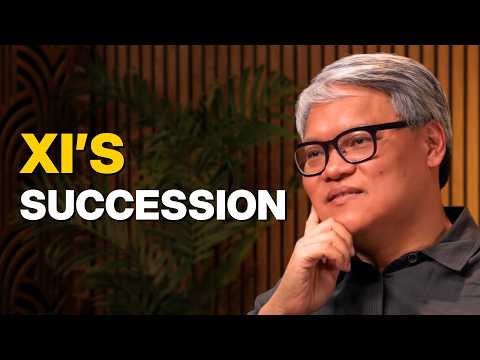
Xi Jinping’s paranoid approach to AGI, debt crisis, & Politburo politics — Victor Shih
Victor Shih (guest), Dwarkesh Patel (host), Narrator
In this episode of Dwarkesh Podcast, featuring Victor Shih and Dwarkesh Patel, Xi Jinping’s paranoid approach to AGI, debt crisis, & Politburo politics — Victor Shih explores xi Jinping centralizes power as China juggles AI, debt, succession risks Victor Shih explains how Xi Jinping has reshaped China’s political system into an intensely centralized, micromanaged regime where his personal preferences quickly become national policy across everything from AI to COVID.
Xi Jinping centralizes power as China juggles AI, debt, succession risks
Victor Shih explains how Xi Jinping has reshaped China’s political system into an intensely centralized, micromanaged regime where his personal preferences quickly become national policy across everything from AI to COVID.
He outlines China’s fiscal evolution from decentralized, growth-friendly local experimentation to a heavily indebted, centrally controlled system where local governments are over-leveraged yet still pushed to finance strategic priorities like tech and infrastructure.
Shih argues that the Communist Party’s overriding goal is preserving its own power, which leads to choices—on AI control, zero COVID, vaccines, and industrial policy—that often sacrifice efficiency, growth, and welfare.
He warns that the absence of a clear succession plan for Xi, combined with fragile capital controls and factional tensions, makes an eventual leadership transition likely to be ruthless, financially risky, and politically destabilizing.
Key Takeaways
Xi has converted collective leadership into a one-man, meeting-driven command system.
Decisions that once involved real debate in the Politburo Standing Committee now effectively flow through Xi-led ‘leading small groups,’ where everyone else is formally and informally subordinate, forcing him to personally arbitrate across many policy domains.
Get the full analysis with uListen AI
Expertise exists in the system, but party self-preservation routinely overrides it.
Chinese leaders frequently consult specialists and hold substantive study sessions, yet on issues like zero COVID, vaccine choice, and economic rebalancing, political priorities—protecting SOEs, party control, or narrative—trump expert recommendations.
Get the full analysis with uListen AI
China’s AI strategy is to accelerate capabilities while building hard political brakes.
Shih interprets Ding Xuexiang’s remarks as evidence that Beijing wants to pour resources into AI/AGI but insists on guaranteed kill-switches and human gatekeepers inside firms to prevent AI-generated content or systems from threatening party authority.
Get the full analysis with uListen AI
Local government debt is massive and structurally tied to China’s growth model.
With central authorities commandeering major tax streams, localities borrowed heavily—via LGFVs and special bonds—to fund infrastructure and industrial parks, leaving total local debt at an estimated 120–140% of GDP atop central debt of ~60–70% of GDP.
Get the full analysis with uListen AI
State-led industrial policy produces some champions but enormous waste and corruption.
Bureaucrat- and expert-approved lending favors politically prioritized sectors regardless of profitability; while a few successes like Huawei emerge, many semiconductor and other projects were fraudulent or unproductive, funded by repressed household savings.
Get the full analysis with uListen AI
China’s financial repression and capital controls mask a fragile macro setup.
Low deposit rates, limited legal channels for capital outflow, and fear of punishment keep money trapped domestically; Shih argues that even a brief perception of a power vacuum in Beijing could trigger massive outflows and a currency/financial crisis.
Get the full analysis with uListen AI
Xi’s succession is an unresolved, high-risk problem for the regime and the economy.
There is no clear heir or institutionalized process; Shih expects a future transition to be more brutal and destabilizing than past ones, with potential capital flight, elite infighting among weakly bonded factions, and heavy reliance on a temporary ‘transition figure.’
Get the full analysis with uListen AI
Notable Quotes
“If Xi Jinping expresses a preference over a policy direction, that is the direction you have to go toward no matter what.”
— Victor Shih
“For the Chinese government, they’re very afraid that some actor outside, but even inside the party, is gonna use [AI] as a tool to usurp the power of the party.”
— Victor Shih
“For socialism, they only care about output… When you maximize the output, you don’t necessarily make money doing that.”
— Victor Shih
“What is the succession plan after Xi is gone? There are no plans right now. I think this transition is going to be more ruthless, more brutal, and potentially more disruptive.”
— Victor Shih
“Right now, financial repression works because… that bureaucrat is like, ‘If I approve this, someone in Beijing is gonna notice it, and I’m gonna be in jail within a week.’”
— Victor Shih
Questions Answered in This Episode
How might China’s insistence on political ‘brakes’ for AI change the trajectory and character of its AI ecosystem compared to more market-driven U.S. development?
Victor Shih explains how Xi Jinping has reshaped China’s political system into an intensely centralized, micromanaged regime where his personal preferences quickly become national policy across everything from AI to COVID.
Get the full analysis with uListen AI
If China’s local government debt is as high as Shih estimates, what specific trigger could turn this from a chronic problem into an acute financial crisis?
He outlines China’s fiscal evolution from decentralized, growth-friendly local experimentation to a heavily indebted, centrally controlled system where local governments are over-leveraged yet still pushed to finance strategic priorities like tech and infrastructure.
Get the full analysis with uListen AI
To what extent does Xi’s micromanagement improve policy coordination versus creating bottlenecks, blind spots, and overreliance on one person’s judgment?
Shih argues that the Communist Party’s overriding goal is preserving its own power, which leads to choices—on AI control, zero COVID, vaccines, and industrial policy—that often sacrifice efficiency, growth, and welfare.
Get the full analysis with uListen AI
How could an eventual, messy succession struggle in Beijing reshape China’s external behavior—especially on Taiwan, military posture, and economic relations?
He warns that the absence of a clear succession plan for Xi, combined with fragile capital controls and factional tensions, makes an eventual leadership transition likely to be ruthless, financially risky, and politically destabilizing.
Get the full analysis with uListen AI
Given the huge waste and corruption in state-directed industrial policy, why has China still managed to produce so many globally competitive firms, and can that continue under tighter party control?
Get the full analysis with uListen AI
Transcript Preview
AI apparently is one of the higher priorities for Xi Jinping. The party is very, very paranoid that some actor outside, but even inside the party, is gonna use it as a tool to usurp the power of the party. The Chinese leadership, they're not going to play golf three days out of a week. Xi Jinping and his colleagues are having meetings about policies 270 days out of the year. If Xi Jinping expresses a preference over a policy direction, that is the direction you have to go toward no matter what. If he observes that you're dragging your feet, uh, you will be purged.
What is the succession plan after Xi is gone?
There are no plans right now. I think this transition is going to be more ruthless, more brutal, and potentially more disruptive.
Today, I'm talking with Victor Shi, who is the director of the 21st Century China Center at UC San Diego. China is obviously the most important economic and geopolitical issue over time, and doubly so if you believe what I believe about AI. I was especially looking to talk to you because you have deep expertise not only in Chinese elite politics, but also its economic system, its fiscal banking policies. We'll get into all of that before we get into the AI topics. Is China actually a more decentralized system than America? If you look at government spending by provincial governments versus the national government in China, it's like 85% local plus provincial, 15% national. In the US, it's actually, if you look at state and local, it's 50%, national... uh, federal government is 50%. Um, when you think of an authoritarian system, you often think of it as like very top down, the center controls everything. But if you look at these numbers, it just seems like it's quite decentralized.
Mm-hmm.
Or is that the wrong way to look at the numbers?
Uh, I think for a while China was quite decentralized. Um, so this is kinda in... from the mid-1970s all the way until the mid-1990s, China was very decentralized where local governments generated a lot of revenue.
Yeah.
But they also spent a lot of money, uh, and it incentivized them to do, you know, kinda basically good things such as trying to attract as much FDI as possible-
Yeah.
... trying to attract as much, uh, local investment as possible, give tax breaks and so on and so forth. Um, so I think, you know, China had a very good period of mainly sort of private sector driven growth because of this fiscal decentralization. And that's the understanding of, I think, most economists. Um, but then there was a tax centralization in 1994 basically where the central government basically said, "Okay, this is ridiculous. We don't wanna end up like the Soviet Union, you know, and fall into different pieces. We need to control, uh, fiscal income." So then they grabbed the most lucrative, uh, source of taxation at that time, and it continues to be case, which is the value-added tax.
Install uListen to search the full transcript and get AI-powered insights
Get Full TranscriptGet more from every podcast
AI summaries, searchable transcripts, and fact-checking. Free forever.
Add to Chrome