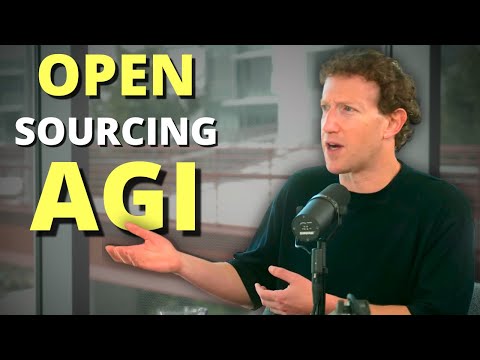
Mark Zuckerberg — Llama 3, $10B models, Caesar Augustus, & 1 GW datacenters
Mark Zuckerberg (guest), Dwarkesh Patel (host), Narrator
In this episode of Dwarkesh Podcast, featuring Mark Zuckerberg and Dwarkesh Patel, Mark Zuckerberg — Llama 3, $10B models, Caesar Augustus, & 1 GW datacenters explores mark Zuckerberg bets on open-source AI, colossal compute, and metaverse Mark Zuckerberg discusses Meta’s launch of Llama 3, positioning Meta AI as the most capable freely available assistant and deeply integrating it into Meta’s apps with real‑time web search and powerful image generation.
Mark Zuckerberg bets on open-source AI, colossal compute, and metaverse
Mark Zuckerberg discusses Meta’s launch of Llama 3, positioning Meta AI as the most capable freely available assistant and deeply integrating it into Meta’s apps with real‑time web search and powerful image generation.
He explains Meta’s long-term AI strategy: massive GPU investments, multi-hundred-billion-parameter models, and eventual gigawatt-scale data centers, while acknowledging future bottlenecks in energy and infrastructure rather than pure compute or capital.
Zuckerberg argues strongly for open-source AI as a way to avoid concentration of power and to harden global systems, while also leaving open the possibility of withholding future models if qualitative risk profiles change.
Beyond AI, he reflects on his personal drive to keep building new things, lessons from history (e.g., Augustus and positive-sum systems), and how AI, metaverse, and custom silicon fit into Meta’s long-term product and business vision.
Key Takeaways
Llama 3 significantly upgrades Meta AI and is released openly.
Meta is rolling out 8B and 70B parameter Llama 3 models as open source and using them to power a revamped Meta AI assistant, integrated across WhatsApp, Instagram, Facebook, and Messenger, with real-time Google/Bing search and fast, interactive image generation.
Get the full analysis with uListen AI
Scale and data still yield big gains, but energy is the looming bottleneck.
Zuckerberg notes that Llama 3–70B kept improving even after 15T tokens, but future scaling will be constrained less by GPU availability and more by permitting and building massive power infrastructure, potentially up to gigawatt-scale data centers.
Get the full analysis with uListen AI
Open-source AI is both a strategic advantage and a safety play.
Meta believes open weights enable community innovation, cheaper and better inference, and broad access—but also help prevent a single actor (state or company) from holding a uniquely powerful model, analogous to how open-source software hardens global security.
Get the full analysis with uListen AI
Meta expects AI to permeate every product, not just chatbots.
Zuckerberg anticipates industrial-scale inference across assistants, business and creator agents, recommendation systems, and scientific applications, with agentic systems taking on multi-step tasks rather than just answering single prompts.
Get the full analysis with uListen AI
General intelligence is incremental, multi-dimensional, and not a single threshold.
He frames AGI as a gradual accumulation of capabilities—coding, reasoning, multimodality, memory, emotional understanding—rather than a single moment, and is skeptical of sudden ‘runaway’ intelligence given physical and infrastructural constraints.
Get the full analysis with uListen AI
Meta balances near-term, concrete harms with longer-term existential concerns.
Currently, Meta devotes major effort to preventing fraud, violence, and misinformation with AI, viewing adversarial threats like state election interference as an ongoing ‘arms race’ where defensive AI must outpace offensive uses.
Get the full analysis with uListen AI
Zuckerberg’s core edge is an almost compulsive drive to build new things.
He attributes decisions like refusing early acquisition offers and persisting with metaverse and AI bets less to detailed financial modeling and more to deep conviction, personal values, and a feeling that he’s “doing something wrong” if not building the next thing.
Get the full analysis with uListen AI
Notable Quotes
“With Llama 3, we now think that Meta AI is the most intelligent AI assistant that people can use that's freely available.”
— Mark Zuckerberg
“Then when you start getting into building a data center that's like 300 megawatts or 500 megawatts or a gigawatt, just no one has built a single gigawatt data center yet.”
— Mark Zuckerberg
“I’m fundamentally incapable of running something… and not trying to build new things that I think are interesting.”
— Mark Zuckerberg
“I do think that a concentration of AI in the future has the potential to be as dangerous as it being widespread.”
— Mark Zuckerberg
“From wherever you sit, there’s gonna be some actor who you don’t trust. If they're the ones who have, like, the super strong AI, I think that that's potentially a much bigger risk.”
— Mark Zuckerberg
Questions Answered in This Episode
How might widespread open-source AI practically counterbalance a hostile actor that gains access to very powerful models?
Mark Zuckerberg discusses Meta’s launch of Llama 3, positioning Meta AI as the most capable freely available assistant and deeply integrating it into Meta’s apps with real‑time web search and powerful image generation.
Get the full analysis with uListen AI
At what specific risk thresholds or observed behaviors would Meta decide not to open-source a future Llama model?
He explains Meta’s long-term AI strategy: massive GPU investments, multi-hundred-billion-parameter models, and eventual gigawatt-scale data centers, while acknowledging future bottlenecks in energy and infrastructure rather than pure compute or capital.
Get the full analysis with uListen AI
How will Meta measure whether its massive AI and energy investments are paying off in products versus becoming commoditized infrastructure?
Zuckerberg argues strongly for open-source AI as a way to avoid concentration of power and to harden global systems, while also leaving open the possibility of withholding future models if qualitative risk profiles change.
Get the full analysis with uListen AI
In a world of millions of specialized agents (for creators, businesses, users), how will Meta manage alignment, safety, and abuse at scale?
Beyond AI, he reflects on his personal drive to keep building new things, lessons from history (e. ...
Get the full analysis with uListen AI
What concrete steps is Meta taking to develop AI capabilities in emotional understanding and memory without creating opaque or manipulative systems?
Get the full analysis with uListen AI
Transcript Preview
That's not even a question for me, whether we're gonna go take a swing at building the next thing. I'm just incapable of not doing that. (whoosh) There's a bunch of times when we wanted to launch features and then Apple's just like, "Nope, you're not launching that." I was like, "That sucks."
(laughs)
Are we set up for that with AI where you're gonna get a handful of companies that run these closed models that are gonna be in control of the APIs, and therefore are gonna be able to tell you what you can build? (whoosh) Then when you start getting into building a data center that's like 300 megawatts or 500 megawatts or a gigawatt, just no one has built a single gigawatt data center yet. (whoosh) From wherever you sit, there's gonna be some actor who you don't trust. If they're the ones who have, like, the super strong AI, I think that that's potentially a much bigger risk.
Mark, welcome to the podcast.
Hey, thanks for having me. Big fan of your podcast.
Oh, thank you. That's very nice of you to say. Um, (laughs) okay, so let's start by talking about the releases that will go out a l- when this interview goes out. Um, tell, tell me about the models, tell me about Meta AI. What's new? What's exciting about them?
Yeah, sure. So, you know, I think the, the main thing that most people in the world are gonna see is the new version of Meta AI.
Hmm.
Right? So it's, um... And, you know, the most important thing about what we're doing is the upgrade to the model. We're rolling out Llama 3. We're doing it both as open source for the, the dev community, and it is now gonna be powering Meta AI. Um, so, you know, there's a lot that I'm sure we'll go into around Llama 3, but I think the bottom line on this is that with Llama 3, we now think that Meta AI is the most intelligent AI assistant that people can use that's freely available. Um, we're also integrating Google and Bing for real-time knowledge.
Mm-hmm.
Um, we're gonna make it a lot more prominent across our apps. So, you know, basically, you know, at the top of WhatsApp, and Instagram, and Facebook, and Messenger, uh, you'll just be able to, um, you know, use the search box right there to ask, ask us any question. Um, and there's a bunch of new creation features that we, that we added that I think are pretty cool that I think people enjoy. Uh, and I think animations is, is a good one. Um, you can basically just take any image and animate it. But I think one that, that, uh, people are gonna find pretty wild is, uh, it now generates high-quality images so quickly. I don't know if you've gotten a chance to play with this. That it actually generates it as you're typing and updates it in real time. So you're, like, typing your query and it's, and it's kind of, like, honing in on... And, and, you know, it's like, "Okay, here, um, you know, show me a picture of a, a cow, okay, in a field with mountains in the background." And just like everything's populated-
Install uListen to search the full transcript and get AI-powered insights
Get Full TranscriptGet more from every podcast
AI summaries, searchable transcripts, and fact-checking. Free forever.
Add to Chrome