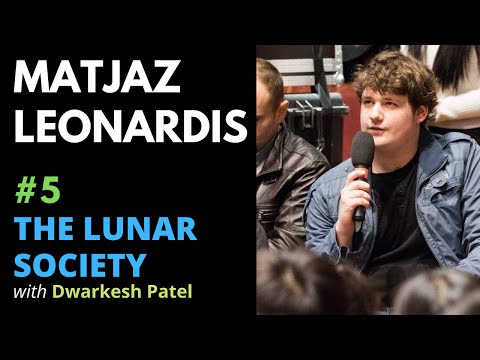
Matjaž Leonardis - Science, Identity and Probability
Dwarkesh Patel (host), Matjaž Leonardis (guest), Dwarkesh Patel (host)
In this episode of Dwarkesh Podcast, featuring Dwarkesh Patel and Matjaž Leonardis, Matjaž Leonardis - Science, Identity and Probability explores matjaž Leonardis Challenges Scientific Identity, Bayesian Induction, and Learning Myths Dwarkesh Patel interviews Matjaž Leonardis about the nature of science, arguing that overidentifying with the label 'scientist' and with a singular 'scientific method' can be counterproductive to genuine inquiry.
Matjaž Leonardis Challenges Scientific Identity, Bayesian Induction, and Learning Myths
Dwarkesh Patel interviews Matjaž Leonardis about the nature of science, arguing that overidentifying with the label 'scientist' and with a singular 'scientific method' can be counterproductive to genuine inquiry.
Leonardis discusses the Popper–Miller theorem and his paper with David Deutsch, which critiques the idea that Bayesian probabilistic updating provides genuine inductive support for theories.
They explore Popper’s focus on explanatory, content-rich theories versus merely probable ones, touching on the conjunction fallacy and the psychological need for regularity.
Finally, Leonardis offers unconventional advice on becoming a polymath, emphasizing unlearning rigid study structures, following curiosity, and connecting with real problem-solvers rather than obsessing over formal curricula.
Key Takeaways
Overidentifying as a 'scientist' can hinder genuine problem-solving.
Leonardis argues that constantly asking whether one is 'doing science' or following the 'scientific method' can create self-consciousness that interferes with simply pursuing problems wherever their logic leads.
Get the full analysis with uListen AI
Scientific activity need not be unified under a single method or identity.
Universities can support many distinct inquiries (helium, star formation, etc. ...
Get the full analysis with uListen AI
Bayesian updating does not straightforwardly provide inductive support for theories.
The Popper–Miller theorem, as explained by Leonardis, shows that increases in a theory’s probability given evidence need not represent evidence-driven inductive support; the supposedly 'inductive' part of a theory’s content can even lose probability.
Get the full analysis with uListen AI
People seek explanatory, content-rich theories more than merely probable ones.
Drawing on Popper and the conjunction fallacy (the Linda example), Leonardis notes that humans often prefer theories that explain more—even if they are formally less probable—suggesting that 'believability' diverges from mathematical probability.
Get the full analysis with uListen AI
Narratives about the Enlightenment and methods of progress are less clear-cut than often claimed.
Leonardis is agnostic about whether a specific methodological shift caused modern scientific progress, noting alternative explanations like economic change and the deep difficulty of assigning causal credit to 'the Enlightenment' or 'reason'.
Get the full analysis with uListen AI
Structured, linear learning paths (fundamentals → intermediate → advanced) are largely fictional and limiting.
For aspiring polymaths, Leonardis recommends abandoning the idea that subjects have to be mastered in rigid tiers; knowledge emerged historically from concrete problems, not textbook sequences, and can be absorbed more organically and opportunistically.
Get the full analysis with uListen AI
Finding good problems usually requires connecting with real communities, not abstract 'unsolved problem lists'.
He emphasizes that what counts as a valuable problem is context- and person-dependent, making it hard to enumerate online; young people should instead experiment with joining groups and mentors whose needs and projects they can gradually understand and contribute to.
Get the full analysis with uListen AI
Notable Quotes
“People were able to do science before [the word 'scientist'], quite well.”
— Matjaž Leonardis
“There is this idea that there is a specific method that one ought to use, rather than just where the logic of the problem itself leads you.”
— Matjaž Leonardis
“It is very unclear if one is ever using a method, because thoughts are constantly arising in the mind… it often feels like a stretch to say they arise as a result of a method.”
— Matjaž Leonardis
“What people actually want, what they believe in, what they seek, are not tautology-like contentless but likely theories, but incredibly informative, explanatory and therefore less likely theories.”
— Matjaž Leonardis
“Polymath is not something you learn to be, it’s something you unlearn to be.”
— Matjaž Leonardis
Questions Answered in This Episode
If the 'scientific method' is overstated or ill-defined, how should researchers practically decide which reasoning patterns or tools to use on a given problem?
Dwarkesh Patel interviews Matjaž Leonardis about the nature of science, arguing that overidentifying with the label 'scientist' and with a singular 'scientific method' can be counterproductive to genuine inquiry.
Get the full analysis with uListen AI
What concrete implications does the Popper–Miller theorem have for current Bayesian approaches in AI, forecasting, or scientific inference?
Leonardis discusses the Popper–Miller theorem and his paper with David Deutsch, which critiques the idea that Bayesian probabilistic updating provides genuine inductive support for theories.
Get the full analysis with uListen AI
How might institutions like universities be redesigned if we stopped treating 'science' as a unified identity and instead focused on supporting diverse, problem-driven inquiries?
They explore Popper’s focus on explanatory, content-rich theories versus merely probable ones, touching on the conjunction fallacy and the psychological need for regularity.
Get the full analysis with uListen AI
If humans privilege explanatory theories over merely probable ones, how should that reshape the way we teach statistics, probability, and rational decision-making?
Finally, Leonardis offers unconventional advice on becoming a polymath, emphasizing unlearning rigid study structures, following curiosity, and connecting with real problem-solvers rather than obsessing over formal curricula.
Get the full analysis with uListen AI
For a young person today, what are some practical, low-barrier ways to 'connect with people doing something' and escape the trap of purely textbook-based learning?
Get the full analysis with uListen AI
Transcript Preview
Hello, and welcome to The Lunar Society. Sorry it's been so long since the Tyler Cowen interview. I want to thank all of you for joining this podcast so early on. I especially want to thank those of you who have been sharing these episodes on Twitter and other platforms. Since this is a new podcast, almost all of the views and listens I get here are because of your retweets and endorsements, so please continue sharing this podcast if you enjoy it. I also want to thank those of you who have bought me books and equipment off my Amazon wishlist. Scott Hamilton bought me the very microphone I'm recording off of. John Beattie donated Nassim Tayeub's new book. Someone else donated Charles Murray's new book. And someone gifted me a $120 Raspberry Pi kit for embedded systems programming. If you're one of the people who anonymously donated, please DM or email me so I have a chance to thank you personally. And to Scott and John, I'm really grateful for your gift. I also want to let you know that I'll be writing daily at dwarkesh.substack.com, so please sign up there to receive my blog via email. The newest post I have out is titled, If Prediction Markets or Policies Were Legal, based on Robin Hanson's idea of a future archaic. In fact, I just interviewed him for a podcast, so expect that in the next week. Okay. Today, I have the pleasure of speaking with Matus Leonardus. Matus has co-written a paper with David Deutsch about the problem of Miller theorem, and we get into that, as well as the dangers of the scientific identity, the nature of scientific progress, advice to young people who want to be polymaths. Matus is one such, as you will see. He's a fascinating person that I've had the pleasure of getting to know, and he has a broad range of interesting ideas, which we get into. So, without further ado, here's Matus Leonardus. Okay, Matus, you have co-written a paper with David Deutsch-
Mm-hmm.
... about, uh, Bayes' theorem. But before we get into that, let's talk about the big picture questions. Science-
Mm-hmm.
Uh, what is it? And is it s- somewhat of a... Is it somewhat of a confusion to even talk about it, uh, distinctly from other disciplines?
Um, well, so my view on that subject is that, is that, um, often a, a, a lot of, a lot of talk about science ends up being quite counterproductive. I'm not saying that there is no such thing as science, but I definitely think that, um, um, that sort of, um, that people identify with science too much. Um, they, they, they wonder whether what they are doing is science. Um, they, they think they are scientists and wonder what is it that they should do in their capacity as scientists, um, and I think that often has a counterproductive effect on, on, on basically what they do. Now, one interesting thing to note is that, is that, you know, the, the name scientist is actually, um, uh, an early 19th century invention. Um, it was traced back to, I think, to, um, to, to professors at, I think, Trinity College in Cambridge. Um, and it's... Uh, and you know, people were able to do science before that, um, quite well. Um, and, uh, s- so, so w- one of the problems that I see, I guess, in that, in that respect is just that, uh, people, people perhaps think about, you know, uh, what, what is a scientist and, uh... Sorry. Who is a scientist and what is science a bit too much.
Install uListen to search the full transcript and get AI-powered insights
Get Full TranscriptGet more from every podcast
AI summaries, searchable transcripts, and fact-checking. Free forever.
Add to Chrome