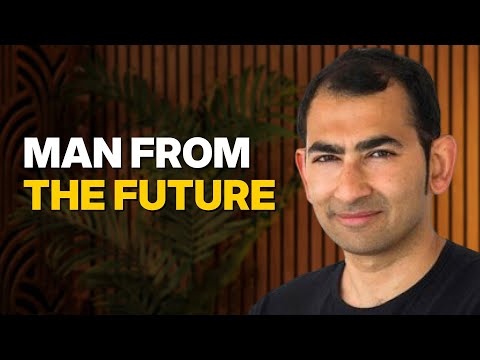
Ananyo Bhattacharya - John von Neumann, Jewish Genius, and Nuclear War
Ananyo Bhattacharya (guest), Dwarkesh Patel (host)
In this episode of Dwarkesh Podcast, featuring Ananyo Bhattacharya and Dwarkesh Patel, Ananyo Bhattacharya - John von Neumann, Jewish Genius, and Nuclear War explores john von Neumann: Jewish Prodigy Who Shaped Computing, War, and Strategy The conversation explores the life, context, and intellectual legacy of John von Neumann through Ananyo Bhattacharya’s biographical lens. It traces von Neumann’s Budapest upbringing, extraordinary early abilities, and role among the so‑called Hungarian “Martians,” then follows his contributions to mathematics, quantum mechanics, computing, game theory, and automata. Bhattacharya emphasizes how von Neumann’s willingness to engage with real‑world military and strategic problems amplified his impact, particularly on the atom bomb, the modern computer, and economic/game-theoretic thinking. The discussion also examines his controversial nuclear views, his political temperament shaped by European turmoil and antisemitism, and why his more speculative ideas—like universal constructors—may still be ahead of their time.
John von Neumann: Jewish Prodigy Who Shaped Computing, War, and Strategy
The conversation explores the life, context, and intellectual legacy of John von Neumann through Ananyo Bhattacharya’s biographical lens. It traces von Neumann’s Budapest upbringing, extraordinary early abilities, and role among the so‑called Hungarian “Martians,” then follows his contributions to mathematics, quantum mechanics, computing, game theory, and automata. Bhattacharya emphasizes how von Neumann’s willingness to engage with real‑world military and strategic problems amplified his impact, particularly on the atom bomb, the modern computer, and economic/game-theoretic thinking. The discussion also examines his controversial nuclear views, his political temperament shaped by European turmoil and antisemitism, and why his more speculative ideas—like universal constructors—may still be ahead of their time.
Key Takeaways
Extraordinary talent plus historical timing can drastically magnify impact.
Von Neumann emerged just as foundational crises in mathematics, the birth of quantum mechanics, and massive wartime science funding converged, allowing one mind to shape multiple core fields from pure math to programmable computers.
Get the full analysis with uListen AI
Engaging with real-world problems can make abstract ideas far more powerful.
Unlike many pure mathematicians, von Neumann actively sought practical challenges—ballistics, nuclear design, computing hardware, and strategy—which forced him to turn deep theory into tools that redefined technology and economics.
Get the full analysis with uListen AI
Cultural pressure and elite institutions helped channel raw genius in Budapest.
Intense antisemitism, the perceived need to excel to avoid ‘extinction,’ and access to superb private schools and mentors created an ecosystem in which unusual talents like von Neumann, Wigner, Szilard, and Teller could flourish.
Get the full analysis with uListen AI
Von Neumann’s game theory was more about coalitions than cartoonish zero-sum hawkishness.
His early work focused on cooperative solutions and stable alliances in multi-player games, contrasting with the later popular image of him as a purely zero‑sum thinker obsessed with preemptive nuclear strikes.
Get the full analysis with uListen AI
Automata theory and universal constructors remain underexploited, but influence is growing.
Ideas like self-reproducing machines were long treated as curiosities, yet they’ve inspired nanotechnology, self-replicating 3D printers, xenobots, and space exploration concepts, suggesting their true significance is only starting to surface.
Get the full analysis with uListen AI
Political views can be rooted in lived experience of chaos and authoritarianism.
Von Neumann’s anti-authoritarian, Cold War–hawkish stance was shaped by witnessing a brutal communist regime, an even more violent right-wing backlash in Hungary, and then Nazi Germany, leading him to see U. ...
Get the full analysis with uListen AI
Trying to copy von Neumann’s lifestyle is neither realistic nor desirable.
His near-constant work, strained relationships, and tormented final years show that extreme productivity at his level came with serious personal costs, limiting the usefulness of treating his life as a self-help template.
Get the full analysis with uListen AI
Notable Quotes
“The only phenomenon that needs explaining is Johnny von Neumann.”
— Eugene Wigner (as quoted by Ananyo Bhattacharya)
“If you say, ‘Bomb them tomorrow,’ I say, ‘Why not today?’ If you say, ‘4:00,’ why not 2:00?”
— John von Neumann (as recounted by Ananyo Bhattacharya)
“If mathematicians retreat too far into their ivory towers… the maths became baroque and not interesting.”
— Ananyo Bhattacharya paraphrasing John von Neumann’s essay ‘The Mathematician’
“He just says, ‘Yeah, well, let’s look at this mathematically, shall we?’ And then he solves it.”
— Ananyo Bhattacharya, on von Neumann answering whether machines can reproduce
“Read about this incredible human being, but don’t try to draw too many life lessons from it.”
— Ananyo Bhattacharya
Questions Answered in This Episode
How might von Neumann’s approach to blending theory and practice inform how we organize today’s hyper-specialized research institutions?
The conversation explores the life, context, and intellectual legacy of John von Neumann through Ananyo Bhattacharya’s biographical lens. ...
Get the full analysis with uListen AI
If universal constructors become technologically feasible, what governance structures should exist to control or constrain their replication?
Get the full analysis with uListen AI
In a multipolar nuclear world with cyber and economic conflict, how should game theory be adapted beyond von Neumann’s original formulations?
Get the full analysis with uListen AI
Does the intense cultural and existential pressure that helped produce the ‘Martians’ have any ethical analogue we would accept creating today?
Get the full analysis with uListen AI
Given how badly von Neumann’s nuclear views and personality were caricatured, what other scientists’ legacies might we be misreading through simplified narratives?
Get the full analysis with uListen AI
Transcript Preview
(instrumental music plays) I try to lay out the context of this. I mean, this was after the most destructive war that the world had ever known. Millions of people had died. And von Neumann had predicted this, um, the Holocaust very s- you know, successfully years in advance. And he now was convinced that within a decade, there would be a third world war with nuclear weapons.
Okay. Today, I have the pleasure of speaking with Ananyo Bhattacharyah, who is a science writer, who has worked at the Economist and at, uh, Nature, and most recently, he's the author of The Man From the Future: The Visionary Life of John von Neumann, and it was a extremely enjoyable read, super interesting. And so, before we jump into the questions, Aananyo, I'm wondering if you can kind of give context to my audience and summarize the life of this giant.
(laughs) Uh, well, that's not an easy task, but I'll give it a go. So he was, um, born in Budapest, uh, in around 1903 to this wealthy Jewish family, and pretty early on, um, they realized that, um, there's something quite special about him. So he can do these long six-figure calculations in his head by six, and he's learnt calculus by eight, right? And he's teaching himself the finer points of set theory, um, by kind of 11, right? So he's going on long walks with, uh, Eugene Wigner, who was a childhood friend of his and a future Nobel Prize winner, and, uh, Wigner's a year older than him, and he's, he's teaching Wigner set theory at that age. So it's, it's kind of clear that even among geniuses, as he would be later on at, uh, Los Alamos, for example, or, um, at the, uh, Princeton and at the Institute for Advanced Study, uh, where he'd be recruited along with Einstein, that he was kind of, um, a cut above even all of these, uh, incredibly clever people. And, uh... And so yeah, so he grows up in this, uh, quite privileged Budapest surroundings. Um, their home was, um, often visited by, um, the, the greats of the time, um, it was an incredibly cultured city, and, um, his, um, father, Max, was a kind of successful banker, so they were quite wealthy. I mean, he was a self-made man. Um, but, um, he had, as a result, von Neumann, who was one of, uh, three brothers, actually, he was the eldest, he had the benefits of, um, kind of a top flight education as well.
Yeah. So, you know, um, w- right before we did the interview, I was c- thinking about what... Uh, you know, I have a computer science degree, and I was thinking about, okay, what portion of my computer science degree can be traced back directly to von Neumann? I was go- just going through just like an initial glance at a few of the classes that I took where, like, a large part of the fraction of the content, uh, came from von Neumann, right? So you could like... Okay. Algorithms, linear programming, um, you know, merge sort, li- like, probably like a quarter of my curriculum. Um, quantum computing, uh, you know, density, and density matrix, uh, von Neumann entropy. Hardware, von Neumann, uh, the, uh, you know, the von Neumann architecture for my, uh, the computers. Um, you know, e- even like in my organizational ethics class, you know, that, that, that game theory, um, th- that comes up. Uh, you know, theory of computing, uh, you know, finite state machines, um, cellular automata. So, like, I, uh, it's astounding to me that this person is responsible for probably like a third of everything I learned in college. Um, and so it was, uh, it was, um, very interesting to then get to read the history of this person and the ideas that he came up with and interacted with. Um, a- and now, uh, o- one very interesting part about the context, um, uh, context surrounding von Neumann's work is, you know, he was part of this group, as you talk about, called the Martians. They were, uh, Hungarian and Central European Jews who migrated to the United States in the early 20th century, and w- um, as Scott Alexander has a fun blog post title about this, he says, uh, the, um, the, the (hand clap) nuclear, uh, the, the nuclear bomb was a high school science project for a bunch of, uh, Hungarians, uh, because the, uh, eh, a- a lot of the scientists who worked on the, uh, n- nuclear bomb were par- uh, like, went to the same high school. So what was the cultural or other factors that made this group of people so... I mean, uh, produce so many geniuses?
Install uListen to search the full transcript and get AI-powered insights
Get Full TranscriptGet more from every podcast
AI summaries, searchable transcripts, and fact-checking. Free forever.
Add to Chrome