Artificial meat is harder than artificial intelligence — Lewis Bollard
Dwarkesh Patel (host), Lewis Bollard (guest)
In this episode of Dwarkesh Podcast, featuring Dwarkesh Patel and Lewis Bollard, Artificial meat is harder than artificial intelligence — Lewis Bollard explores why Ending Factory Farming Is Harder Than Building Artificial Intelligence Lewis Bollard, who runs Open Philanthropy’s farm animal welfare program, explains why factory farming is extremely resilient to technological change and why artificial meat alone is unlikely to end animal suffering.
Why Ending Factory Farming Is Harder Than Building Artificial Intelligence
Lewis Bollard, who runs Open Philanthropy’s farm animal welfare program, explains why factory farming is extremely resilient to technological change and why artificial meat alone is unlikely to end animal suffering.
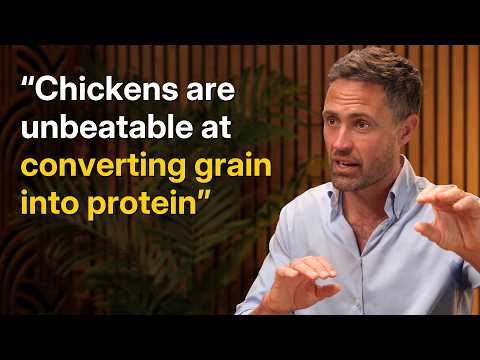
He argues that while AGI and cultivated meat may help, cultural preferences, political barriers, and the sheer economic efficiency of chickens as “bioreactors” mean we must also pursue incremental welfare reforms within current systems.
Bollard details highly leveraged interventions—corporate campaigns, government regulation, and humane technologies like in-ovo sexing—that have already improved conditions for billions of animals at extraordinarily low philanthropic cost.
The conversation closes with a concrete donation match, a call for major donors and politically engaged listeners to enter the space, and a strategic look at global expansion, policy fights, and the political economy of the meat industry.
Key Takeaways
Do not rely on AGI or cultivated meat to automatically end factory farming.
Even with advanced technology, cultural demand for ‘real meat’ and political bans on cultivated meat mean factory farming could remain the cheapest and most entrenched protein system for decades.
Get the full analysis with uListen AI
Target the existing system with humane technologies that improve welfare without raising costs much.
Tools like in-ovo sexing (preventing male chick culling), immunocastration for pigs, and higher-welfare chicken breeds can sharply reduce suffering while remaining commercially viable, but receive under $10M/year in VC funding.
Get the full analysis with uListen AI
Shift focus from individual diet purity to systemic corporate and policy change.
Bollard argues the movement erred by centering veganism; large-scale impact comes from government standards and corporate pledges that shift billions of animals out of the worst conditions, regardless of any one person’s diet.
Get the full analysis with uListen AI
Corporate campaigns are currently one of the highest-leverage mechanisms.
Advocates have secured over 3,000 corporate pledges; cage-free and broiler welfare campaigns already improve conditions for hundreds of millions of hens and over a billion chickens annually, often by exploiting gaps between what consumers think is happening and reality.
Get the full analysis with uListen AI
Farm animal welfare philanthropy is astonishingly underfunded yet massively effective.
Only ~$200M/year of ‘smart money’ globally targets farm animal welfare; Bollard estimates that in some cases $1 can avert more than 10 years of animal suffering, a ratio rarely seen in other cause areas that already attract billions.
Get the full analysis with uListen AI
Policy design must neutralize the ‘race to the bottom’ via import and sale standards.
State or national welfare rules fail if cheaper, cruelly-produced meat can be imported; measures like California and Massachusetts’ sales standards—and EU consideration of similar rules—are crucial to lock in progress and align farmer incentives.
Get the full analysis with uListen AI
Political influence requires organizing sympathetic farmers, donors, and voters as a real counter-lobby.
The meat lobby, though small in population share, wields outsized power through money, organization, and the ‘family farmer’ image; Bollard emphasizes that coordinated donations, constituent pressure, and mobilizing family farmers can materially shift legislative outcomes.
Get the full analysis with uListen AI
Notable Quotes
““The end of factory farming is far from inevitable.””
— Lewis Bollard
““You’re trying to beat the price of grain times two plus a few extra costs. And that is actually a really hard target to meet.””
— Lewis Bollard
““We made a mistake as a movement making this about personal diet.””
— Lewis Bollard
““We are manufacturing creatures basically optimized for suffering.””
— Dwarkesh Patel
““We’re talking about a ratio that is far less than one to ten of a dollar per year of animal wellbeing improved.””
— Lewis Bollard
Questions Answered in This Episode
If AGI and advanced biotech arrive but factory farming remains cheapest, what concrete strategies could ensure those technologies are actually deployed to reduce, rather than entrench, animal suffering?
Lewis Bollard, who runs Open Philanthropy’s farm animal welfare program, explains why factory farming is extremely resilient to technological change and why artificial meat alone is unlikely to end animal suffering.
Get the full analysis with uListen AI
How should donors weigh farm animal welfare against other cause areas, given the extremely high estimated impact per dollar and the current funding gap?
He argues that while AGI and cultivated meat may help, cultural preferences, political barriers, and the sheer economic efficiency of chickens as “bioreactors” mean we must also pursue incremental welfare reforms within current systems.
Get the full analysis with uListen AI
What specific legislative or corporate wins over the next 5–10 years would most convincingly demonstrate that factory farming’s trajectory can be reversed globally?
Bollard details highly leveraged interventions—corporate campaigns, government regulation, and humane technologies like in-ovo sexing—that have already improved conditions for billions of animals at extraordinarily low philanthropic cost.
Get the full analysis with uListen AI
Given the risk of welfare improvements being ‘eaten up’ by new efficiency gains, how can reforms be designed and enforced so that they permanently raise welfare floors rather than being eroded over time?
The conversation closes with a concrete donation match, a call for major donors and politically engaged listeners to enter the space, and a strategic look at global expansion, policy fights, and the political economy of the meat industry.
Get the full analysis with uListen AI
What would a serious, well-funded pro-animal political strategy in the US look like if it matched or exceeded the meat lobby’s roughly $45M per election cycle?
Get the full analysis with uListen AI
Transcript Preview
Today, I'm chatting with Lewis Bollard, who is farm animal welfare program director at Open Philanthropy. And Open Philanthropy is the biggest charity in this animal welfare space. So Lewis, thanks so much for coming on the podcast.
Thanks for having me on.
Okay, first question: At some point, we'll have AGI. How do you just think about the problem you're trying to solve? Are you trying to make conditions more tolerable for the next 10 years until AI solves this problem for us? Or is there some reason to think that the interventions we're making, in terms of improvements like anovosexing or cage-free eggs, et cetera, will have an impact beyond this transformative moment?
I think that the end of factory farming is far from inevitable. Every year, w- we're factory farming about 2% more animals-
Mm-hmm.
... globally. I think there are two possible trajectories we could go down. One is the trajectory that we have been on for the last century, which is technology has made factory farming ever more efficient, resulted in evermore animals being abused in evermore intensive ways.
Yeah.
There is a trajectory where we reduce the number of animals on factory farms, where we reduce the suffering of each of those animals. So even if we get AGI, I- I am really optimistic that that will accelerate forms of technological progress. It will bring us better alternative proteins. It will improve the humane technology. But there are still huge cultural and political obstacles to alternatives. So the cultural obstacles are that most people want real meat. I mean, most people have the option already of plant-based meat that tastes about as good as real meat. And-
Does it? I don't know.
Well, so this is the debate. That's fair. This is a debate, but I don't think that's just the obstacle that people have. I think there are a lot of people who say, "I'm just not interested in, you know, the alternative. I want the real thing." And then there's also the political obstacles. So let's say that AGI solves cultivated meat for us. Well, cultivated meat's already illegal in seven US states.
Mm.
It- it's might soon be illegal in the entire European Union. So by the time we get AGI, will they even be able to sell it anywhere? So again, I think there's a huge amount of good that technology can do in this space, and I'm optimistic that AGI can accelerate that hugely. But at the same time, I think we should prepare for the significant possibility that AGI does not end factory farming, that actually this is an incredibly efficient system that has persisted through all kinds of technological changes-
Mm.
... and that could persist through this technological change.
And sort of what is it that makes it so efficient?
So the, the basic efficiency is th- the animal, and the chicken in particular-
Install uListen to search the full transcript and get AI-powered insights
Get Full TranscriptGet more from every podcast
AI summaries, searchable transcripts, and fact-checking. Free forever.
Add to Chrome