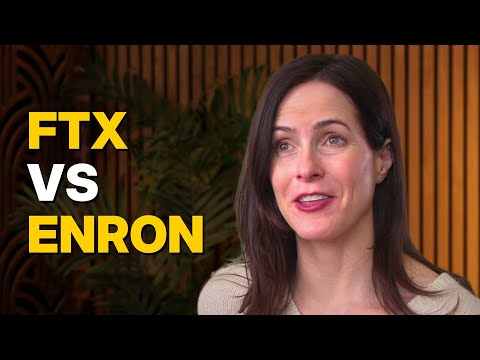
Bethany McLean — Enron, FTX, 2008, Musk, frauds, & visionaries
Bethany McLean (guest), Dwarkesh Patel (host), Narrator
In this episode of Dwarkesh Podcast, featuring Bethany McLean and Dwarkesh Patel, Bethany McLean — Enron, FTX, 2008, Musk, frauds, & visionaries explores bethany McLean dissects fraud, visionaries, markets, and capitalism’s blind spots Bethany McLean and Dwarkesh Patel explore the blurry boundary between visionary founders and fraudsters, using Enron, FTX, Theranos, and Elon Musk as case studies in self‑delusion, incentives, and capital markets. They discuss how legal-but-destructive behavior, opaque private markets, and cultural forces inside firms can produce crises without classic, prosecutable fraud. McLean argues that regulation and jail sentences have limited deterrent effect because markets evolve faster than rules and key actors rarely see themselves as criminals. The conversation broadens into critiques of financialization, rating agencies, executive pay, and the pandemic-era stress test of American capitalism, previewing McLean’s forthcoming book on how markets and government rules interact.
Bethany McLean dissects fraud, visionaries, markets, and capitalism’s blind spots
Bethany McLean and Dwarkesh Patel explore the blurry boundary between visionary founders and fraudsters, using Enron, FTX, Theranos, and Elon Musk as case studies in self‑delusion, incentives, and capital markets. They discuss how legal-but-destructive behavior, opaque private markets, and cultural forces inside firms can produce crises without classic, prosecutable fraud. McLean argues that regulation and jail sentences have limited deterrent effect because markets evolve faster than rules and key actors rarely see themselves as criminals. The conversation broadens into critiques of financialization, rating agencies, executive pay, and the pandemic-era stress test of American capitalism, previewing McLean’s forthcoming book on how markets and government rules interact.
Key Takeaways
Visionary storytelling and fraud often share the same underlying traits.
Charismatic leaders who sell a grand vision (Skilling, Holmes, SBF, Musk) use the same tools—narrative, optimism, and selective disclosure—whether they end up as celebrated visionaries or exposed fraudsters; often the difference is simply continued access to capital long enough for the story to come true.
Get the full analysis with uListen AI
Most major blowups are driven more by self-delusion than by conscious evil.
McLean emphasizes that key actors rarely think, “I’m committing fraud”; they rationalize their behavior as temporary fudge in service of a greater good, which makes traditional deterrents like long prison sentences less effective than people assume.
Get the full analysis with uListen AI
“Legal fraud” can be just as damaging as outright illegality.
Enron and the 2008 crisis relied heavily on exploiting accounting rules and legal structures in ways that misrepresented economic reality but technically complied with regulations, revealing that behavior can be destructive without being clearly illegal.
Get the full analysis with uListen AI
Short sellers and skeptics are systemically undervalued yet crucial.
Cultural hostility to short selling, combined with long bull markets and the psychological difficulty of being contrarian while losing money, means there are too few people incentivized to challenge euphoric narratives before they implode.
Get the full analysis with uListen AI
Private markets and venture capital are fertile ground for large hidden bubbles.
Because there is no shorting, limited disclosure, and investors like “smoothed” marks, opaque private valuations can remain inflated for long periods, masking risks that ultimately fall on pension funds and ordinary savers, not just sophisticated institutions.
Get the full analysis with uListen AI
Executive incentives and compensation design often backfire.
Mechanisms like stock options were meant to align managers with shareholders but instead frequently encourage earnings manipulation, short-term stock pumping, and highly leveraged deal-making; even long vesting schedules have perverse side effects.
Get the full analysis with uListen AI
Finance has grown too large relative to its underlying social purpose.
At roughly 9% of GDP and commanding a disproportionate share of top talent and rewards, finance often becomes “the thing itself” rather than the enabling infrastructure for productive businesses, distorting capital allocation and societal priorities.
Get the full analysis with uListen AI
Notable Quotes
“You think visionaries and fraudsters are on opposite ends of a line, but in reality they’re where the ends of the circle meet.”
— Bethany McLean
“A lot of what happened at Enron wasn’t actually outright fraud... I’ve coined this phrase ‘legal fraud’ to describe it.”
— Bethany McLean
“Culture is so strong. The idea that you can remain an island in a bad situation is not true of most of us.”
— Bethany McLean
“Finance is supposed to be the substrata of our world. It’s supposed to enable other things to happen. It’s not supposed to be the world itself.”
— Bethany McLean
“To write clearly requires thinking clearly, and thinking clearly is really, really hard.”
— Bethany McLean
Questions Answered in This Episode
How can regulators and boards practically distinguish between aggressive vision and dangerous self-delusion before a company blows up?
Bethany McLean and Dwarkesh Patel explore the blurry boundary between visionary founders and fraudsters, using Enron, FTX, Theranos, and Elon Musk as case studies in self‑delusion, incentives, and capital markets. ...
Get the full analysis with uListen AI
What specific changes to accounting, disclosure, or governance could reduce the prevalence of “legal fraud” without stifling legitimate risk-taking?
Get the full analysis with uListen AI
Given the structural incentives in private equity and venture capital, is there any realistic way to bring market-style discipline (like shorting) into private markets?
Get the full analysis with uListen AI
If finance is “too big,” what policies or market reforms could gradually shift top talent and capital back toward building real-economy businesses?
Get the full analysis with uListen AI
How should ordinary investors and employees assess the cultural and incentive structures of companies they work for or invest in, to avoid being trapped in the next Enron or FTX?
Get the full analysis with uListen AI
Transcript Preview
... this line between a visionary and a fraudster. You know, you think that they are two opposite ends of the spectrum, but in reality, they're where the ends of the circle meet. But if somebody has the ability to put a vision forward, like Jeff Skilling did at Enron, like Elizabeth Holmes did at Theranos, like SBF did, then you're particularly susceptible. Self-delusion is such a strong component of all of these stories of business gone wrong. The line between what happened at Enron and, and, and what happened in the global financial crisis, it's not a matter of black and white. Well, do you believe in the efficient market hypothesis?
The rapid implosion of a company worth tens of billions of dollars, insider dealing and romantic entanglements between sister companies, a politically generous CEO who is well-connected in Washington, the use of a company's own stock as its collateral, the attempt, the short-lived attempt to get bought out by a previous competitor, and the fraudulent abuse of mark-to-market accounting. We are not talking about FTX, we are talking about Enron, which my guest today, Bethany McLean, uh, first broke the story of, and has written an amazing and detailed book about, uh, called The Smartest Guys in the Room. And she has also written, uh, a book about the housing crisis, All the Devils Are Here, a book about Fannie and Freddie, Shaky Ground, and a book about fracking, Saudi America, all of which we'll get into. She is, in my opinion, the best finance non-fiction writer out there, and I'm really, really excited to have this conversation now. So, Bethany, thank you so much for coming on the podcast.
Thank you so much for the probably undeserved compliment.
(laughs)
(laughs) Thank you for having me on the show.
But my first question, what are the odds that SBF read The Smartest Guys in the Room and just followed it as a playbook, given the similarities there?
Y- you know, I, I love that idea. I have to, I have to admit-
(laughs)
... I guess I love that idea. I don't know, that would make me responsible for what, for what happens.
(laughs)
So, maybe I don't love that idea. L- let me take that back. (laughs)
(laughs)
Anyway, but I, I, I actually think that, that, that even if he had read the book, it would never have occurred to him that, that there was a similarity, because self-delusion is such a strong component of all of these stories of business gone wrong. It's very rare that you have one of the characters at the heart of this who actually understands what they're doing and understands that they're moving over into the dark side, and thinks about the potential repercussions of this and chooses this path anyway. That's usually not the way these stories go. So, it's entirely possible that SBF has studied Enron, knew all about it, and never envisioned that there were any similarities between that and what he was doing.
Install uListen to search the full transcript and get AI-powered insights
Get Full TranscriptGet more from every podcast
AI summaries, searchable transcripts, and fact-checking. Free forever.
Add to Chrome